Summer reading list (so far)

I’d been off the novels kick for a while, until my good friend and fellow poet Richard O’Brien mentioned that he was reading John Hawkes. I hadn’t read Hawkes in years, I told him, but books like The Cannibal, Beetle Leg and Second Skin were among my favorites from my days as an undergraduate.

The discussion that ensued on Facebook led me to put aside all of the other things I was reading (research for a book, essays by Orwell and Walter Benjamin) and reread Hawkes’ great The Lime Twig, which is perhaps his best. That began a month-plus devoted to nothing but fiction that continues this week with The Girl Who Played with Fire.

Here is the list, so far) of the summer of fiction:

  • John Hawkes, The Lime Twig
  • Don Delillo, Angel Esmerelda
  • Russell Banks, The Reserve
  • Ernest Hemingway, For Whom the Bell Tolls

On the list for the rest of the summer: More John Hawkes, Jim Thompson’s The Getaway and we’ll see what else piques my interest.

Send me an e-mail.

CCR: An appreciation

Creedence Clearwater Revival is one of those bands that everyone acknowledges as great, but that few people think to rank among the best of their era. But John Fogerty’s achievement with the band — and CCR only exists with Fogerty as front man — is one of the most singular of any American musician. As I said in a tweet last week, Creedence Clearwater Revival might be the most American of bands.

On six albums across about five-plus years, Fogerty and his band provided us with a tour of American music — moving from country and folk to swamp blues, all of it built atop a strong rhythm section, Fogerty’s screaming guitar and one of the most recognizable vocal styles in rock ‘n’ roll.

Two things stand out, though, which may explain CCR’s oddly ambivalent place in the rock pantheon. First, Fogerty (usually) eschewed the typical late-’60s excess in his songwriting. Aside from a handful of guitar-driven classics (“Heard It Through The Grapevine,” “Suzy Q”), Fogerty mastered the three-minute pop song and applied this tightly structured approach across what we now call the Americana genre. He could have a light touch — “Lookin’ Out My Back Door” — or full of pathos –“(Wish I Could) Hideaway.” He could go country (“Lodi”), rage politically (“Fortunate Son”) and play some R&B (“Born to Move”).

Something else struck me as I relistened (and relistened and relistened) to the CCR catalogue: the cover songs. Fogerty and band were recording at a time when playing others’ music was still an acceptable practice in rock — as it has remained in the other genres — and each album features CCR remaking early rock and blues in their own image. What is key, though, is that the cover impulse is reciprocal — Ike and Tina’s driving version of “Proud Mary” is the obvious example, but it is much more extensive than that. CCR may tear through “The Night Time is the Right Time,” but punk stalwarts like Richard Hell and the Voidoids doing a masterful version of “Walking on Water,” one of Fogerty’s lesser-known classics. Or The Gun Club doing a punked-up “Run Through the Jungle.”

No one denies the greatness of CCR (and if they do, they probably know very little about rock ‘n’ roll), but CCR does tend to get lost in the shuffle. For my money, they are every bit as good a band as the era produced. If you need a reminder, get your car, rolled down the windows and blast Green River from the speakers.

Send me an e-mail.

Rolling Stone, journalism and boycotting the boycott

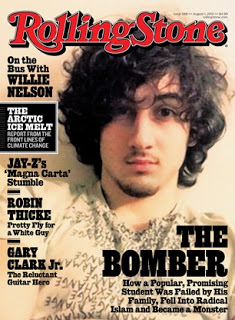
The upcoming issue of Rolling Stone magazine has created quite a stir — and it hasn’t even hit newsstands yet.

That’s because it features a cover story — and cover — of suspected Boston Marathon bomber Dzhohkar Tsarnaev. Officials in the Boston area and many, many others in the social media universe reacted harshly. I posted a link yesterday to Twitter and Facebook saying I agreed with Jon Wolfson, the editor of Boston Magazine. Wolfson told Jim Romenesko, who runs the influential Romenesko journalism blog, that

“There are people here in the city, and even on my staff, who are really angry about the cover, but I’m having a hard time getting as upset as everyone else. I completely understand how the cover could be interpreted as glamorizing Tsarnaev and, in a way that further wounds the victims, painting him in a sympathetic light. But I think that interpretation misses the point of what Rolling Stone was trying to do, which was to spotlight just how unlikely it would have seemed on April 14 that his kid could have done something like this.

“Could the execution have been better? I think so. The cover language describes Tsarnaev himself as a victim, and from my perspective at least, that was insensitive to the people who were killed and wounded in the bombings. But overall, it’s my opinion that the outrage has been to some degree out of proportion to the magazine’s offenses.”

This seems eminently reasonable. It is important to note, for instance, that — as The Huffington Post reports — Tsarnaev’s picture (a self-portrait)

has in fact been used by other publications since the April 15 Boston Marathon bombing, which Tsarnaev stands accused of carrying out with his brother, Tamerlan. The photo even appeared on the front page of The New York Times in May. However, its presence on the cover of Rolling Stone, a space typically occupied by rock stars and actors, sparked outrage on Twitter and Facebook, where many observers objected to what they saw as the glamorization of Tsarnaev.

Both assertions are correct. The photo has been used in the past and a story like this, which purports to explain how a seemingly integrated kid ended up turning extremist and conducting an act of terror on American soil, certainly deserves cover treatment. But the cover, as designed by Rolling Stone, does treat Tsarnaev like the pop-culture stars that usually take up this coveted real estate.

In judging the cover, I attempt to follow a set of journalist principles, some of which are in conflict and require a delicate balancing: Is the story and cover newsworthy? Does it warrant lead placement — i.e., is it the most interesting or important piece in the magazine? What are the expectations of the readership (this is different than the expectations of the larger community)? There are other questions that I would ask and there are questions that might come from someone higher on the food chain — like the publisher — but I think you can understand the general outlines of the decision-making process.

I’ve already answered the first two questions — yes, it is newsworthy and, yes, it does warrant lead treatment, though executed a bit differently. The expectation question is harder to answer, but I suspect that the magazine’s audience will have far less of an issue with this cover than those who are criticizing it, meaning that the community that Rolling Stone serves is likely to be OK with what has been presented here.

This brings me to one of the more interesting parts of this story — the call for boycotts. First, I am generally critical of boycotts that target media organizations and their sponsors, whether they be Rolling Stone or Rush Limbaugh. They amount to an economic attack on editorial independence and are really just the converse of a publisher coming to an editor and saying “write this story to please our advertiser.” Rolling Stone attempts to make this argument, but does so badly — no, Rolling Stone, this is not a constitutional issue because government is not involved in censoring the press and because newsstands, stores and advertisers have a right to determine what they will sell and where to place their advertising.

I also find it unlikely that the boycott will have their desired effect, partly because the goal seems kind of murky — is it to get Rolling Stone to change its cover? to punish the magazine for offending the community? or is the goal something else? — and partly because the people who are engaged in this conversation are not the people reading the magazine in the first place. Rolling Stone’s demographic skews young and somewhat liberal. It is not a group likely to take umbrage at the cover, as I said, and in the end the advertisers are going to acknowledge that and stick with the magazine.

The uproar over the cover is overblown and likely to blow over quickly, though it does have the potential to spark a conversation about what good journalism is, what responsibilities journalists have to the community and — something rarely ever mentioned — what the community at large owes to the journalists.

In the end, I’ll be boycotting the boycott.

Send me an e-mail.

In immigration debate, words do matter

Language matters. That’s why the Associated Press’ decision to drop the use of “illegal immigrant” as a way of describing those immigrants who lack legal standing was such an important moment in the immigration debate. The AP’s decision accepted one of the basic arguments being made by activists — that a person cannot be illegal, only an action can.

A piece on Salon today wants to take this rhetorical shift a step further. Anat Shenker-Osario asks that we stop using the term “undocumented worker.” Reformers, Shenker-Osario says, “the delicate euphemism ‘undocumented worker'”

is becoming the journalistic term of favor for the people who used to be called “illegal aliens.” The U-word is certainly many steps above that noxious label, but public opinion research shows that it still fares poorly among likely voters. They smell the forced artificiality, and they are not wrong in finding the term ineffective.

The argument goes like this: “it describes immigrants by what they lack, not what they bring” and it keeps the immigration debate “squarely in the rule of law framework.”

The language here is a problem, but the polling Shenker-Osario offers is of no use. Yes, terms like “aspiring American” and “new Americans” may be more positive, but they carry the same level of bias from a journalistic standpoint as does “illegal immigrant.” They may be useful terms for activists, giving them access to a more positive rhetorical language, but they do little to address how journalists can better and more accurately describe the people at the center of the immigration debate. They are as flabby and potentially inaccurate as any of the less positive terms being offered.

For instance, “Aspiring citizens” assumes that all of those who lack legal residency papers want to become citizens. Most likely do, but given that there are 10.5 million immigrants here without official status we can also assume that at least some don’t. “New Americans” is flawed in the same way — many of those without status have been here for decades, which stretches the word “new” beyond its logical meaning. The terms also don’t differentiate between those with legal status — work visas, for instance — and those here without, a distinction that has been central to the debate. From a journalistic standpoint, then, Shenker-Osario’s alternatives offer very little help.

“Illegal immigrant” is inaccurate because it conflates the person with the legal action and “aspiring citizen,” like “undocumented workers” is inaccurate because it is too vague.  

What I tell my students — and have told reporters who have worked for me in the past — is that they should be as descriptive as they can be. There are moments when short-hand is necessary, but as a general rule you should provide as much information as possible.

Take some of the people who testified at the hearing last month on the New Jersey tuition equality bill. The bill would treat students who are lack legal residency papers but who graduated from New Jersey high schools as in-state students for the purpose of tuition. One former student who testified came to the United States from Mexico when she was 1 with her parents on a tourist visa to visit family. They overstayed the visa and stayed. She is now about 25, graduated from a New Jersey high school and Rutgers.

How should we describe her? She works as a bartender, but does not have legal residency papers. In that way, she is undocumented. But she has other documents, so calling her undocumented would seem to fall short. Is she an “aspiring citizen”? I believe so. Is she a “new American”? Only if you can still be new 23 years or so after your arrival.

So, how do we describe her? We need some kind of short-hand — I have been using “immigrants who lack legal documentation” or “immigrants who are currently undocumented” — to help set up the larger issues in a story (in the lede and nut graphs).

But when we get to the specific person in question, we should be as detailed as we can be, providing as much information as we can about the individual immigrant so that he or she is not just a statistic or a stereotype, but a real person.
It is not about polling data, but about accuracy.

Send me an e-mail.