A tale of two economies

David Cay Johnston has a piece today at The National Memo that should put an end to the notion that unleashing the corporate monster will make our economy whole. Rather, giving corporations a free reign does little more than allow those at the top of the economic heap to reap even more benefits, while the rest of us struggle with unemployment, underemployment and a shredded safety net.

As Johnston reports,

Individual income tax payments have been rising fast since the economy began to recover, even though wages have hardly budged.

For corporations of all sizes, the story is quite difference, however.

For the vast majority of America’s 5.8 million corporations, profits soared in 2010 — up 53 percent compared to 2009 — when the recession official ended at mid-year. Despite skyrocketing profits, however, their corporate income tax bills actually shrank by $1.9 billion, or 2.6 percent.

The effective tax rate paid by 99.95 percent of companies fell to 15.9 percent in the robustly profitable year of 2010, from 24.9 percent in the half-recession year 2009.

Those figures do not count the 2,772 companies that dominate the American economy. These giant firms, with an average of $23 billion in assets, own 81 percent of all business assets in America.

Their combined profits soared 45.2 percent to a new record in 2010, but their taxes rose just 14.8 percent, new IRS data show. Profits growing three times faster than taxes means their effective tax rates fell.

In 2010 these corporate giants paid just 16.7 percent of their profits in taxes, down from 21.1 percent in 2009. The official tax rate is 35 percent.

Corporations, as we can see, are doing quite well. So, how about the rest of us? The national unemployment rate remains at 7.6 percent, which is lower than at nearly any point during the Obama administration but still about 2 percentage points above pre-recession levels. The under-employment rate — or the percentage of people who are out of work, stopped looking or working part-time when they would prefer full-time employment — according to Money Morning, “climbed to 14.3% from 13.8%. The number of ‘involuntary part-timers’ jumped by 322,000 to 8.2 million.”

This is, quite simply, the tale of two economies. Corporations are doing quite well, but the rest of us continue to struggle. The argument we consistently hear from the anti-tax crowd is that we need to take the shackles off businesses — in the form of taxes and regulations — so that businesses can generate profit, which then will trickle down to the rest of us in the form of jobs and higher wages. Yet, we are living in a time of record corporate profits AND higher-than-acceptable unemployment.

Doesn’t anyone else see the contradiction?

Send me an e-mail.

Racial bias and the canard of self-defense

Like many, I was saddened by the failure of a Florida jury to do justice following the murder of Trayvon Martin. But I was only nominally surprised. Florida law and the Sanford police made it nearly impossible for justice to actually be done. They jury, unfortunately, may have been following the law in this case — which is why we need to put the law on trial.

The only thing we know for sure is that Trayvon Martin was shot to death by George Zimmerman after Zimmerman saw the hoodie-clad kid in Zimmerman’s Florida neighborhood. Zimmerman called police and then proceeded to follow the teen, which led to a fight and the fatal shot. There were no witnesses and, thanks to the seeming indifference of police, no physical evidence.

The entire case depended upon the characterization of Zimmerman as a seething racist and overzealous police-wannabe. This proved too tall an order and Zimmerman was acquitted.

We can view this trial singularly — as just an effort to determine the guilt or innocence of Zimmerman, which it of course was — but that ignores the larger racial subtext and the larger legal structure that probably created the circumstances that led to Martin’s death.

I have no idea whether Zimmerman is an overt racist — the prosecution failed to make that case — but he did appear to exhibit the kind of tacit and endemic racism that plagues the larger society. He sees a 17-year-old African American wearing a hoodie and he reacts — the same way that too many react when we see a black kid on the street and assume the worst. That is what triggered the events of Feb. 26, 2012.

And this endemic racism was compounded by Florida’s “stand your ground” law, which allows people in Florida to claim self defense and to use deadly force if they claim that they felt afraid — not that they were actually under attack or that there was an imminent threat.

Zimmerman claimed self-defense, relying on both the “stand your ground” concept and allegations that Martin had attacked him and was beating his head into the sidewalk. There were no witnesses to the scuffle, though Zimmerman did sustain some injuries. If Martin and Zimmerman did fight, isn’t it fair to assume that Zimmerman’s actions — his decision to ignore dispatcher warnings not to follow Martin — left the teen fearful? That’s the question that Eugene Robinson raises in his column today. The jury, he said, along with police and the initial prosecutors bought into the notion that “black boys in this country are not allowed to be children.”

They are assumed to be men, and to be full of menace.

I don’t know if the jury, which included no African Americans, consciously or unconsciously bought into this racist way of thinking — there’s really no other word. But it hardly matters, because police and prosecutors initially did.

The assumption underlying their ho-hum approach to the case was that Zimmerman had the right to self-defense but Martin — young, male, black — did not. The assumption was that Zimmerman would fear for his life in a hand-to-hand struggle but Martin — young, male, black — would not.

The confluence of these — the cultural acceptance of the notion that young black males are predators and automatically inspire fear and a law that allows a man with a gun to use it if he feels afraid — has to be addressed. Florida’s “stand your ground” law — and the variations of it on the books in many other states — needs to be put on trial.

***
An addendum comes from Ryan Grim on Huffington Post, who pretty well sums up the series of bad decisions in play — and the seventh, stated ironically, which pretty much sums up how Florida law treated Zimmerman and Martin differently. Martin, Grim says, “could have chosen to not defend himself.”

It’s important to note that the jury’s verdict sends a message to anyone confronted or pursued by another man: If you engage the confrontation, even an act of self defense could be used as justification to shoot and kill you. What led up to the confrontation in the Martin-Zimmerman case was ruled irrelevant; only Zimmerman’s state of mind at the time he shot him was to be taken into account by the jury. That doesn’t leave someone being followed through their neighborhood many options other than fighting back.

Send me an e-mail.

Notes on description via Mark Doty

What follows is an essay I wrote a couple of years ago on Mark Doty’s The Art of Description: World into Word, from Graywolf Press’ indispensible Art of series. I was thinking of it this week as I was running through revision of a poem. A friend of mine, after reading it, reminded me to watch the use of adjectives — and I immediately thought of Doty’s book and the challenge that it implies, which is to cut out the adjectives and to find better nouns and verbs, ones that can do the work on their own without the crutch offered by adverbs and adjectives.

***

Mark Doty in The Art of Description argues that description in poetry does more than just present sensory information or paint a picture. Description, he says, is about the relationship of speaker to the world that the speaker experiences. Good descriptive poems – like “The Fish” by Elizabeth Bishop or “The Starlight Night” by Gerard Manley Hopkins – in many ways are depictions of the thought process:

What descriptions – or good ones, anyway – actually describe then is consciousness, the mind playing over the world of matter, finding there a glass various and lustrous enough to reflect back the complexities of the self that’s doing the looking. (Doty, p33)

To that end, Doty presents an argument that description encompasses more than just the presentation of images or sensory information. He makes it clear that the poet’s descriptive toolbox contains more than just words. For the poet to accurately and evocatively recreate his or her world, the poet also must rely on rhythmic and syntactical variations, line length, syllable pitch and length to supplement word choice.

Consider Doty’s reading of Bishop. “The Fish,” he says, “interprets a wordless, creaturely presence,” which “carries … the possibility of endurance.” (Doty, p.16) And yet, Doty says, this is just part of the poem’s project. The speaker in the poem “is concerned with the experience of observing” and “track(ing) the pathways of scrutiny.” (Doty, p. 17) “The Fish,” he says, is “a carefully rendered model of an engaged mind at work.” His reading is about the process contained within the poem:

First, she notes sound and weight, fusing impressions synesthetically in a startling phrase, a “grunting weight.” Peeling scales provoke simile: the fish’s surface is reminiscent of the condition and patter of ruined wallpaper. There’s pleasure taken in working out this comparison, and these lines signal just how leisurely and careful an examination this will be. The poet seems to proceed from a faith that the refinement of observation is an inherently satisfying activity. To see is joy and scruple, privilege and duty. (Doty, p. 17)

This is a visual poem, he admits – “painterly” in some respects – but it is not just the recounting of details that create the impact; it’s the presentation, the arrangement, the choices made by the poet. For Doty, an 11-line section that focuses on “those haunting, yellowed eyes, with their scratchy eyes” is “the most extended and intricate of the poem’s descriptive acts.” The lines “focus our sights on the primacy of vision here, dilate our attention, and slow our movement forward.” (Doty, pp. 18-19) The passage ends with a note of hesitation, he says, (“— It was more like the tipping / of an object toward the light.”), a “gathering of breath” that indicates a mind at work.

This hesitation reveals that what’s been stated so far isn’t necessarily authoritative; each descriptive act is one attempt to render the world, subject to revision. Perception is provisional; it gropes, considers, hypothesizes. Saying is now a problematic act, not a give; one might name what one sees this way, but there’s also that one, and that one. And if we’re not certain what we should say, can we be certain what we’ve seen. A degree of self-consciousness, of uncertainty has entered the project of description. (Doty, pp. 19-20)

And so has music. Echoing sounds ring throughout what follows.

Sometimes it’s simply the chiming of a repeated vowel (far and larger, scratched and glass); sometimes it’s a complete rhyme (shallow and yellow, backed and packed). Then there are echoed initial consonants (tarnished and tinfoil), and subtle groups of near-rhymes (seen and lenses and isinglass). Such music-making lends the surface of language the complexity and interest of the surface that’s being observed. (Doty, p. 25)

This complexity is evident in the temporal shifts the poem undertakes, as well, Doty says. The rhymes and half-rhymes and echoes have the effect of slowing the poem down, their “thickness” making the reader “labor to enunciate” even as other lines in the poem roll quickly off the tongue.

It’s a slightly longer activity, sounding a line like “the irises backed and packed,” than it is to speak a plainer line like “I looked into his eyes.” On a subtle level, this variation speeds the poem up and slows it down again, allowing our movement through the lines to mimic the character of experienced time. (Doty, p. 26)

The poem’s temporality also is a product of its unfolding in the past tense, Doty says. Past tense makes this a re-examination rather than just a “straightforward record of perception.” It happens “in the composition of the poem, in a second layer of time.”

This “second layer” is the contemplative dimension of recollection—meditative but dynamic, penetrating deeply into the fish’s body, rigorously attending to the peculiar character of its gaze. Perhaps the experience of joy the poem chronicles, in the final lines, was the character of the original event (“that’s exactly how it happened”). But surely the understanding of that joy, the interpretive work that holds the sources of such feeling to the light, is the work that has gone on at the desk, where the dimensions of being open themselves to investigation. The poem’s work of inquiry – or at least a compelling replica of such a process, designed to enlist the reader’s participation in a version of the work of consciousness. (Doty, p. 27)

He makes the same point regarding Hopkins’ poem in the book’s third chapter, detailing the poet’s use of a variety of rhetorical flourishes (repeating the word “look,” for instance, four times in the poem’s first two lines and three more times in the second and third lines of the second stanza, creating a mad, ecstatic rush forward) and eccentric imagery (“curiously pagan images,” Doty calls them, and “precise observations of the natural world”). (Doty, p41) Hopkins, Doty says, “seems madly in love with the surface of the world” (Doty, p. 42) and, while spiritual, the poem refuses to be pigeonholed as simply religious.

I think this is a key point. If we define the goal of poetic description as presenting an accurate portrayal of world as seen and experience by the poet, then the descriptive toolbox must include these other poetic effects. “Description,” Doty correctly asserts, “is a mode of thinking” (Doty, p. 33) presented in language – words, syntax, line endings, etc. – that ultimately create a singular presence.

The more accurate and sensory the apparent evocation of things, the more we have the sense of someone there doing the looking, a sensibility at work. It’s as if the harder the eyes and the verbal faculties work to render the look of things, the more we see that gaze itself, the more we hear that distinctive voice. (Doty, p. 45)

Later on, he discusses the use of the sunflower in four separate poems – by William Blake, Alan Shapiro, Allen Ginsberg and Tracy Jo Barnwell – reminding us that it is the poems’ rhetorical and technical flourishes that create both meaning and voice. The sunflowers depicted in the four poems

gain power from resisting the flower’s conventional associations: Blake’s flower pines, its phototropism a sign of insatiable longing. Shapiro’s flames and talks tough. Ginsberg’s hides illumination beneath its grimy skin, while Barnwell’s lives on neon alone. They’re self-portraits, at least in the sense of portraying some aspect of the speaker’s psyche, and they manage to be true to sunflowers, too, in the slyest of ways: they foreground the character of the flower by insisting that we see it in some unfamiliar light, finding qualities nearly opposite to those we might expect. (Doty, pp. 62-63)

The sunflowers themselves do not do the resisting; it is the language of the poems – the word choices and settings selected by the poets, the associations these choices raise, the other poetic tools in play – that create the unconventional connections that are the reflections of the speakers’ consciousness.

The act of describing something, whether it is a fish pulled from the water, the night sky or a sunflower by the side of railroad tracks, is far more complicated than just creating a “word picture,” to use a cliché foisted upon students in writing classes. Good description, as Doty makes clear, goes much deeper than that. In poetry, description is a collaborative effort bringing together all of the poet’s tools to present the poet’s experience in words and the poet’s arguments about the world around us.

“The best description,” Doty says, “is never merely decorative, but makes meaning in itself, building an argument about the nature of the real.” (Doty, p. 93)

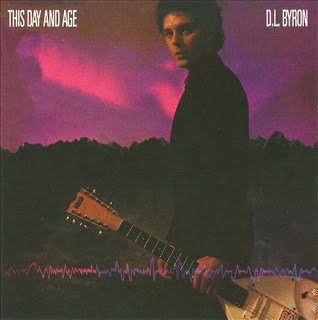
What I’m listening to: This Day and Age

D.L. Byron‘s career proves there is no justice in the music business.

The New Jersey musician released one of the great power-pop/new-wave records in 1980, an explosive, non-stop rocker that put so much of what became new-wave radio fare to shame, and yet he has become little more than a footnote.

This Day and Age, released in 1980 on Arista Records and sadly still not available on iTunes, is characterized by a sound that is one part Byrds, one part Springsteen, one part pub-rock a la Elvis Costello and Graham Parker, with a amphetamine rhythm section. The opening track, the short, punchy “Listen to the Heartbeat,” kicks off what is 30 minutes of open-the-window and step-on-the-accelerator pop that does not let up. There are no bad songs on this record and, by all rights, Byron should have become a star. That he didn’t owes to the inability of Arista — and later, other record companies — to let him do his thing.

As Allmusic.com tells it, Byron recorded the demos for a second Arista album, including the song “Shadows of the Night.”

Arista, however, told Byron that “Shadows of the Night” and the other songs were not commercial enough and promptly put him on suspension for a year. Later, several other artists recorded “Shadows of the Night,” the most famous of whom was Pat Benatar. Benatar used the song as the opening track on her 1982 Get Nervous LP, which went on to sell over four million copies. “Shadows of the Night” won the 1982 Grammy Award for Record of the Year and has since been included on several compilations and greatest-hits packages.

Byron (@dlbyronzen) asked out of his contract, focused on songwriting and fell in with drugs, according to Allmusic. He returned in the 1990s with some solid recordings — and you can get a great live album via iTunes that showcases his live show circa 1980-1981, but nothing he has done in the last 30-plus years matches This Day and Age for its intensity. It is an album that still stands with the best of its kind.

Send me an e-mail.

A vacancy at Homeland Security — might Christie get the nod?

Janet Napolitano is out at the Department of Homeland Security. The former Arizona governor “announced Friday that she would step down to become president of the University of California system.”

Napolitano’s departure has been in the works for several months and she plans to leave her post in early September, according to two administration officials. Napolitano, a former governor of Arizona who had been seen as a potential Democratic presidential candidate, will exit the political stage to run one of the nation’s largest public university systems.

As homeland security chief, Napolitano has been a central figure in the immigration debate as well as the government’s counter-terrorism policies and responses to natural disasters. Her sudden departure leaves Obama with a Cabinet-level vacancy at a critical time, as the House debates a bill to overhaul the nation’s immigration laws.

The Post goes on to say that there are high-level department functionaries who could be in line for the job, though the position would seem to call for someone with a higher national profile because. The New York Times describes the difficulties of the job:

Her departure creates an opening that could be hard for Mr. Obama to fill. The secretary of homeland security presides over a sprawling department with nearly two dozen agencies as varied as the Secret Service, Transportation Security Administration, Coast Guard and Federal Emergency Management Agency. Created by President George W. Bush and Congress after the attacks of Sept. 11, 2001, it has proved to be a thorny management challenge for everyone who has headed it.

The job put Ms. Napolitano in the middle of a wide range of crises and volatile issues, from the Boston Marathon bombings to Hurricane Sandy. She presided over extensive deportations of immigrants in the country illegally while enacting a new policy intended to allow young immigrants brought here without documents as children to stay.
At times, she drew criticism. When a Nigerian man listed in a terrorism database was able to board a Detroit-bound commercial airliner and was later stopped by fellow passengers from blowing up the plane with explosives in his underwear, Ms. Napolitano said “the system worked.”
Mr. Obama, in contrast, said there was “systemic failure” and she later explained she meant only that the system worked in response to the attempted bombing not before it happened. After that episode, Ms. Napolitano was rarely the administration’s public face when it came to other terrorism episodes, although her department was in the middle of responding to many of them.

Given the issues on the administration’s plate right now — especially those concerning immigration — the administration may punt and leave the job to a temporary chief, which would avoid a confirmation fight. Or he could think outside of the box. The most interesting — if unlikely — is New Jersey Gov. Chris Christie, floated by Matt Rothschild at The Progressive, becauseof his background in law enforcement and in running a state with a massive budget. He wouldn’t take it if offered, I suspect, given the timing (four months before his re-election) and his national ambitions, but thinking about something like this would make New Jersey progressives giddy.

Send me an e-mail.