My latest column from The Progressive Populist offers some thoughts on Obama’s rebranding of a bad idea from the ’80s.
Send me an e-mail.

My latest column from The Progressive Populist offers some thoughts on Obama’s rebranding of a bad idea from the ’80s.
Send me an e-mail.
The Wall Street Journal News Graphics team tweeted out this interesting graphic:
Where U.S. states stand on gay marriage and the rights of same-sex couples pic.twitter.com/VW3lVq0EDe
— WSJ News Graphics (@WSJGraphics) February 11, 2014
There are 17 states that provide full marriage rights to same-sex couples, along with another four that provide some level of rights and benefits. The 17 states represent 36.1 percent of the population and all but one — Maine — are represented in the U.S. Senate by at least one Democrat. Maine is represented by Republican Susan Collins and independent Angus King, who caucuses with the Democrats.
Send me an e-mail.
Rolling Stone sent out this tweet a few minutes ago:
10 cases of musicians selling out in ads: http://t.co/VT4fEuyhn9 / @wired
— Rolling Stone (@RollingStone) February 7, 2014
Ostensibly, this is in response to the Bob Dylan Super Bowl Chrysler ad, which was long and not particularly interesting. But it also raises an interesting question: What does it mean to “sell out”?
The standard answer is that allowing businesses to use your music to sell product is “selling out,” which is something that Mr. Dylan — one of my musical idols — has been doing for a long time.
Some artists — Bruce Springsteen, some members of The Doors — refuse and I commend them for doing so.
But should we really be critical of artists who turn their music over to the ad industry? The answer, I think, is no. What, after all, are we criticizing exactly? The connection to a product or the act itself? If it is the specific economic transaction, then we need to re-examine exactly how our culture industry works and the deals the artists are forced to make just to have the art they produce reach the public.
Recording artists work with labels, which front them money to record and ultimately take off the top a piece of the money generated when a record is released and sold. The writing of the songs, the recording and mixing of the music, the choice of cover art and even the session players, are viewed as elements in a larger economic transaction. Most of these costs, as I understand it, are borne by the artist — charged against the revenue that comes in before royalties are distributed (please correct me if I am wrong). Once the record is released, the artist goes on tour to promote it — again, on the band/artist’s dime — along with making all the requisite appearances on local radio and local and national television, when possible.
These post-recording efforts are lumped under the category of promotion — writers and filmmakers do this, as well — and is generally viewed as part of the business model for producers of popular art.
And, yes, it is a business model — which brings me back to the question of the use of songs in advertising or the artists themselves in ads. The critics of the practice view this as inherently different, as somehow more unseemly than the various economic transactions that occur during the recording and promotions process. Asking artists to sell themselves out to record companies is OK, according to this line of logic, but making a few dollars by hawking Victoria Secret panties, as Dylan did a decade ago, is not. (And, really, how is Dylan appearing in an ad for underwear or cars any different than Matthew McConaugheyand Scarlett Johansen doing the same, or Martin Scorcese appearing in ads for credit cards and so on.)
I’m not saying that there is no difference. Rather, what I am saying is that the difference is not as great as we choose to believe, that the issue isn’t the use of the music in ads but in our decision to subject everything we do in our society to market principles. We have turned everything — including our high and popular arts — into commodities. Lady Gaga’s latest single — of Bruce’s or the Dum Dum Girls’ — are no different under our economic model than a can of Starkist Tuna, a Twinkie or the Edsel. The success of all of these ventures is judged on their sales figures — as bands who have been dropped from major labels because of slow sales know all too well. If the artist needs to license his or her music to make money, who am I to stop them?
Is this right? No. I do believe there is something inherently different about art, that it should not be treated purely as another object for profit. But until we move away from the current system of art-as-commodity — and not only art, but health care and other social needs — we should be careful about leveling charges against musical artists for using what we tell them is a salable item to make themselves a few extra dollars.
Basically, by ensuring that art remains a commodity no different in the marketplace than soap, we are the ones who have sold out our artists. They are not the ones selling out.
Send me an e-mail.
Jay Rosen offers a compelling dissection of the political-junkie school of political journalism, which he describes derisively as “the cult of the savvy,” or an “ideology and political style” that “severs any lingering solidarity between journalists as the providers of information, and voters as decision-makers in need of it.”
This kind of journalism, as he makes clear, is about power relations and the kind of winner-and-lower coverage that focuses on whether Chris Christie will still be able to run for president in 2016, rather than on the impact that alleged misuse of Sandy relief money might have on the people who live in areas badly damaged by the 2012 hurricane.
The impact of this kind of journalism, as Rosen says, is the disempowerment of voters. The “savvy in the press”
Cultivate the political junkies. Dismiss and ridicule the activists, the “partisans.” Assess the tactics by which the masters of the game struggle to win. Turn the voters into an object, the behavior of which is subject to a kind of law that savvy journalists feel entitled to write.
Voters should be subjects (the doer of the action) rather than objects (which receive the action), and politics should not be a game. There are too many real consequences at stake.
Send me an e-mail.

It took minutes, really. I received an alert on my phone from the Associated Press at 3:33 p.m. and went to the Web for confirmation and something I could post with a tweet on the great Ralph Kiner. Before I could even do that, however, I saw this tweet:
BREAKING: Ralph Kiner, @Mets broadcasting legend and Hall of Fame Pirates player, dead at 91. http://t.co/lXs9moql5O –@NYDNSports
— New York Daily News (@NYDailyNews) February 6, 2014
I immediately retweeted and then tweeted this out:
Found this photo of #RalphKiner from glory days of #Mets broadcasting — w/Murphy & Nelson, a great announcing team. http://t.co/szihEQ4Lcb
— Hank Kalet (@newspoet41) February 6, 2014
My Twitter account is linked to my Facebook account, so the tweets hit Facebook and Mets fans started commenting, remembering Kiner and those early days when it was OK for the Mets to be bad and when we were fans of the men in the booth as much as we were of the team itself.
Kiner’s death at 91 is not major news, unless you’re a baseball fan — great Pirate slugger, great Mets broadcaster — but the conversation that took place on Facebook and Twitter proves the value of both social media sites.
Social media is sometimes dismissed as vanity writing, a chance to basically vomit out every thought that comes to our mind or to recount the slightest minutiae of our days. That’s certainly a part of what happens on social media. But if that is all you see, you are missing its impact as a news vehicle and as a way of generating engagement with audiences.
I always ask journalism students when major news breaks how they heard about the news. Where did they see it first. When I was a kid, the answer was television — the sudden breaking-in to a show by a news anchor with the news that Richard Nixon resigned, for instance. Before that, it was radio — think of the stories people tell of how they heard about Kennedy’s assassination.
The answer today is simple: Social media.
Think about how this works: I post the Kiner story to my Facebook page. My friends comment and then comment upon each other’s comments and we have a conversation online, group reflection perhaps. As this is happening, their friends may jump in, but they are also sharing the story on their Facebook page, expanding not only the story’s reach but the discussion about the story.
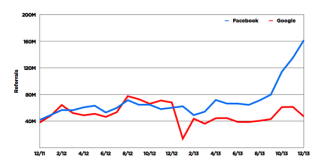
The same thing happens with all kinds of news — and not always for the good (think of the recent panic that spread across social media regarding a not-really-pending 30-inch snowstorm.) Of course, only the technology is new — we’ve always spread our news through social networks, only it was done word of mouth. Now, the technology allows for massive distribution and journalists need to understand this and continue not only to improve our social media skills but to innovate, to find newer and better ways to research/report, tell and market our stories.Consider this story and chart from The Atlantic, which I had read just an hour or so before the Kiner news hit the wire:
And Just Like That, Facebook Became the Most Important Entity in Web Journalism
The graph above tells maybe the most interesting—and definitely the most surprising—story of the past year of digital media.
It shows two years of referrals from Facebook and Google to the Buzzfeed Partner Network, a collection of websites (including this one!) that share their traffic stats with Buzzfeed. It quantifies what so many publishers have experienced: a massive surge of traffic from Facebook, unparalleled in its regular, day-after-day size and scope.
Facebook, basically, has become the most dynamic and useful distribution mode for Web journalism that exists today, more effective than Google and still stronger and more functional than the upstart social media. There are a lot of reasons for this — the ease of sharing stories, for sure, and sheer amount of time we spend on the social media site. But Facebook also offers journalism something else: A better and more diversified way to engage with stories — see above — than the traditional commenting function or the letter to the editor.

Journalists not only should be tweeting out their stories, but engaging their audiences — asking for help in reporting, joining the comment fray on Facebook and Twitter — and making clear that the process is an open-ended one. The more engaged the journalist is with his or her audience, the more engaged the audience is going to remain and the more likely it is that the story will move around the Web.
Journalists are in the business of collecting and disseminating information and creating opportunities for discussion and debate. Facebook, Twitter and other current social media do not replace journalism or journalists, but expand our tool box.
Send me an e-mail.
 Hank Kalet