
There is a good 4 inches, maybe as much as 6, at 4:15 — and there are still another 12 hours more of snow to come.

The scandal surrounding New Jersey Gov. Chris Christie has created a separate cottage industry on the right, one best characterized as the “I know I am but what are you” defense.
The two houses of the New Jersey Legislature are conducting parallel investigations into what is being called “Bridge-gate” — or the purposeful disruption of the region’s traffic for political purposes. Several people close to Christie — his deputy chief of staff, two high-ranking officials with a bi-state transportation agency and potentially others — are accused of shutting toll ramps to the George Washington Bridge in the town of Fort Lee as political payback for a local Democratic mayor’s failure to endorse a Republican governor. Or it was retribution against a Democratic state senator for her part in scuttling Christie’s judicial appointments. Or possibly was tied to a massive redevelopment project. The reasons remain unclear, which is why the Legislature has issued subpoenas and numerous high-ranking officials have resigned or been fired.
These investigations are appropriate. “Bridge-gate” – can’t we find a better name for this? – is about the abuse of state power and government resources for apparently political purposes and ultimately inconveniencing and endangering New Jersey commuters and Fort Lee residents. Democrats and liberal media outlets have been running with the story, as is to be expected, given Christie’s national profile and his administration’s carefully crafted image as a confrontational politician.
The response on the right can be summed up – in the words of Dick Polman and others – as “But but Benghazi!” Karl Rove invoked it. So did Reince Preibus and others (here is a good summary from Dave Weigal.
Cal Thomas, the long-time political columnist and Fox News contributor, makes the case. He doesn’t excuse Christie or the governor’s administration, but he makes it clear that he views the decision to go after Christie as essentially a political one – especially in light of the supposedly more important scandals engulfing the Obama administration: Benghazi, the IRS’ refusal decision to grant non-profit status to some conservative groups and the failures of the Affordable Care Act.
One wishes the media would grill President Obama over far more important matters with the same zeal they have applied to Governor Christie.
In light of A, B, C and D above, closing two lanes leading to a bridge is nothing. It does, however, again expose the media’s agenda and their intention to bring down anyone who is a potential threat to a Hillary Clinton presidency.
Has Thomas watched any television or read the newspaper over the last year or so? I seem to remember wall-to-wall coverage of the botched launch of the federal Affordable Care Act website – it was all Obamacare all the time for about two months late last year.
Consider the below graphic from Right Wing News and The Patriot Press, which has been making the rounds on Facebook:
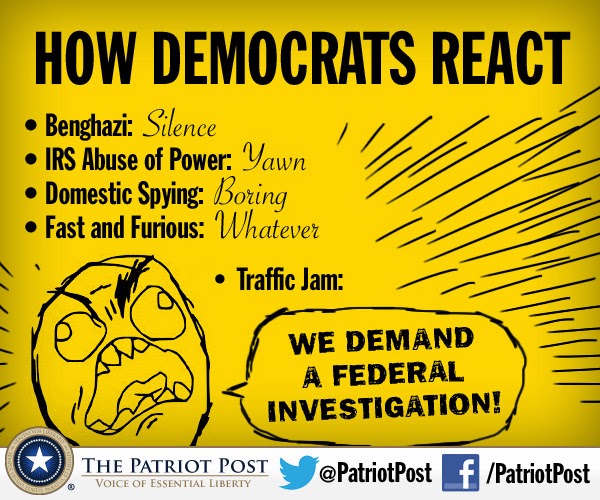
The message is pretty clear. Here are four major scandals (at least as defined by Fox News) that met with silence from “Democrats,” which is supposed to cover a rather large and amorphous entity that includes not only the Obama administration, but members of Congress and the Senate and the media. The one scandal under investigation? A “Traffic Jam” – a phrase designed to make light of the abuses under investigation.
The premise, of course, is false, as the Los Angeles Times columnist Robin Abcarian points out. This “specious (and probably predictable) reaction” to the Christie scandal, she writes, “is a silly attempt at misdirection by whiny conservatives” who apparently have short memories of the extensive coverage that all of the above scandals elicited.
The reality, I must add, is that some of the loudest voices demanding investigation of domestic spying have been Democrats and members of the progressive community and Republicans (Lindsay Graham, John McCain, Fox News) have been at least as quick to call Glenn Greenwald and Edward Snowden traitors as establishment Democrats like Diane Feinstein.
And there have been a string of investigations into Benghazi, the IRS and Fast and Furious scandals, including Congressional inquiries (led by Republicans) and significant reporting by the major news outlets. The latest on the IRS scandal – IRS employees are accused of denying tax-exempt status to conservative groups on political grounds – hit in January, when the FBI announced it would not be filing criminal charges. Does this end the matter? No. The FBI is continuing its investigations, as is a Congressional panel – though U.S. Rep. Darrell Issa (R-Cal.), chairman of the House Oversight and Government Reform Committeeand the man driving the investigation, “has not exactly been on fire to resolve the matter,” as Kelly Phillips Erb points out on Forbes.com.
So the conservative argument falls apart for a number of reasons. First, it essentially is a variant of the tu quoque fallacy, but rather than arguing “he did it, so I can too,” conservatives are saying “they didn’t do what they were supposed to do, so you shouldn’t here.”
Second, it is a variant on the ad hominem attack, which seeks to use the identity or character of someone to undercut his or her argument. In this case, what is being argued is that Democrats are making this an issue only because they are Democrats – which means you shouldn’t take their arguments seriously. (There is some of this in the response to conservatives, with some on the left dismissing every defense of Christie as being suspect.)
Third, the analogy between these other scandals and the bridge controversy is weak, as I hope is clear from above. They have been investigated and reported on, which undercuts the premises of the GOP argument (that they were met with silence).
But rhetorical rigor no longer matters in our politics. Maybe it never did. What’s troubling, however, is the degree to which our political debate has excised any sense that we are discussing real policy. It is about ratings and rantings and it is more important to score partisan points than to actually make a coherent and logical point about policy and the lives of Americans.
The alleged abuses of power at the center of the bridge scandal need investigation. No amount of name-calling and obfuscation should intefere.
Send me an e-mail.
I have been chewing on the new Bruce Springsteen album or four days now, soaking it in and considering what I might say about that I haven’t said about much of his catalog in the past. Readers of this blog know that Bruce is part of my big four: The Beatles, Bob Dylan, Bruce and Lou Reed. And some of you might have read previous blog posts or columns in which I’ve gushed over the latest. In some cases, my judgments hold up — Magic is a complete record in a way that The Rising and its shorthand lyrics just isn’t. So where does High Hopes fit into The Boss canon?
Some random thoughts to carry me through. High Hopes is an odd record in that it is a collection of material that Springsteen apparently liked a lot, but which did not fit onto earlier releases. In that way, it is like Devils & Dust (my original review), which was composed of outtakes from The Ghost of Tom Joad sessions — a record that came out in 2005, 10 years after Tom Joad, but sounded like a completely new effort. Devils & Dust‘s lyrics, which continued the southwestern motif of The Ghost of Tom Joad, managed to connect to current topics — the war in Iraq, immigration, cultural and economic dislocation — and turned the canned material into a meditation on a broken American dream and made it feel more acutely attuned to the times than Joad.
So how does one judge an album of older material that includes three cover songs — the first time he has done this on an album of otherwise original music — and two covers of his own work? High Hopes, lyrically, hits upon all of the familiar Springsteen themes — working class despair, economic dislocation, the meaning of identity and Americanness. “American Skin (41 Shots),” which was written as an homage to Amadou Diallo, the immigrant killed by New York police in 2000, fits here seemlessly, with acknowledgement that race and identity remain central to our lives. It is not just the dead black man who he is mourning in this song — which is all the more powerful in the wake of the Trayvon Martin death and the acquittal of his killer — but the police who pulled the trigger, who stand over the dead body and wonder what happened.
“The Ghost of Tom Joad”‘s reappearance, nearly 18 years after he first put the song on a CD, reminds us that all of the issues that were in play then remain relevant today. I could go song by song, but I think this review from Star Pulse does a good job and I don’t see the point in retracing its steps.
What I find compelling about this album is its sonic palette. Springsteen has not always been known for the sound of his records — aside from Born to Run, though I would argue that the two records that followed offered a distinct sonic sensibility and albums like Magic and Wrecking Ball present different elements of Springsteen’s aural approach.
High Hopes has a massive sound, with Springsteen making use not only of his traditional band, but a big horn section, strings and an array of studio tricks. Tom Morrello’s guitar is a key element here, taking these efforts in new directions for Springsteen, adding an extra edge of nastiness to many of the tracks.
Stephen Thomas Erlewine on Allmusic.com describes the album, quite accurately as an “unkempt collection,” on which “protest songs and workingman’s anthems are surrounded by intimate tunes” — which is quite a distance from the meticulous approach Springsteen usually takes. This meticulousness, of course, has resulted in classics, but has at times (The Ghost of Tom Joad, Tunnel of Love) lessened the potential impact of the songs by making them a little too neat. That is not the case here, as Erlewine says.
Much of this record oscillates between the moody and militant, particularly in the politically charged numbers, which are often colored by percussive guitar squalls
He goes on to make it clear that
these 12 songs don’t cohere into a mood or narrative but after two decades of deliberate, purposeful albums, it’s rather thrilling to hear Springsteen revel in a mess of contradictions.
Send me an e-mail.
I came across this magazine from 2006, which has an older poem of mine. You can find it on page 51. It was part of a longer series of pseudo-sonnets, all called Sonnet of the Everyday.
Send me an e-mail.
– On economics, the naturalness of corporate capitalism is unchallenged. Issues such as wealth inequality, hunger, and child poverty must be framed as unfortunate problems to be solved by elites’ adjustment of the system, not as an evitable outcome of a pathological system that leaves economic decisions in the hands of a relatively few people.
– On foreign policy, the naturalness of U.S. domination of the world system is unchallenged. Direct U.S. violence and support for the violence of client regimes must be framed as actions that are necessary to maintain order in a chaotic world, not as imperialism designed to expand U.S. power and enrich elites.
These are “foundational questions of economy and nation” that cannot be addressed by ensuring that journalists have more knowledge — one of the basic precepts of Thomas Patterson’s Informing the News, the book being reviewed (I haven’t read the book.), Bensen says. That’s because these questions are not knowledge-based, he says. They are “about values.”
A technocratic journalism that brackets out such basic questions is, by default, a journalism that will be limited in its ability to analyze and critique systems of power because it will not reflect on its own values.
So, we end up with the failures exhibited by the press in the lead up to the Iraq War, in which nearly all mainstream news outlets took at their word Bush administration officials — and the hangers on that make up the permanent foreign policy establishment in Washington — who were itching to fight rather than questioning the information being provided by these so-called experts. This was never a question of knowledge — or the lack thereof — but of method and relationship. He describes the issue this way:
[T]he crucial “source problem” is not that journalists routinely draw on the greater expertise of others, which is inevitable in the practice of daily journalism, but that sources who reflect the views of concentrated wealth and power are, on average, given far more credibility and visibility. That produces a fidelity to ideology, not truth.
As he points out, there were plenty of other sources in the lead up to Iraq who were critical of the rush to war, but the mainstream press kept going to the same tired generals and politicians.
There was a robust anti-war movement, nationally and internationally, which included a wide range of people with extensive expertise on issues of weapons, diplomacy, and Middle East history. The problem was that most journalists reflexively allowed sources with power to define the issue and create the “facts.”
You can see the same thing with the economic meltdown and the collapse of the housing bubble. The press was caught flat-footed because we only heard from people like Alan Greenspan, Robert Rubin and the approved group of economists who kept saying that housing prices would never come down. We rarely heard from people like Dean Baker, a lefty economist who was predicting the collapse as early as 2003.
In many respects, this is just Journalism 101. It is what we teach students about beat coverage — the greatest danger for any beat reporter is that he or she will be co-opted, that the reporter will get too close with sources in power and forget for whom he or she is actually writing. The people in charge become the reporter’s friends, or people the reporter is afraid of offending, so the reporter stops questioning them, starts taking them at their word and dismissing the gadflies and critics floating around. This goes for the reporter who covers city hall and the police beat, as well as for the reporters in the Statehouse in Trenton — most of whom had seen Christie in action but never bothered to fully connect the dots until now — or in Washington, where reporters have become enamored of their TV appearances and other perks of covering powerful (mostly) men.
But it is more than co-optation by a source. There also is the notion of false balance, a fealty to a misinterpretation of neutrality and fairness that leaves reporters writing “he said, she said” stories on issues like climate change — 99 percent of the scientific community is on one side of this, but we treat deniers as having the same credibility as the rest — or the economy when there really is no balance needed for many of them.
Bensen points to a third issue: the impact of ownership of media — i.e., who owns the press and what kind of constraints, both overt and tacit, that places on reporting.
Overall, if we are to address the shortcomings of American journalism, Bensen writes, we have to own up to this.
[I]deology and ownership are key to understanding how journalism works, and therefore how to start a conversation about the aspects of journalism that don’t work well. Those who believe that capitalism and U.S. imperialism are good things are welcome to argue that, as are those who believe that a corporate-commercial media system produces the most democratic journalism. But these conclusions can simply be assumed or asserted without argument.
He goes on to point out that journalism’s failures are tied to a larger institutional, cultural and ideological failures, which is why this discussion cannot take place “outside a larger discussion of U.S. social, political, and economic dogmas, the failures of which are increasingly apparent.”
Though it is difficult to imagine rethinking the systems and structures of power that have brought us to this point—what would a world beyond capitalism and imperial nation-states look like?—that is the central task of politics, and therefore a central concern of journalism. Though it is difficult, people all over the planet, without the help of knowledge-specialists, are imagining and working to bring that world into being.
This not only will require journalists to start asking more difficult questions, but to reach out beyond the traditional base of sources to whom we turn regularly. And, as Bensen says, it will require more than technocratic effort to know more. It demands from us “reflection on, and a more honest articulation of, values than contemporary mainstream journalism has yet offered the public.”
Our job, as journalists, is not to be stenographers, though there is a need for some of that. It is to be critical interlocutors and observers, to ask hard questions and to make people in power uncomfortable. At our best, we are the institutional voice of the public, the people with the money and time (at least in theory) to dig into matters of public interest and get answers, or at least ask the questions that need to be asked. To do that properly, we need to step down from our perch among the power brokers and return to our roots.
Send me an e-mail.
 Hank Kalet