Where did the finger fall off?

From an ESPN story:

Canseco, who underwent the surgery last month after shooting himself in the hand, revealed that his finger fell off in a series of tweets Friday.

I know it’s unlikely that anyone will think that the finger fell off in the tweets, but it’s still sloppy placement. How about “revealed in a series of tweets Friday that his finger fell off”?

With housing, as with food, the system is broken

Mark Bittman’s column in The New York Times makes the case that the unacceptably large portion of humanity that regularly faces hunger is not about food. There is enough food to go around; the issue is that too many lack the resources to buy into the food system as it currently exists.

The difference between you and the hungry is not production levels; it’s money. There are no hungry people with money; there isn’t a shortage of food, nor is there a distribution problem. There is an I-don’t-have-the-land-and-resources-to-produce-my-own-food, nor-can-I-afford-to-buy-food problem.
His point is pretty simple. We produce plenty of food, so much, in fact, that we have created entire food products with no nutritional value and have opted to use others to feed our cars’ engines. We have, he said, a “virtually unregulated food system that is geared toward making money rather than feeding people.”
What struck me about his piece is not only his prescription — shift to a more sustainable agricultural model — but that the points he makes can be applied to other issues. Consider the housing dilemma. We have enough space — whether it is land or existing housing — to provide for the vast majority of people who need a roof over their heads. The problem is that our zoning and tax rules make the development of affordable rentals cost prohibitive. Throughout Central Jersey, for instance, we have endorsed 1-acre lots and other large-lot development — ostensibly, to reduce the number of children who may enroll in local schools and, therefore, to control local school spending. But taxes continue to rise, even as the zoning rules create sprawl, drive up the price of housing and lead to economic (and often racial/ethnic) segregation. This, of course, is the goal.
We can build more houses for more people, but we need to change the way we think about zoning and taxes, and we need to rethink the kind of housing we need — especially in our more well-off communities. Towns throughout the state have pushed the construction of warehouses to offset their tax burden. At the same time, these same towns have pushed hard to limit the number of moderate- and low-income housing units that can be built. Basically, they want the taxes that the warehouses pay, but they don’t want the people who work in the warehouses to move into the neighborhood.

We also need a more robust minimum wage (more of a living wage), income supports and housing subsidies so that the poor can afford the housing that does exist.

As things stand, to paraphrase Bittman, we have a badly regulated housing system that is geared toward making money and insulating the affluent rather than putting a roof over everyone’s head.”

Send me an e-mail.

Property crimes

The New York Times had a story yesterday on asset forfeiture — or the ability of police departments to seize property from those alleged to have committed a crime.

The theory behind forfeiture — as I understand it — is that the taking of property connected to criminal activity acts as a deterrent, as a fine of sorts. The Times describes it this way. It

allows the government, without ever securing a conviction or even filing a criminal charge, to seize property suspected of having ties to crime. The practice, expanded during the war on drugs in the 1980s, has become a staple of law enforcement agencies because it helps finance their work. It is difficult to tell how much has been seized by state and local law enforcement, but under a Justice Department program, the value of assets seized has ballooned to $4.3 billion in the 2012 fiscal year from $407 million in 2001. Much of that money is shared with local police forces.

Police and prosecutors like it — from their perspective, what’s not to like? But it is, in many ways, an extra-legal measure — legal, to be sure, but existing outside regular due process. Whereas, someone accused of a drug crime — often cited as the most frequent use of the maneuver — must have his case heard in court and a conviction won (or plea entered) before jail time can be assigned, property doesn’t have the same rights. It gets taken on the strength of the accusation alone.

My phrasing is not accidental. Property seizure relies on the notion that the property is not just involved in the crime, but that it somehow commits the crime. It’s a notion that shifts the due process question. Prosecutors don’t have to worry that the “accused” — the car, the flat-screen TV, the house — will mount a vigorous defense, or any defense at all. The property is guilty when the prosecutor says the property is guilty.

Property owners can challenge this, but it is the now-former owner who must mount the affirmative case, must prove that the property shouldn’t be seized. This — to my non-lawyerly way of thinking — would seem to violate the Fifth Amendment, which holds that no one should be “deprived of life, liberty, or property, without due process of law; nor shall private property be taken for public use, without just compensation.” The courts have upheld seizure rules, but the courts have granted overly wide latitude to police in a number of areas, this included. Essentially, the courts have generally said, the cops are right unless you can demonstrate they’re not.

This inevitably leads to abuses — such as the ones described by the Times, and others: cars and houses taken after relatively minor arrests, the use of forfeiture as punishment when convictions can’t be won and the use of it as a threat to pressure suspects.

I remember a conversation early in my career as a journalist in which a narcotics officer told me how excited he was that the suspect’s sports car was seized during a drug arrest. He’d now have the opportunity to drive around in a car he otherwise couldn’t and the department couldn’t afford. This was on the day of the arrest and well before any trial would take place. I was taken aback by the admission. I wish I had written a story about it at the time — I was green and probably a little worried about damaging my access to the department. (I don’t remember anything else about the case, unfortunately, just this conversation.) My point is not to attack this particular officer, but to point out how easily even the best can fall prey to the distorted incentives the forfeiture law creates.

As Lee McGrath, a lawyer for the Institute for Justice, a public interest law firm that has mounted a legal and public relations assault on civil forfeiture, pointed out to the Times, departments are “supplementing their budgets by engaging in the type of seizures that we’ve seen in Philadelphia and elsewhere.”
And videos obtained by the Times offer an inside look at  how “the nuts-and-bolts how-to of civil forfeiture is passed on in continuing education seminars for local prosecutors and law enforcement officials.”

The Institute for Justice, which brought the videos to the attention of The Times, says they show how cynical the practice has become and how profit motives can outweigh public safety.

In the sessions, officials share tips on maximizing profits, defeating the objections of so-called “innocent owners” who were not present when the suspected offense occurred, and keeping the proceeds in the hands of law enforcement and out of general fund budgets.

This, as I said, is offers distorted incentives. There may be good arguments for some forfeiture efforts — at most under extremely limited circumstances, I would argue — but as with so much that has happened with law enforcement since Nixon used the “tough on crime” line as a cudgel, empowering police with new tools (see militarization of departments, a la Ferguson) often has dangerous side effects. Police are an important bulwark in our society, protecting us from harm and keeping the peace, but they also are an arm of state power and cannot be allowed unchecked power. The current forfeiture regime allows them that and it has to change.

This mall is running like a ghost mall

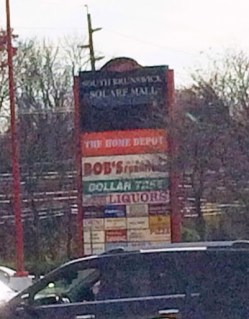
The South Brunswick Square Mall is a ghost town — or ghost mall. But that’s no surprise. The mall, which is nearing 30 years in existence (it opened sometime in the mid- to late-’80s), has long had trouble keeping its storefronts filled.

I started writing about the shopping center in the early ’90s, when one of its many revolving anchors fled. The mall has been home to an array of failing medium-size box stores — Jamesway, Rickel, Channel — and a supermarket. Macy’s opened there temporarily, but didn’t last long. And this has stressed the smaller merchants, of which there have been more than can be remembered.

Home Depot, which opened about 10 years ago $, and Bob’s Discount Furniture are holding their own there now, but the food store closed and a new one is unlikely to move in, given the small space.

So, what to do? It’s not an easy question, but it is one with which the community must grapple. The market ultimately will determine what happens to the center, but allowing it to live in limbo for as long as it has creates real and potential impacts.

First, a shopping center with empty storefronts can be an attractive nuisance. We’re lucky that there are enough tenants right now to keep that from occurring, but vacancies do tend to breed vacancies, and so on.

There also are potential tax implications. Empty storefronts lead to tax appeals, which lead to a loss of revenue, both because the town has to pay back previously paid taxes and because the properties that appeal end up with lower bills going forward.

The appeals situation was so bad last year that the Township Council considered a revaluation — a massive enterprise. Appeals, of course, are likely to happen during economic downturns as real market value and assessed value diverge. But things are made worse when you have a property that is badly underutilized, as is the case with the mall.
My sense, as I said, is that we probably want to get ahead of the market forces that might otherwise determine the future of the mall. That doesn’t mean mandating what goes there, but looking at the zoning — signage, parking, allowable square footage — and trying to determine what will work best there. In the end, the mall may require a complete renovation — remember, Home Depot revamped the back end of the property to suit its needs. In fact, it may need a fresh start, as we are seeing with the Marketplace on Route 27.
I certainly don’t have the answers, but I would like to hear people asking the questions. So here goes: What would you like to see happen to the South Brunswick Square Mall?

And the ballot is cast

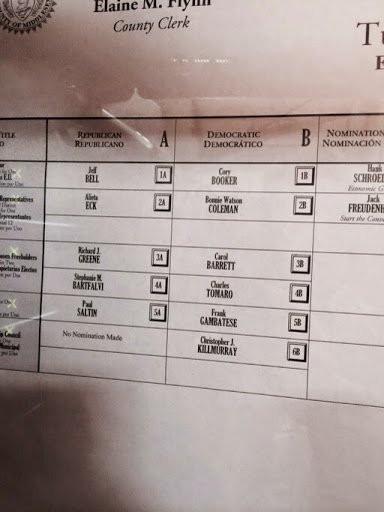
I just cast my ballot. I won’t say for whom, but it will say I voted against the bail reform question for open space and for the two Middlesex County questions — non-binding — calling for arts and women’s health funding.

I’m generally critical of the notion that voting is our only democratic responsibility, but it is incredibly important. The way our money is spent (not just how much, even though conservatives want to paint that as the only question, but on what), how our land and resources are used, and how are democracy functions all depend on who we elect AND on whether we force ourselves into the conversation the rest of the year.

So, if you haven’t cast a ballot, do so. And then get out there and hold accountable those we elect by showing up at meetings, calling their offices, protesting, writing — whatever it takes.