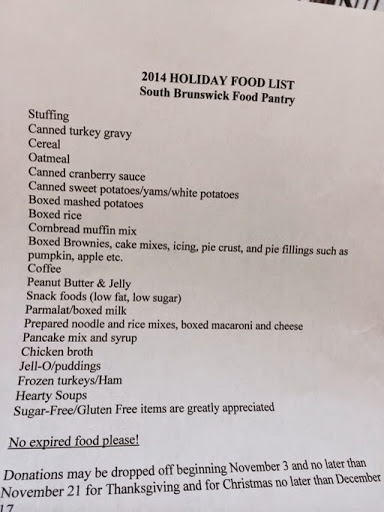
The South Brunswick Food Pantry’s looking for help and there’s a food drive today at Stop & Shop on Route 27. Help if you can.

The South Brunswick Food Pantry’s looking for help and there’s a food drive today at Stop & Shop on Route 27. Help if you can.
 |
| Photo credit: Richard Brown, from GalwayKinnell.com |
I missed the news when it first hit the wire, but the poetry world lost one of its most important voices this week when Galway Kinnell died at his home in Vermont on Tuesday. I fell in love with Kinnell’s work in my 20s and have returned to it periodically since.
Poetry.org has a wonderful tribute, with photos and several poems. But I wanted to point to a particular poem. “The Bear,” perhaps his most known poem (and one of a handful that turned me on to Kinnell’s magnificent gift), is a wonderful exploration of mind and space and time and language. I’ve included a YouTube clip of his reading — he also was a magnificent performer (I was lucky enough to see him read at the Geraldine R. Dodge Poetry Festival in the early 1990s):
I came across “The Bear” originally in an anthology, but then found the book Body Rags, which contains “The Bear,” as well as “Another Night in the Ruins” and “Vapor Trail Reflected in the Frog Pond.” It is a remarkable collection that moved me away from the simple approach to poetry I had been following. I was, until that moment, pretending to be some kind of cross between a modernist a la Eliot (I had somehow yet to discover William Carlos Williams) and a beat a la Ginsberg and Corso, with a little Black Mountain tossed in for good measure. Kinnell helped me realize that there were other modes, other voices, and Body Rags sent me in new directions and made me consider the world and the language in new ways.
The literary magazine Cold Front noted Kinnell’s death with one of his more recent poems, “A Promissory Note,” which you can read here and which seems like a perfect epitaph for one of American poetry’s most important voices.
Rest in peace, Mr. Kinnell.
Send me an e-mail.
This is an interesting explanation by Patrick Stokes as to why all arguments are not equal and why journalists should strive for true balance — seeking out all legitimate and appropriate views — and avoid the false-equivalencies we tend to traffic in. His example — the anti-vaccine movement — is a good one, but one can also look at the attacks on climate scientists by business interests and a host of other issues to see how this works.
I see it in my classes as students substitute unverifiable opinion and belief for fact-based analysis in their papers and in class discussions, and as our political discourse is controlled more and more by shout-fest cable shows and radio hosts.
Send me an e-mail.
A 21-year-old Christian man is in custody on charges that he killed a college student in Oklahoma by attempting to behead him. It is a fairly nasty story that, unfortunately, points to the differing ways that we treat violence committed by religious people.
As KFOR in reports, “Isaiah Zoar Marin, 21, is accused of using a ‘long knife or sword’ to kill 19-year-old Jacob Andrew Crockett.” The motive, according to the story, “is still unclear.”
But here is the kicker: Police say “the case is not related to recent beheadings by Islamic extremists and said the case had no religious implications.”
As a friend on Facebook points out, however, the story has religious fingerprints all over it — and not Islam. Police say “Marin is a ‘heavy drug user’ and ‘religious zealot,'” and that he “had been watching YouTube videos related to his Christian beliefs” when he committed the murder.
I have no reason to doubt the Stillwater Police Department’s characterization of this as not religious in nature, but I have to wonder how this story would have played out were Marin a Muslim. Think of the New Jersey case from last year — when a Muslim beheaded two men in South Jersey. The conservative media, especially the blogosphere, ran with it, offering headlines and stories like this one (there are does if you do a simple Google search):
BOMBSHELL: A Muslim Beheaded Two Christians in NJ… And the Media IGNORED ItThe Islamic State in Iraq and Syria recently beheaded two journalists and an aid worker. They followed up this atrocious act by calling on their supporters in the west to carry out attacks and beheadings on non-believers as well.
Perhaps coincidentally, but probably not, there was soon a beheading on a public street in London, as well as the highly publicized beheading in Oklahoma.
Although the connection between these beheadings and radical Islam is so obvious that a blind person could see it, President Obama has repeatedly claimed that the “Islamic” State has absolutely nothing to do with Islam, a foolishly disconnected theme that the liberal media has tried to run with.
The point, according to The Conservative Tribune, is that these kinds of stories are endemic to Islam, which is why it tried to paint the murder of two Coptic Christians last year as a religious crime.
Yusuf Ibrahim was arrested after the decapitated bodies of two Egyptian Coptic Christians were found buried in a shallow grave in the backyard of a home in New Jersey.
The Coptic community was shocked and saddened by the horrific incident, which appeared to be a “ritualistic killing, religious in nature”.
Police described the killer as “ruthless” and “calculating” and said he deserves to be behind bars.
It should be noted that this occurred at about the same time that the Muslim Brotherhood was staking claim to control over Egypt, and were severely persecuting, crucifying, and beheading the Coptic Christian community in Egypt, one of the oldest Christian communities in the world.
Pretty strong stuff. And it is true that the police called him ruthless and calculating — not in a religious way, however. Rather, he was described as a “ruthless and calculating individual.” And police, as NJ.com reported in April, described Ibrahim as “shooting Hanny F. Tawadros, 25, and Amgad A. Konds, 27, in the chest during an argument inside a Mercedes Benz belonging to one of the victims.”
Given Ibrahim’s earlier arrest on car-jacking charges, one can probably assume that the motive for the crime being alleged probably has little to do with religion. But that has never stopped anyone from smearing Muslims to gain political points or to spread a message of hate.
Send me an e-mail.
I posted this to Facebook, but should probably have posted it here first. I found it refreshing that, in a news climate that privileges certainty over nuance, that has come to assume that answers are written in stone, we have a piece from a medical writer in Forbes that admits its ambivalence. Feel free to comment here or on the Facebook post.
Send me an e-mail.
 Hank Kalet