
Doubling down on my no-endorsemenet stance

Back in the fall of 2013, I wrote a blog post critical of an endorsement editorial published by The Star-Ledger. The paper’s editorial, which backed Gov. Chris Christie for re-election, can be summed up this way: The governor sucks, but Barbara Buono sucks more, and, besides, we like his views on school reform.

My response was simple: Stop making endorsements. If you feel that you have to endorse someone who does not live up to your standards, then maybe you need to rethink the entire process.

Not everyone agreed with me. Some said the newspaper endorsement was a long and necessary tradition — one I used to subscribe to — while others said that we should reserve the practice for those cases when a choice was clear.

I’ve thought about this on and off since my 2013 post and have wondered whether I was too harsh. In the end, I don’t think so — and today’s odd, pre-endorsement endorsement on MyCentralJersey.com (home of The Courier-News and The Home News-Tribune) underscores my thinking. In it, MyCentralJersey.com essentially endorses a Republican Assemblyman without making an endorsement, pushing him to throw his hat in and saying he had qualities that would make him a good candidate. (The editorial also attacks the current redistricting rules as corrupt and overly partisan because the Legislature gets to pick the tie-breaking vote on the panel — which is not accurate. The 13th member is appointed by the Redistricting Commission if there are seven votes in favor of the appointment. If not, the state Supreme Court chooses.)

Here is what MyCentralJersey has to say about Assemblyman Jon Bramnick, the subject of today’s editorial. Bramnick, it says, “is a funny guy,” who wants to remind public officials that they “should lighten up a little in trying to get things done.”

MyCentralJersey calls that “a message public officials would do well to heed.”

Most New Jerseyans would love to find a politician they can laugh with rather than laugh at. That doesn’t mean treating the serious business of government and politics lightly. It does mean giving residents a sense that real people are in charge, people with an independent mind and a sense of humor and not just a collection of vaguely shady characters serving themselves and their benefactors instead of the public.

The governor would seem to fit the bill, but he

has turned out to be just as manipulative and abusive with his power as those of whom he had once been so critical. He earns points with the public for his own self-deprecating humor, but there’s a phony quality to it that’s been exposed by his thin-skinned arrogance and bullying nature.

Bramnick is different, the editorial says. He’s a politician, to be sure, but he “also spends a lot of time talking about humor and civility in politics, not exactly common topics among lawmakers.”

This, MyCentralJersey says, is of paramount concern. So, it goes on,

Here’s hoping Bramnick does indeed toss his hat into the gubernatorial ring for 2017. Maybe he can be what Christie has only pretended to be — a leader who can distance himself from the usual political nonsense and govern the state responsibly. We’d still like to think that’s possible. Hey, don’t laugh.

My point here has nothing to do with Bramnick. He may very well turn out to be the best candidate for the job. My criticism is with MyCentralJersey, which has complicated future endorsements. Imagine you are another Republican down the road who loses out on an MyCentralJersey endorsement to Bramnick; you could make the case that the fix was in before you even attended an editorial board meeting.

As I said last year, we should move away from the personal endorsement and focus more on laying out the issues that matter, telling the reader why and then explaining where the candidates stand. Essentially, we should frame the debate, but let the voters decide what is most important.

Send me an e-mail.
Quote of the Day

From William Grieder in The Nation:

The Republicans are a wholly owned subsidiary of the business-finance machine; the Democrats are rented.

Does this mean that electoral politics doesn’t matter? No. It only means that we have to be more creative in how we approach it, while also being more aggressive outside the electoral arena. On this point, here is more from Greider:

What we need is a rump formation of dissenters who will break free of the Democratic Party’s confines and set a new agenda that will build the good society rather than feed bloated wealth, disloyal corporations and absurd foreign wars. This is the politics the country needs: purposeful insurrection inside and outside party bounds, and a willingness to disrupt the regular order.

Historically, it is what made labor unions effective, along with so many other social and economic movements. The willingness to break with the system to generate change within the system created a moral urgency, a momentum that pushed the system to reform itself. The outsiders’ efforts create space in which reformist insiders can work.

The meaning of ‘classiness’ in a not-so-post-racial America

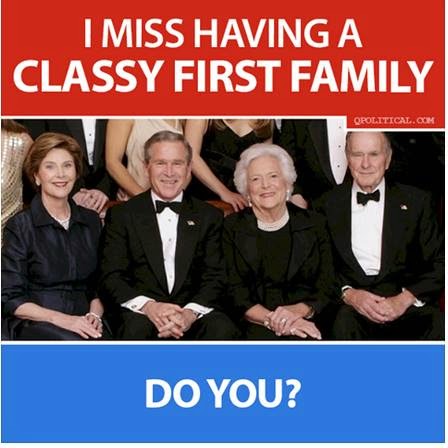
This meme has been circulating on Facebook — and the responses to it offers an interesting glimpse into the growing divide in the United States.
I first came across it on a conservative friend’s Facebook page. The post seems pretty straightforward to me, though it is based on a set of underlying assumptions and carries a subtle message that conservatives — at least some of them — are not likely to want to admit to holding.
Consider the image — two generations of smiling, happy ex-presidents, who happen to be the last two Republicans to hold the office and who also happen to hail from a wealthy and influential family. They also are white. Then, consider the statement and follow-up question: “I miss having a classy first family. Do you?” It implies, rather unsubtly, that the Bushes’ classiness is missed — primarily because the current occupant of the White House apparently lacks class.
What is missing is a definition of class, though it is implied both by who is pictured and who is purposely not pictured but is central to the understanding of the entire meme. The Bushes have class, the meme says, and the Obamas do not.
What should we make of this? Perhaps this is a partisan meme, one based solely on party identification or ideology. That would equate class with being a Republican or with being a free-market ideologue and foreign-affairs hawk. But if this was about ideology or political party, as a friend points out, why raise the question of class?

The answer is that this meme is designed to plug into racial animus while allowing a level of plausible deniability. Conservatives can post this and claim they just miss the Bushes without having to own up to the inherent racially racial underpinnings of the image and text.

I explained it this way on a friend’s Facebook page, and I think it sums up my thinking:

There is no doubt that this is built on the race/class trope, but I don’t want to go so far as to say that all who deploy it see the racial aspect overtly. It is latent, subconscious, and the poster and many of the people who would deploy this would vehemently deny any racial animus — and they would thoroughly believe their denials and are unlikely to question their own assumptions or the assumptions on which this is built. I agree … that the hate of many Obama haters has little to do with race, though the tropes — like this one — too often come back to race, partly because we are in a political climate in which everything is on the table and anything that can be used against an opponent is fair game to trot out.

So, even if the posters of the meme do not think of themselves as racist, they are trafficking in racism. When I questioned the friend who had posted this originally about his definition of “class,” he said “he knows it when he sees it.” But what does he see? And is he willing to questions the assumptions that underlie what he sees?

That is, as I said later in the same Facebook discussion, “part of the difference between the fundamentalist mindset and others — the ability to look inward and to examine one’s beliefs, assumptions, etc.”

We all have assumptions and biases that control much of our thinking, but intellectual growth demands that we constantly challenge them. This kind of post, however, allows for the bunker response — when called on its underlying racism, the poster can plausibly deny the connection and claim that the critic of the post is being overly sensitive or dogmatic on the other side. Sadly, that is the state of our public discourse these days.


It is, as the phrase goes, “dog-whistle politics,” the use of a phrase that has a certain meaning to certain people, and that is designed to rally the faithful without raising the hackles of the rest of us. “I’m not talking about race,” the argument goes, even as the meme connects with the undercurrent of racism that continues to exist in polite, middle-class society. It is more subtle than the Jesse Helms “Hands” ad or the Willie Horton ad used by George H.W. Bush against Michael Dukakis in 1988. But it plays to the same instincts, nonetheless.

Send me an e-mail.

Fundamentally speaking and the fallacy of association

Let’s get this out of the way first: Bill Maher has a right to say what he wants about Islam, no matter how much it angers Muslims, or how offensive it may be. That is something built in to the structure of our system of laws. We have freedom of conscience (the five clauses of the First Amendment taken together).

Let’s get another thing out of the way: I disagree vehemently with Maher and find what he said to be reductive and juvenile. He used the views of some Muslims as a cudgel against all Muslims, which is no different than most of the attacks on religious, racial and ethnic groups across history. Take a single tenet, or a characteristic, or even a single person, and then have that tenet, characteristic or person stand in for the broader group. It is a fallacy of association (as when we assign guilt to one because of his or her association with someone or something else) or composition (which assumes that something is true of the whole because it is true of a part).

I raise this because Maher and his monologue last month — described by Jeffrey Taylor on Salon as a “‘Real Time’ monologue against liberals who treat Islam with excessive deference” and not as an attach on Islam — continues to rile people. There was the Internet petition that garnered 5,000 signatures, as Taylor writes, “demanding that the University of California, Berkeley — long a beacon in the history of the American free-speech movement — rescind the invitation to Maher to deliver the fall 2014 commencement ceremony address because of his ‘blatantly bigoted and racist’ comments about Islam.” And more recently, there was the Rula Jebreal, on Maher’s show, taking Maher to task.

The Jebreal appearance is the target of the Taylor essay, and he makes several good points about Jebreal’s argument — assuming that Jebreal’s argument was as simple as Taylor makes it out to be, that Jebreal was arguing that “critical speech about Islam cannot be tolerated in a public forum if it causes ‘offense.'”

He quotes her as saying that the students “feel offended, feel offended, that . . . your views of Islam . . . the generalizations [that you’re making] perpetuate bigotry . . . .  I’m all for freedom of speech. I love debate, I hate monologues.” This, of course, makes it sound like she is only talking about offense — but what about those pesky little ellipses? Watch her complete remarks here, and you’ll notice that she offers a more nuanced take. Is her argument flawed? Yes. But she also makes the point that Maher has conflated all Muslims into one, unthinking and violent horde — which Maher, with his pithy responses (“Is there a gay bar in Gaza?”), seems find with.

But my point here is not to attack Maher — I’m no fan of his brand of atheistic certainty any more than I am a fan of religious fundamentalists — or to defend Jabreal. Her argument, while more nuanced than Taylor lets on, was badly flawed.

My issue is with Taylor’s argument, which conflates criticism of Maher’s take on Islam with efforts to censor speech. That is absurd. Maher’s critics are not trying to shut him up — even the Berkeley students asking that his commencement invitation be rescinded are still inviting him to debate his views on campus. (To be clear, I tend to be agnostic about commencement speakers because I find the entire commencement speech thing a racket. But if they are invited, let them speak, but also allow vibrant response and protest from the other side, even if it means disruption.) The critics aren’t asking Maher to shut up. They are criticizing him for the things he says — which, if I’m not mistaken, is exactly what free speech is supposed to be about.

I won’t comment on Taylor’s characterizing of the precepts of Islam — that one must proactively declare one’s faith in Islam,

the canonical texts of which inveigh against “unbelievers” and advocate violence and even warfare against them, with, at best, subservient dhimmi status and a special tax, the jizyah, imposed upon Jews and Christians 

— because I just don’t have enough background to do so. I will say, however, that I have attended some Eastern Orthodox religious observances that still cite Jews as the killers of Christ, a belief that at an earlier date had been prominent among Christians.

But I will say that Taylor — at least in this piece — displays an uncomfortable certainty that does not allow for debate. Like Maher, he has crafted a narrative that immunizes him from criticism, that “Jebreal, Aslan and others” are “trying to stifle free speech about Islam,” and that anyone who disagrees with his version of the truth is an enemy of the enlightenment.

Nonbelievers should not sit idly by as those who attack the single greatest historical enemy of human progress, organized religion, are intimidated or barred from the debating table (or the commencement-address podium).

That said, Maher and Taylor are right about at least one thing. Organized religion (and not just Islam) has been responsible for more than its share of organized and grassroots violence across the centuries — though, as Karen Armstrong points out, much of the violence was actually perpetrated in the name of politics, wealth and power with those in control using religion as a weapon. But it also has been responsible for a lot of good — the Northern abolitionist movement, the Catholic workers movement, the civil rights movement, the sanctuary movements of the ’80s, and so on, were all influenced by religion. Religion and faith are complicated and contradictory and it is foolish of anyone to attempt to paint any religious faith with a single broad stroke. Doing so assumes that all members of a religious faith are no better than the worst members of those faiths, which is logically fallacious and counterproductive.

Religious belief and religious groups should not be immune to criticism, any more than political or commercial entities. But our criticisms need to be logically constructed and open to alternative points of view. The strand of atheism that Maher at least seems to represent, because of its unwillingness to admit any level of uncertainty on the issue of religion, is no better than the fundamentalist preacher who denounces Mormons and Jews.

Send me an e-mail.