
It’s a matter of trust

Attacks like this one in Los Angeles — and the one recently in Bed Stuy that has the New York City Police Department and police union at war with Mayor DeBlasio — are an assault on the notion of civil government. Police, as Djelloul Marbrook points out, are representatives of civil authority — they are empowered by the citizenry to serve and protect and to uphold the laws agreed to by what is supposed to be a representative government. As such, they deserve respect, though that does not put the institution or individual officers above criticism.

Police, however, at least many in New York City, appear to differ, with thousands turning their back to the mayor in protest during a funeral for one of the two officers killed in Bed Stuy.

As he rose to deliver the customary mayoral eulogy, thousands of uniformed officers outside silently turned their backs on him in a pointed display of disrespect as his image filled the large screens broadcasting the service


Angered by the mayor’s qualified sympathy for nationwide demonstrations calling for police reform, some New York police officers had similarly shunned de Blasio as he arrived a week ago at the hospital where Ramos and his police partner, Wenjian Liu, were declared dead.

DeBlasio was elected on a reform platform and, as Reuters points out, has”has struggled to balance the interests of police critics who helped elect him and the officers who now work for him.” This, according to police union president Patrick Lynch, represents a “betrayal.” Once officer, quoted by Reuters, put it bluntly:

“A lot of people feel he has taken a side, and that side is not ours,” a New York police officer said on condition that her name be withheld because of a department ban on unsanctioned media interviews.

This neatly sums up the problem — that many police officers (and, yes, some of the protestors, as well) see this as an us-against-them issue. By acknowledging that the protestors have legitimate grounds for their criticisms and a right to protest, DeBlasio has taken sides. He is with “them” — the protestors — and, therefore, against the police because any criticism of the police must be ruled out of bounds.

It is the police demonstrating that they believe themselves above criticism, that they view anyone who calls their behavior into question as an enemy and that they do not need to address the very real problems that exist within the institution.

The fact is there is a palpable disconnect between the police and minority communities and people of color more generally. Many minority residents of largely poor areas feel as if the police function as an occupying army, while those blacks and Latinos who live in less racially or economically segregated areas say they feel as though they are watched far more closely than their white neighbors. This is what my students tell me and I have no reason to disbelieve them.

Is this fair to the police? That is not the point. The numbers show a disparity in arrest rates and other interactions. There may be rational reasons for the disparities, ones that have nothing to do with structural bias. We can — and should — have that discussion.

Police Forces Across the U.S. Get Low Job Ratings in Many Areas

But the issue at hand is one of trust, and we have reached a point where it is clear that police have lost the trust of African-Americans. A Pew Research Center for the People & the Press poll conducted in August found wide disparities in the trust of local police departments, with blacks being more likely than whites to question the work that police are doing.

Fully 70% of blacks say police departments around the country do a poor job in holding officers accountable for misconduct; an identical percentage says they do a poor job of treating racial and ethnic groups equally. And 57% of African Americans think police departments do a poor job of using the right amount of force.

Overall, according to the poll, only 10 percent of blacks say police departments do either a good or excellent job of holding officers accountable or of treating racial and ethnic groups equally, while just 6 percent say police do a good or excellent job of using the right amount of force.

It is in this context that Mayor Bill DeBlasio made his remarks — quoted here from Michael Tomasky in The Daily Beast — about how he and his wife have “trained” their son to interact with police, should it happen.

Chirlane and I have had to talk to Dante for years, about the dangers he may face. A good young man, a law-abiding young man, who would never think to do anything wrong, and yet, because of a history that still hangs over us, the dangers he may face—we’ve had to literally train him, as families have all over this city for decades, in how to take special care in any encounter he has with the police officers who are there to protect him.

The comment, as Tomasky points out, “was completely unremarkable and so obviously true that in other contexts we don’t even bat an eye when someone says it.” He goes on to add that

two decades’ worth of statistics tell us that black men are killed by police at 21 times the rate white men are, and yet half the public has persuaded itself that police treat blacks and whites no differently. And it’s controversial for a mayor with a black 16-year-old son to say something so obvious—indeed, what every parent of a black son has to say.

This should be the focus of the public debate — how the police can win back the confidence of African-Americans and Latinos, how we can make it so that parents no longer have to prepare their black sons for a hostile world. Instead, we are caught in a cesspool of divisive political rhetoric pushed by the New York police union and its allies, who seem to have respect for free speech and protest only when they benefit their own cause.

 Send me an e-mail.
Who’s to blame?

The assassination over the weekend of two New York City police officers has inflamed the already heated rhetoric and has given conservatives a convenient excuse to ignore the issues that have created a fraught relationship between police and African-Americans around the country.

I’ve written about this a few times over the last month, since the decisions not to indict police officers in separate and unrelated killings of unarmed black men. And I am the first to admit that I write this post from a position of privilege — I am a white middle-age guy living in the suburbs. I don’t fit the profile our culture has misguidedly created that transforms all young black males into potential criminals, nor am I a police officer who has been tasked with protecting society.

So, yes, I’m lucky. Yes, I sit in my “safe house,” holding my “enlightened thoughts” and comment “on police policies.” Yes, I support the protesters in their efforts to ensure that the war mentality that has taken hold among some departments and to fix the broken relationship between police and communities of color.

I don’t do any of this smugly — contrary to what bloggers like House and Home seem to believe. I do this because I believe that police officers are public servants and that their job is to serve the public. They have a difficult job, an often thankless job and a dangerous job. Most police officers are conscientious, public-minded, concerned with the public and advancing the public good.

But the police operate in a society in which race remains a flashpoint, in an economic environment in which many neighborhoods (mostly black and Latino) have been robbed of hope, in which schools have been allowed to deteriorate (if not collapse outright), and in which poverty is more prevalent than in the white suburbs. We then treat these areas — both in policy and rhetoric — as war zones, sending the police in not to keep the peace, not to serve the residents, but to clean up, keep order and, ultimately, to protect the status quo.

That is the history of policing — it has always been an arm of the state, which always has been an arm of the economic elites. Police are a part of the larger social and economic structure, are influenced by it, and they are subject to the dictates of the economic, political and police hierarchies, hierarchies that have pushed failed policing policies in many places, that have endorsed profiling and the militarization of police in recent years, that endorse order over all other prerogatives.

I don’t mean to indict all departments — there are many that have embraced community policing concepts that attempt to reconnect police to the communities in which they serve. But the larger cultural imperative — starting with the law-and-order political rhetoric that has been ascendent since Nixon and including news coverage and television shows and movies — remains one of us against them, of good guys and bad guys.

This is an environment that leaves many in the minority community feeling disconnected from the police, feeling targeted, and which is sowing distrust. This is what we see in polling and what I hear from my students. They are angry at being profiled. They feel that too many police officers are too quick to escalate situations involving minorities — especially young male blacks and Latinos. They want to be accorded the same deference and respect that they feel is being given to whites.

On the other side, police officers are right to feel that many are being painted unfairly by the broadest brush possible — some of the rhetoric certainly does that — and that they are not given credit for the efforts that they do make.

And while I disagree with Mayor Bill DeBlasio that it’s time for the protests to go on hiatus — protests are necessary to induce changes — I think it is pretty clear that the heated rhetoric is making discussion impossible. The mayor and the protesters are not responsible for the death of the two officers; the blame for the senseless deaths of officers Wenjian Liu and Rafael Ramos lies with the shooter,  Ismaaiyl Brinsley. The blame for the deaths of Michael Brown, Eric Garner and Tamir Rice, while all occurring at the hands of police officers, were not killed by a single, monolithic entity known as “the police” — though systemic failures did make their deaths more likely.

We are unlikely to move forward until we stop generalizing and start being honest with ourselves.

Send me an e-mail.

A rigged system

Another day and another inexplicable grand jury ruling on police use of force.

I say this despite not being on the grand jury and not being there the day Eric Garner was choked to death by a New York City policeman — a choke hold that is against police procedure in New York and illegal, a death ruled a homicide by the medical examiner.

But maybe calling the grand jury’s decision inexplicable misses the point. It is, after all, all too explicable, given the way the law is structured, given the deference we show police and the racial animus that underlies so much of our day-to-day interactions.


I don’t use the phrase “racial animus” lightly. Race infects everything we do, at least on some level. It is there in our language — see this interesting piece on seven common, racially coded expressions that we think are harmless, but that carry subtle and not-so-subtle messages. It is there in our hiring practices, our politics, our policing. It remains a central fact of American life.

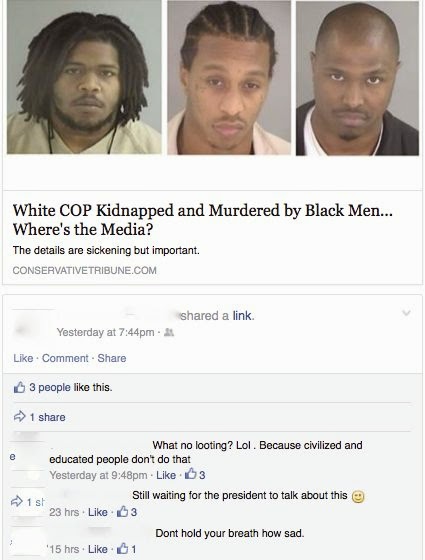
Consider this screen grab of a Facebook discussion from yesterday — I blotted out the names and icons of the people involved. This is a fairly typical conservative/white response to the protests against police abuses triggered by the Ferguson grand jury and intensified in the wake of yesterday’s announcement in Staten Island. (I am not saying that all whites or conservatives think this way, but this seemed to sum up the tenor of many of the conversations I’ve been hearing over the last two weeks — both from politicians and the conservative blogosphere, and people I talk with live or on social media.)

This argument creates a false equivalency, which gets to the heart of the different ways in which blacks and whites view the criminal justice system. I say false equivalence because:

  • The accused were indicted and there is a pretty good chance they will be convicted, while the officers who killed Michael Brown and Eric Garner were not.
  • The Virginia case is a rarity when compared with the Brown and Garner cases.
  • Police are state agents acting on behalf of us, meaning their actions reflect our values. It’s why shootings deaths like Brown’s, or Tamir Rice’s in Cleveland, and why Garner’s death literally in the hands of a police officer are more than tragic, and why African Americans see police shootings not as an anomaly — as many whites do — but as an extension of a lived history.

Whites can pretend it is otherwise, that African Americans are overreacting (they are not), and that race no longer matters in the United States. We can pat ourselves on the back and point to the election of a black president, of a black senator here in New Jersey, and pretend we are in a post-racial era. We are not — made clear when we look at the differences in earnings and wealth between blacks and whites, when we look at housing patterns, at the wide gulf in school spending and educational outcomes, and so on.

We can say the criminal justice system did its job — and that is probably true. But that is only because the system is rigged in favor of police, in favor of power, in favor of maintaining the status quo.

 
Send me an e-mail.

More than skin deep

This CNN piece from earlier this week dovetails with some of what we have been discussing in my composition classes this semester — that racism can manifest itself in more subtle ways than the more overt race-baiting and hatred with which we normally associate the race discussion.

The piece opens with a discussion of what it calls a “classic study:

They showed people a photograph of two white men fighting, one unarmed and another holding a knife. Then they showed another photograph, this one of a white man with a knife fighting an unarmed African-American man.
When they asked people to identify the man who was armed in the first picture, most people picked the right one. Yet when they were asked the same question about the second photo, most people — black and white — incorrectly said the black man had the knife.
This is just one of several studies reviewed in the story, which ultimately points out that race and racial biases affect nearly all of us in ways more subtle and perhaps more insidious than the overt hostility of the white-hooded Klansman. Duke University sociologist Eduardo Bonilla-Silva calls it “racism without racists.” As he explained to CNN,

“The more we assume that the problem of racism is limited to the Klan, the birthers, the tea party or to the Republican Party, the less we understand that racial domination is a collective process and we are all in this game.”

I write this not to castigate anyone in particular. We all engage in this kind of subtle and often unconscious bias — myself included. What does it mean when we say “some of my best friends are black” or that “we shouldn’t throw accusations of racism around lightly”? What does it mean to say something is “ghetto” or to call something “classy”? And doesn’t the meaning of the phrase “hip-hop culture” change depending upon how it is used? How about “the race card”?

This is ingrained — and unfortunate. And it has infected even the least prejudiced of us. When we talk about good and bad neighborhoods, we may be talking about crime rates, but often we also are talking — at least on some level — about race. When we describe black athletes as gifted, but white athletes as smart (this occurs far less frequently than it did in the past), we are using racially coded language.

Howard J. Ross, author of “Everyday Bias,” told CNN that these biases are normal, but that we need to own up to them and take responsibility for them. 
“We need to reduce the level of guilt but increase the level of responsibility we take for it,” he says. “I didn’t choose to internalize these messages, but it’s inside of me and I have to be careful.”

Again, I could be wrong about this, but our use of language has embedded in it these codes — “ghetto” versus “classy,” “good” and “bad” neighborhoods, etc. And the language probably reflects our underlying beliefs. I wrote last week about the “classiness” meme as it related to criticism of the Obamas and made the point that the racism contained in the meme was subtle. Not everyone who posted it is racist, but the meme seems to have been designed, at least in part (that is a lot of qualifiers), to appeal to this racial undercurrent.

I think we need to be honest about it and admit that this inherent bias may be guiding some of our decisions and that it does affect our politics and even our policing. Was Officer Darren Wilson a racist, or the officer who shot Tamir Rice in Cleveland? I don’t think so — at least no more than most of the rest of us. But subconscious racial assumptions may have left the officers assuming the worst — and with disastrous results. This is why we need to constantly question our assumptions and our motives. None of us are so pure as to be immune from this.

Send me an e-mail.

Thoughts on Michael Brown and Ferguson

So, the shooting of Michael Brown in Ferguson, Mo., was justified. That is essentially what the grand jury said yesterday when it refused to hand down an indictment against the shooter, Police Officer Darren Wilson. I know that, technically, the grand jury didn’t say that. It found that there was not enough evidence to indict, but that is not the message being sent. And that is why there is a lot of anger in Ferguson and throughout the country.

I don’t know what happened that night. I wasn’t there and I was not on the grand jury. Few of us were, so we can’t say for certain that Wilson did not fear for his life — a key component of his defense. We can’t know if he was afraid — and, even if we assume he was, we can’t know on what he based that fear, whether it was tied to stereotypes of young black males or to Brown’s size or a real threat.

That distinction is important, because it relates back to the question of race in America. Police, as the courts have ruled, have a right to use deadly force if they fear for their lives or the lives of others. But what triggers the fear? When race is involved, as we saw in the Trayvon Martin tragedy, it literally can color judgment, lead us to assumptions that are far from accurate.

Brown was a large black teen, a fact that carries with it certain assumptions and biases to which even the best of us fall prey. So, it is not out of the realm of possibility that race played a role in Wilson’s thinking, in the way he read the situation, in his reaction. Brown’s physical presence may have been enough of a threat for Wilson to create fear in the officer’s mind, may have been enough for him to believe he needed to respond with fatal force.

If this was true and the fear was enough to justify the use of deadly force, then this is more than a tragedy. It was a travesty. It is part of a long history in which black bodies come to stand in for danger and that black teens are seen as predators.

That’s why I am having trouble not looking at this through the lens of race. We are supposed to assume that the justice system works, that the grand jury did its job and that the evidence led it to make a fair and well-thought-out decision. We are supposed to assume that the prosecutor in Missouri, St. Louis County Prosecutor Bob McCullough,  was just trying to be transparent and fair to all sides.

But as Dana Milbank, of all people, points out, “the joke of a grand-jury proceeding run under the auspices of McCulloch, the St. Louis County prosecutor,” seemed to guarantee a pre-ordained result: “his decision not to recommend a specific charge to the grand jury essentially guaranteed there would be no indictment.”

McCulloch essentially acknowledged that his team was serving as Wilson’s defense lawyers, noting that prosecutors “challenged” and “confronted” witnesses by pointing out previous statements and evidence that discredited their accounts.

This, as so many commentators have pointed out, put McCullough in the dual position of prosecutor and defense attorney — an untenable position. In August, Vox quoted Alex Little, a former federal prosecutor, as questioning the approach taken by McCullough:

(T)here is no obligation for prosecutors to present possible defenses to the grand jury. The only question the grand jury must answer is whether there is probable cause to believe a crime has occurred. That’s a very low standard, and it’s almost always met when the District Attorney seeks charges.

If he takes that approach, then he’s already decided to abdicate his role in the process as an advocate for justice.

So when a District Attorney says, in effect, ‘we’ll present the evidence and let the grand jury decide,”‘that’s malarkey. If he takes that approach, then he’s already decided to abdicate his role in the process as an advocate for justice. At that point, there’s no longer a prosecutor in the room guiding the grand jurors, and — more importantly — no state official acting on behalf of the victim, Michael Brown.

That, said Vox last night, “could have made an indictment less likely.”

So why go to the grand jury? Some are saying McCullough did not have a choice, that it was politically problematic for him not to seek an indictment. But, as Milbank says, “it appeared he wasn’t even trying to get an indictment” and that “he had a long record of protecting police in such cases.”

So, when the no-bill came down last night, Milbank said, “he prefaced it by blaming the press and social media for whipping up emotions in the case with inaccurate information.” More importantly,

He hid behind the grand jurors, as if he hadn’t orchestrated their decision with the finesse of conductor Christoph Eschenbach: “Anyone suggesting that somehow it’s just not a full and fair process is just unfair to these people” who “gave up their lives” to deliberate.

The point is that the grand jury is not a jury. It is, as I wrote on a friend’s Facebook wall earlier today,
an arm of the prosecution.

Normally, the prosecutor presents HIS case to the grand jury. He acts as an advocate for the victims (in theory) and the state, which is supposed to speak for the victims, and uses the GJ as part of the prosecutorial arm (it is not the same thing as a jury).

There is no right to a defense during a grand jury proceeding. That comes during a trial.

Complicating matters further, the interests of the state and the defense were intertwined, leaving the victim out in the cold with no one to guarantee him, Michael Brown, a fair hearing.

***

None of this is meant to lay a blanket of criticism across all police officers. I have the utmost respect for them and the job they do. And, as I told my class tonight, 95 percent — and probably more — are conscientious and committed to protecting the communities they serve. But they also are human and they are subject to the same foibles — the same prejudices, the same fears, the same momentary lapses — as the rest of us. They are trained to be better, and in most cases they are. But they are human and when they fire a gun and a life is taken, the public has a right to expect a fair and open investigation. As of now, it is unclear that Bob McCullough provided that.

***

This collection of essays, by the way, are a necessary read. They offer a variety of viewpoints on the question of police culpability.

***

Some other thoughts (I posted a version of this to another friend’s Facebook thread, but wanted to share it here):

I was thinking this morning about how we construct narratives. TV news’ need for striking and dramatic images tends to draw the eye away from more peaceful protests to violence because the violence is visual. Then the media uses the imagery to help reinforce its preconceived notion that the violence was inevitable so that it can stop looking at the underlying causes of the rage that resulted in the violence.

What helps drive this is the majority’s almost blind trust in the police — something the minority community lost a long time ago. The default position for most is to assume that police must take a military position, that their job entails cracking down on unruly and dangerous masses — especially the darker ones — and that the police must act like the military to do so. It is the norm, as is the TV-cop-show-inspired militarization of the relationship between police and the public. In many communities (not all — there are thousands of good cops out there), we have moved from “protect and serve” to an occupational mindset. This attitude frames the reaction to photos of police in military gear, which we no longer question. (See my essay on this in Dinosaur, which is only available in full form if you buy the magazine.)

I also think the lessons of the civil rights movement about the impact of violence on the broader public’s acceptance of protest have been lost — because we have (through public policy and not-so-benign neglect) created a series of minority bantustans throughout the country, which allows anger to fester, where jobs in the legitimate economy are scarce, where the money that can be made is tied to drugs and other illicit activities; and because the society as a whole has become more accepting of violence as a tool of redress, whether real, as in our shoot-first foreign policy, or metaphorical, as in the way we have endorsed name calling and personal attack and innuendo as legitimate modes of argument.

In the end, we should be discussing whether the use of force by police deserves more scrutiny on a regular basis (and not just when there is a high-profile shooting); whether we need to re-evaluate the role of police and whether this militarization is necessary or wise; how we can break up these bantustans and provide broader housing and economic opportunities for all (it is going to take more than expanding the pie); and how we can devalue violence as a mode of redress. Instead, we are going to continue to discuss the torching of a convenience store and we will use it to ignore the real issues in play.

 As a postscript, I want to add that

the focus on arson is similar to the repeated playing of the videotape that purportedly shows Brown robbing the convenience store. It shifts the blame for underlying issues of race and power to one in which we can dismiss Brown — or brown people — as unworthy of our respect or support.

Send me an e-mail.