#notapoem — just a rant

Not a poem. Not an essay. Just a rant.

#notapoem Again. Or is it still? A continuing thing, blood flowing into blood into blood. Across borders. Beirut. Paris. Mali. Belgium on high alert. Syria in chaos. Jews stabbed on Tel Aviv streets. Palestinian homes bulldozed and bombed. Iraq & Afghanistan. Libya. Ferguson. Baltimore. Michael Brown & Eric Garner. Sandra Bland. Tanisha Anderson. Tamar Rice. White supremacists target blacks, Jews, Muslims. Shoot up churches, mistake Sikhs for Muslims, assault them on the streets. Presidential hopefuls stoke fear; xenophobes call for closed borders. Trump channels Goebbels, calls for Muslims to register with government, backs away. Media doesn’t blink, rides the tide, stokes the fire. Bombs level buildings. Bombs fall from planes. It’s simple, a friend writes. Life’s simple. They want to kill us, she says, ask the mother of someone who died on 9/11. Ask the mother of the Syrian child found dead on a Turkish beach. Or the 11-year-old Iraqi orphan. Ask. Ask. Ask. #instagramessay
A photo posted by Hank Kalet (@newspoet41) on

Send me an e-mail.

#stolenwagesnj

This is, partly, an experiment in form pulled together to show my class that we can tell stories using a variety of platforms. This one is generally called the Instagram essay, which has been used by writers like Neil Shea and Jeff Sharlet. I am working on a longer version of this for NJ Spotlight.

Let me know what you think of this as a storytelling medium.

Send me an e-mail.

Brief Notes: Mersault, Musa and the Paris attacks

This is making the rounds on Facebook and Instagram and is worth reading.

I woke this morning deeply disturbed by the news from #Paris, but more amazed by the attention it received on social media. I understand Paris is a beloved and familiar space for a lot of people, but it troubled me that #Beirut, a city my father grew up in, had received so little attention after the horrific bombings two days earlier. It also troubled me that #Baghdad, a place I have absolutely no connection with, received even less attention after the senseless bombing that took place there last week. Worst of all, I found the understanding of the refugee crisis skewed and simplistic. If you’ve been following the journeys of the people leaving their homes around the world right now, perhaps you’ll understand why the words #SyrianRefugeeCrisis are just as devastating as #PrayForParis. It’s time to pray for humanity. It is time to make all places beloved. It’s time to pray for the world.
A photo posted by Karuna E Parikh (@karunaezara) on

I would edit it some — we should pray for Paris, if we are to pray, but also for Beirut and Baghdad, and the refugees fleeing violence, and the Jews being attacked in Jerusalem, and the Palestinians horded into camps, and African Americans who continue to be victimized by our racist past and present, and the Latinos who are viewed as somehow less valuable and who have been made the convenient scapegoats of American politics, and… and…. But I can’t pray. And not because I am irreligious. I can’t pray because if I were to pray, then I would do nothing but pray.

I am reading The Mersault Investigation, Kamel Daoud’s novel written as a response to Albert Camus’ The Stranger. Daoud’s point of departure is the murder of the unnamed Arab on the beach and the conceit is that the Arab — actually, the Algerian — has a name and a family. It is written in the voice of Harun, the brother of Musa, and is an effort to reclaim a sense of humanity taken from not only Musa, but from Harun and from all of Algeria by the West. The Stranger essentially posits a hierarchy of importance, Daoud’s novel claims, placing the Frenchman Mersault above the Algerian, consigning the Algerian death to footnote status in a novel about the absurdity of life (the trial in The Stranger is only nominally about the murder and centers around the speaker’s alienation).

The response to the awful events in France is totally appropriate, but as this meme makes clear it is wholly insufficient and betrays a western chauvinism that is at least a part of what creates this cycle of violence. The French dead, for whom we should mourn and for whom we should seek justice, are like Mersault. The dead in Beirut and Baghdad and elsewhere, perhaps because of the regularity with which deaths occur in these places but also because too many of us think these dead lack the same humanity as the victims in France, also deserve justice. But they are no longer mourned in the west, no longer even mentioned. They have been stripped of their names. They are all Musa’s.

Send me an e-mail.
Real stories, real problems, real people, real journalism

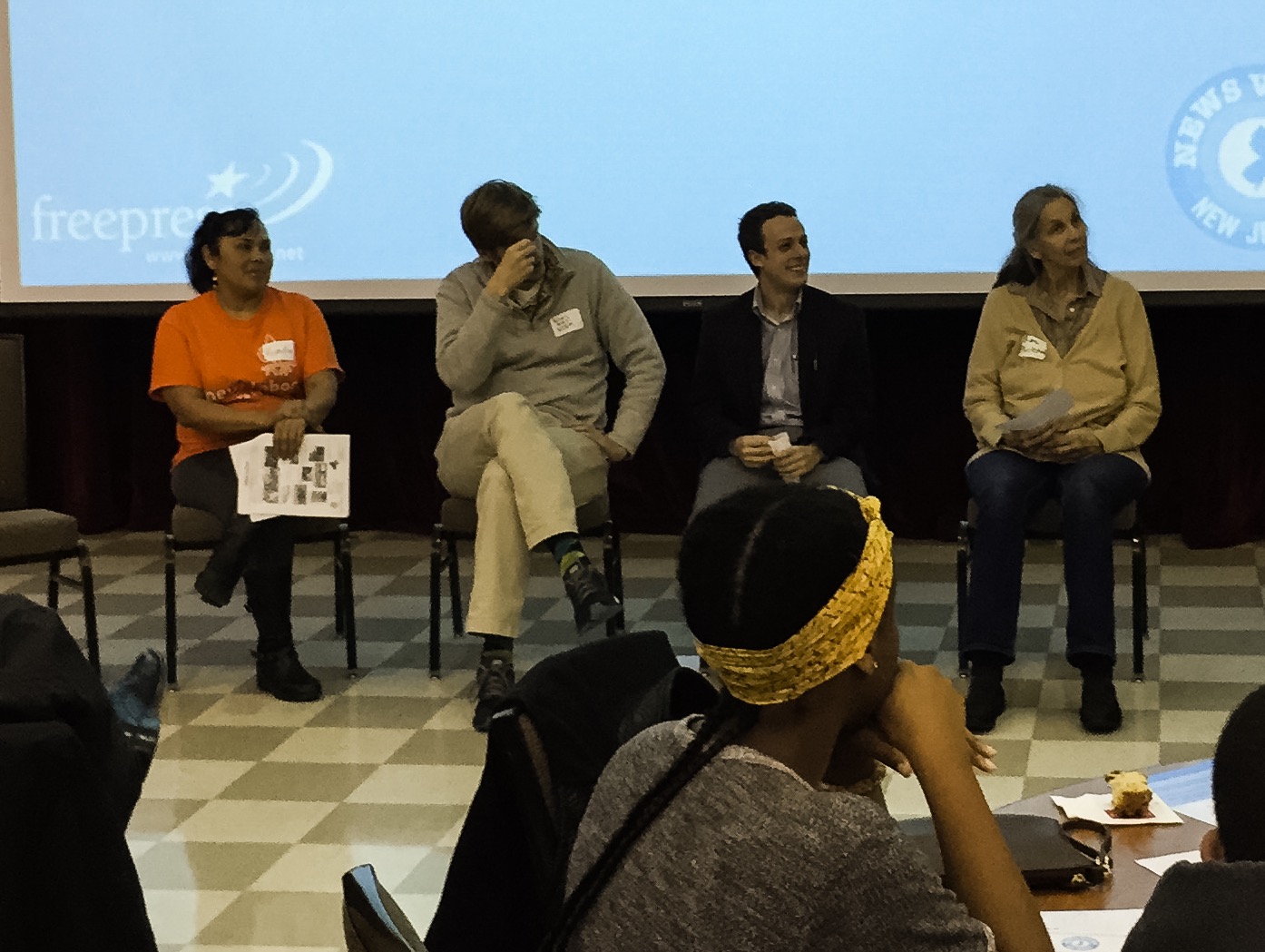
I attended a community forum last night on the state of local journalism sponsored by the Free Press‘ New Voices project. The aim of the event was to connect journalists to community members in New Brunswick and to reinforce the importance that both play in maintaining an informed and engaged citizenry.

Craig Aaron, president of Free Press, summarized the event in a tweet:

During his comments, he made this basic point (summarized in my tweet):

Charlie Kratovil, editor of New Brunswick Today, offered a similar comment (again, my tweeted summary):

Most of the evening was devoted to small-group work, to journalists mixing with community members to ensure that citizens understand what we do as journalists and the constraints under which we operate and that journalists focus our attentions on what is most important to the community.

A lot of issues were raised, some of which will result in stories down the road, but the big takeaway (ugh, biz speak) was something I’ve been trying to impress upon my students — and before them, my reporters: Everything has to be about the reader and the community in which we work. The stories we write are not being written for the mayor or the police chief, but the mom and dad who take their kids to soccer on Saturday morning, or the worker struggling to pay bills on minimum wage.

I met a New Brunswick resident, Reynalda Cruz, who is also an activist with New Labor. The focus of her work has been on wage theft, on trying to force businesses to pay workers what they owe. The issue, despite what the Chamber of Commerce has told me in the past, is not as simple as going to the state and getting a judgment. Too many employers know that workers like Cruz have little recourse — many are undocumented and scared of doing anything that might get them deported. Employers take advantage of this.

New Brunswick has a wage theft law that gives the City Council the ability to strip business licenses from businesses who are sanctioned by the state, but it has its limitations. A New Labor member — whose name I failed to get — told me through an interpreter that he lives in New Brunswick, but works at a Princeton restaurant. Princeton has a wage theft law, but it only applies to landscapers. The upshot is that he is still waiting for his employer to make good on a state judgment.

Cruz explained, as well, that many New Brunswick residents — especially those in the Latino community — work at warehouses outside of the city. They are technically employed by New Brunswick-based temp agencies, which are not covered by the New Brunswick rules. That leaves another group vulnerable to wage theft, she said.

These are the stories journalists should be focusing on, she said.

This is not a new idea, but in an age that prioritizes entertainment value and web clicks, it has become a radical notion.

Send me an e-mail.

Mets fall short, after getting there early

It’s Monday morning, about 12 hours after Wade Davis struckout Wilmer Flores looking to end the 2015 World Series and end a 30-year title drought for the Royals – while also extending the Mets’ own drought another year.
I’m tired. I’m cranky. I’m disappointed.
But I’m wearing a Mets t-shirt and hopeful about the future. Harvey, deGrom, Syndegaard, Matz. Conforto. Lagares, d’Arnaud. Even Flores and Robles (along with Zack Wheeler and Dilson Herrera) offer a sense of hope that this is not a fluke.
They weren’t supposed to be here — I had them pegged as, at best, an 85-win team (though I overreacted to their early hot streak and thought they could be better). Thanks to their young arms, they hung around early in the season when they couldn’t score and, thanks to smart deadline moved by Sandy Alderson, built a powerful and deep lineup and took advantage of the Nationals’ collapse to win the East. Then they battled through the playoffs, got hot, and took the pennant.
It was thrilling. It was crazy. But, in the end, the best team won. The Mets, despite the mid-season upgrades, remained a flawed team — too long-ball dependent, shaky middle relief, little speed, and generally weak in the field. They were no match for a Royals team built to take advantage of mistakes and to put pressure on a team’s defense, that had a deep bullpen that mitigated the flaws in its starting rotation, and seemed to know that it was never out of a game until the final out was called.
The Royals were the better team. Anyone who watched the 2015 World Series and wants to comment on it needs to start there. The Royals were just better. They were better than the Astros. They were better than the Blue Jays. And, finally, they were better than the Mets.
The Royals also were more fun to watch — unless you are a Mets fan like me. They play old-school baseball: put the ball in play, move runners, be aggressive on the base paths, catch the baseball, play smart.
And that can – should? — offer some lessons for the Mets as they look to next year.
1. Chicks may dig the long ball , but teams that make consistent contact are less susceptible to streaks. The second-half Mets were built to go deep — both in the post-season and by hitting homers. The team featured three players with 26 or more home runs, a rookie who hit nine in two months and a shortstop who hit 16 in less than full-time status. It was a deep line-up, a powerful line-up, but it also was a streaky line-up.
The Royals, on the other hand, built their line-up to avoid streaks and to put pressure on pitchers and fielders. Kansas City is about putting the ball in play, under the assumption that you can’t get a hit if you don’t hit the ball.
KC struck out less frequently than any other team, by 200-plus Ks, was second in the majors in hits this year and 24th in homers. They were 11th in on-base percentage and slugging, but third in doubles. They put the ball in play consistently. The Mets did not.
The point is not that the Mets need the second coming of Tony Gwynne or Wade Boggs, but striking out nearly as often as you get a hit is not ideal.
2. You have to catch the baseball. Kansas City and the Mets both finished the season with 88 errors and a near-equal fielding percentage, but those figures are misleading. The Mets defense – including pitching – recorded 32 more outs over the course of the season than the Royals, but the key is this: Mets’ pitchers struck out 177 batters more than the Royals, meaning that Mets’ fielders recorded 145 fewer outs than KC, yet they had the same number of errors.
The Mets also were prone to base-running errors and poor decision-making throughout the season – which came to a head in the Series in the form of bad fundamentals (Murphy’s errors), rushed throws (Duda on Sunday), and lack of baseball smarts (Cespedes’ two outfield mistakes and his baserunning blunder). KC took advantage of those miscues and avoided allowing the Mets to do the same with their mistakes.
3. Speed kills. It’s fashionable to say the stolen base is overrated, and that may be true. But I suspect we’ve gone too far in the other direction now. Speed on the base paths can disrupt a pitcher’s flow and puts pressure on fielders. It can result in runners moving into scoring position and reduces the reliance on the long ball to score. How many runs did KC manufacture with a hit, a steal, an out that moved the runner over and a sac fly, or a single, a steal and a single? How often did the Mets manage that?
4. Pitching is key, and the team that can pitch most effectively for nine innings or more is most likely to win. The Mets had the better starting rotation, though that was offset by KC’s approach to a degree. But the Mets were vulnerable in the seventh and eighth innings. KC’s starters were good enough to keep them in games early and get the game to a deep bullpen. KC had nine-plus innings covered, while the Mets could only count on seven or eight innings of top-notch pitching a game.
These lessons should be integrated into whatever plan Sandy Alderson and Terry Collins hatch for the offseason. Six Mets are free agents this winter – Cespedes, Murphy, Clippard, Colon, Kelly Johnson and Juan Uribe. That’s two starters and two important bench players. The Mets should make a run at Cespedes – but only sign him if the deal is right, which is unlikely. Murphy, on the other hand, probably is done in Queens, despite the historic playoff run. He just doesn’t do enough (he’s a bad baserunner and a minus-fielder, with nominal power despite his October surge) to justify a big payday or blocking Dilson Hererra’s advancement.
Clippard, Johnson and Uribe were hired guns and will be hired guns next year wherever they end up. (I’m not sure where Addison Reed fits in to this.)
Then there is Colon. With Wheeler on the shelf through mid-season and Niese looking like he might make a good reliever, maybe they could bring Colon back as the fifth starter – but only for the right deal and only on the assumption that Wheeler will return to the rotation at some point.
Beyond that, the Mets need to add some contact hitters and some speed and find a way to improve the infield defense. The first step on both counts is promoting Hererra and starting him fulltime at second. The second step would be to find a defensive-minded shortstop, with Flores and Tejada serving as infield depth.
Finally, there is David Wright, the captain, and a part of the team’s emotional core. Wright has shown glimpses of his old self, both at the plate and in the field. But he also has shown the effects of his spinalstenosis, especially when facing hard-throwing pitchers. He has been one of my favorite players, and the face of the franchise, but it is unclear what he has left.
This has been a fun ride, and we should enjoy it. The team’s rotation is set for the next few years and should be one of the best in baseball. It has some good young players on the rise – d’Arnaud, Conforto and possibly Hererra – and  in It’s been a long wait.

Send me an e-mail.
