I thought I was a beat, but I was just a boy, part 13

I thought I was a beat, but I was just a boy 
Notes on Re-Reading Kerouac in my 50s Part  12

When I started this project, I wasn’t thinking about anniversaries. On the Road turns 60 in September, which would seem to give my most recent re-reading a bit of urgency — a news peg, we’d call it in the newspaper business. But this anniversary had nothing to do with my decision to return to the book after a good decade away. I’ve read this book probably a dozen or more times, and each reading has offered different pleasures and different view points. When I was 19, it was fresh and new, and my own intellectual journey was still in its infancy. I read it in a single sitting and thought I’d take off across the country. I was at Penn State; the bus station wasn’t far, and I imagined buying a ticket with the little money I had, going as far west as the fare would allow, and then hitch hiking the rest of the way.

I didn’t, and I don’t have any regrets. But that memory has always acted as a foundation in my reading and rereading of On the Road and Kerouac’s other books. Desolation Angels made me want to drop everything and become a fire look out. The Subterraneans had me chasing the artistic ones, thinking that the kicks were the thing, while The Dharma Bums pointed me toward a (superficial) exploration of Eastern religion.
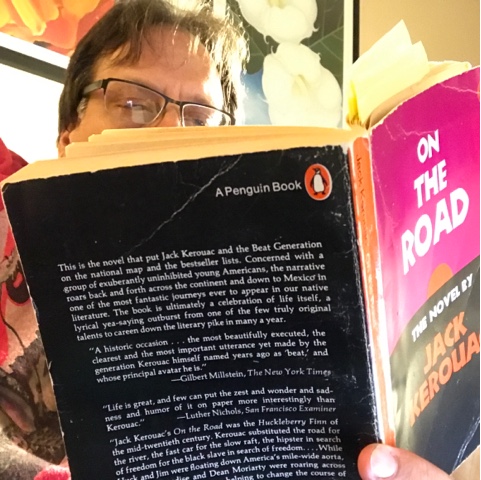
Kerouac remained a touchstone, of sorts, but started to recede, to seem less a part of my own writing history as my own work grew more complicated, as I attempted to integrate my journalism into my poetry and I began to fully consider the personal essay as something worth pursuing. (I had been afraid of the format, or perhaps the honesty it requires to do it well.)

So, a reread of Kerouac was not necessarily on my radar. I had an extensive summer book list that included philosophy, poetry and Samuel Becket, and I was working on a long poem on race and America, writing a play, and reporting an immigration story. The last thing I needed was another project.

But Kerouac is always in the air, which is important. He’s not just a personal touchstone, but a cultural one, and On the Road is in many ways the book that signaled much of what was to come in the 1960s and beyond.

Roger Ebert sums up the book’s allure in a 2013 review of the film adaptation. He and his friends “talked idly of pointing them west and not stopping until we reached the Pacific..”

As a teenager, I snatched up the book in its first paperback edition and chose it above any other to display on my desk at the News-Gazette, sometimes underlining trenchant passages. Still in high school, I slipped away to the Turk’s Head, a campus coffee shop, which played Miles Davis and Monk, and Beats were rumored by the townspeople to stand on the tables and recite their poetry, although table-standing seems to run counter to the Beat ethos.

Vin Scelsa, the legendary New York disc jockey (and a personal hero), name drops Kerouac in a 2015 podcast interview with his daughter, describing his movement away from his Roman Catholicism, and his decision not to attend NYU — because, as his daughter Kate says, Scelsa was a rebel.

“It was my Jack Kerouac phase,” Scelsa says. “I was going to go out west and be a fire watcher on a mountain and get in touch with my Desolation Angels, and that whole thing. I was into the whole Beat world, Allen Ginsberg and all that.”

He didn’t. Instead, he found himself at the Upsala College radio station WFMU, where his rebellious streak and innate creativity found it’s outlet in free-form musical programming. I discovered Scelsa probably in 1978 or 1979 when he ruled the late night airwaves and spun records no one else on commercial radio dared play. The timing was propitious — I was growing tired of the commercial stuffed began listening to more punk and early New Wave, and Scelsa’s imprimatur was important. He showed that this new music was important and that it was part of a much larger mosaic of sound that could include both the popular and the underground.

So, I was prepared for what Kerouac had to offer, not realizing how much Kerouac actually paved the way for someone like Scelsa — or how much Kerouac had and would continue to seep into the larger culture.

The 10,000 Maniacs capture this on their 1987 album In My Tribe, with the song “Hey, Jack Kerouac”: Kerouac, Ginsberg and William Burroughs, the song posits, allowed the “Hip flask slinging madmen, steaming cafe flirts,” and “Cool junk booting madmen, street minded girls,” to speak through them. Or to believe this lonely alcoholic writer lost in a changing America spoke for them.

This is why his influence extends beyond literature and into the broader culture. As Kerouac describes in Big Sur — his novelized take on the aftermath of On the Road‘s success — he couldn’t go anywhere without some 20-something wanting to join the party that had happened 10 years earlier. Big Sur is a difficult book, especially for readers still caught up in the romance of On the Road. It describes Kerouac’s descent into alcoholism and his growing alienation from the new youth culture, an alienation that ultimately would push the so called “King of the Beats” in a few years to outright disgust with the hippies.

But Big Sur describes the cultural moment and his influence on it surprisingly well. His book offered this new generation born during and after World War II liberation. And they took it and ran with it.

Which is why Ebert. says the novel “grew not into a movement but into a brand,” one pushed hard by the new advertising industry, and that ultimately turned the novel into something it wasn’t — a buddy-road story and unapologetic exploration of hedonism.

The novel was always more and less than that, but disentangling its core from the myth has long been shunted aside by its fans, who focus on the freedom and not on the book’s darker elements.

This has made the book far more influential than it might have been, given what William Plummer calls its lack of “literary style in the sense that Hemingway, say, or Faulkner did: a controlled and nuanced voice.” This, Plummer says in a 1979 essay in The New York Times, is why Kerouac’s literary progeny are more likely to be found among adherents of the “New Journalism” — writers engaged in deeply reported, long-form forays in which the journalist became a central character.

The pop and fizz of Tom Wolfe’s prose are surely Wolfe’s own, but his and George Plimpton’s buddying-up with outsize characters like Ken Kesey and Alex Karas owes much to Kerouac’s worshipful relation to Cassady. Then, too, Hunter Thompson’s doped-up madcap forays across the continent are almost unthinkable without his Beat predecessor’s model.

His influence extended to poetry, as well, he writes, though the influence filters through Ginsberg, Corso and Ferlinghetti. His then asks an important question: “who reads Kerouac these days?”

Easy: the same kind of kids, mostly young males, who have been reading him since the fanfare died down in the early 60’s. Bob Dylan read him, and so did future novelists Thomas McGuane and Ken Kesey; all three were extremely impressed. Actor Nick Nolte read On the Road while still in high school in Omaha. His statement in a recent interview is eloquent testimony to Kerouac’s effect on American adolescents: “I remember thinking, ‘You mean you can just do that? Pick up and go?’ It seemed incredible to me.” (Plummer)

Nolte played Neal Cassidy in Heartbeat opposite the late John Heard, as Kerouac. Others as various as S.E. Hinton, Sam Shepherd, Patti Smith, Robert Hunter, Donal Logue, and Amber Tamblyn — all interviewed in One Fast Move or I’m Gone, the documentary on the writing of Big Sur — cite his influence. Tamblyn’s presence in the film, which caught critics by surprise, is evidence of the film’s lasting reach. Tamblyn was 25 when the documentary was released in 2008, but talks about her connection to Kerouac like he was an old friend, romanticize grandson the Beats like so many have before.

This isn’t a criticism. It is nearly impossible to read the book for the first time today without succumbing to the same mythology that has made the book the cultural touchstone it has been, and that drew me in 36 years ago. The struggle, for both the new reader and the long-time admirer, is to disentangle what we’ve come to think about the novel from what really takes place.

On the Road, if it is anything, is an elegy for Dean and for an America on the cusp of change written by a writer in thrall to the apocryphal stories created in dime-store novels and cowboy films, in the culture of the day. Dean’s unraveling in the book’s final act — symbolized by the enormous bandage on his thumb, by his increasingly incoherent proclamations — too often is left out of our conversations about the book. Nolte’s comment — “You mean you can just do that? Pick up and go?” — still represents the consensus of assumptions about the book. Sal’s disconnection, his alienation from his moment in time as his friend, who he builds up as a true American archetype, falls into madness is the book’s true thesis.

I don’t think I got that when I was younger, not for a while, at least. But at nearly 55, I do. This, I think, says as much about me as it does about the book, about how my perspective has changed as I’ve grown older. I see things now I didn’t or couldn’t earlier on — such as the dismissiveness the book has toward women, its casual homophobia, its disturbing condescension on race.

All of this was there the first time I read it; I was just incapable of seeing it.

“There are nights when I think that Sal Paradise was right / Boys and girls in America / They have such a sad time together,” sings Craig Finn of The Hold Steady, as he makes his case that the kicks have consequences. “Stuck Between Stations,” the opening cut of Boys and Girls in America, is anthemic and bold, but sad and painful — like the album it leads off and the novel from which it borrows its opening line.

What we have is never enough, Finn sings, so we chase what we don’t have and do not need, thinking it will make us whole. In the end, it can’t, and we are left to struggle and pick up the pieces.

My point is that everyone remembers the party, but no one remembers the clean-up. We remember the excitement, the kicks — the breathless adventures, the drinks, the music. But parties end. People go home, or crawl up in a ball in the corner and sleep. What follows are he recriminations — smoking the butts of cigarettes, drinking stale beer from plastic cups. And the clean-up. No one remembers the clean-up.

On the Road is both party and clean-up. We remember Sal and Dean rushing west and east and west in a crazy buddy movie; we remember the jazz clubs and blow-outs, the Benzedrine-fueled gabfests that took all night. We romanticize these elements, but rarely consider the book for what it is — a romance in the sense of the Romantic-era, of Byron, Shelley and Keats. The English romantics of this second generation were tragic figures, rebels against the contemporary order who created mournful elegies that looked both forward and backward.

On the Road is in that tradition, and is one of the saddest books to be published in America.

Send me an e-mail.

Another war president

addressed the nation on Monday from Fort Myer military base in Arlington, Va.
― Full Transcript and Video: Trump’s Speech on Afghanistan – The New York Times

President Donald Trump anounced his new old strategy for Afghanistan last night, in a speech before active solddiers that lacked specifics but was full of the kind of bromides he has offered in the past when forced to offer a scripted speech.

The speech essentially offered a Fox News approach to military engagement — take off the gloves, let the military do what they want — but had some on the populist right a bit miffed.

Breitbart, for instance, which has been Trump’s biggest media backer, was critical, calling Trump’s plan a “flip-flop.”

There are questions coming from some Marines:

To some of the Marines, though, optimism, no matter how cautious, rings hollow after nearly 16 years of war and new approaches that sound a lot like the old ones.

“You know, it’s like everyone forgot,” said one Marine, who spoke on the condition of anonymity to discuss the issue frankly. “Like someone hit the reset button and now we’re out here again saying, ‘We can do this, we can win this thing.’”

The speech was in many ways a typical presidential address on military matters, which should explode the notion that some on the left had that Trump was set to change course militarily. He was never a peace candidate, never someone who would keep up out of military adventures. In fact, as his rhetoric on North Korea shows, he may be more reckless than even George W. Bush because he lacks the background to stand up to the generals with which he’s surrounded himself.

I’ve annotated the speech (see above).

Send me an e-mail.

Cafe envy

#CafeEnvy // Every corner a strip mall. Every strip mall a pizza place. Dry cleaners. Chinese food. Maybe bagels. I long for a cafe, a coffeehouse, a place with soft chairs and low tables, where I can sit with a black coffee and write. A place with small tables outside overlooking the street. A place where artists hang their work. // Princeton has Small World and its strong biting coffee, best in the region by far. But I don’t want to drive the 7 miles into town and park; Thomas Sweet, the famed ice cream place, has a coffee house in Montgomery. I sat there this morning, having stopped on the way back from the doctor. Coffee. Turkey sausage, egg and cheese on a croissant. I wrote in my small black notebook, a poem about Glen Campbell, my mom, and Alzheimer’s. The coffee was good, not as strong as I usually like, and the sandwich was large and flavorful, but expensive. There are better cafes and worse, and yet I find myself envious of the patrons who came and went. // We have a diner, and another coming, and a great family restaurant. But no coffee house. No cafe, nothing like the small bistro in Paris Hemingway would frequent, where he’d sit and draft out stories long hand in a small notebook. Or that’s what I remember from A Moveable Feast. He drank rum while he wrote, I just want a place with coffee and wifi, soft chairs and breakfast. Someplace to sit and work. #instagramessay @newspoet41
A post shared by Hank Kalet (@kaletwrites) on

Send me an e-mail.

I thought I was a beat, but I was just a boy, part 12

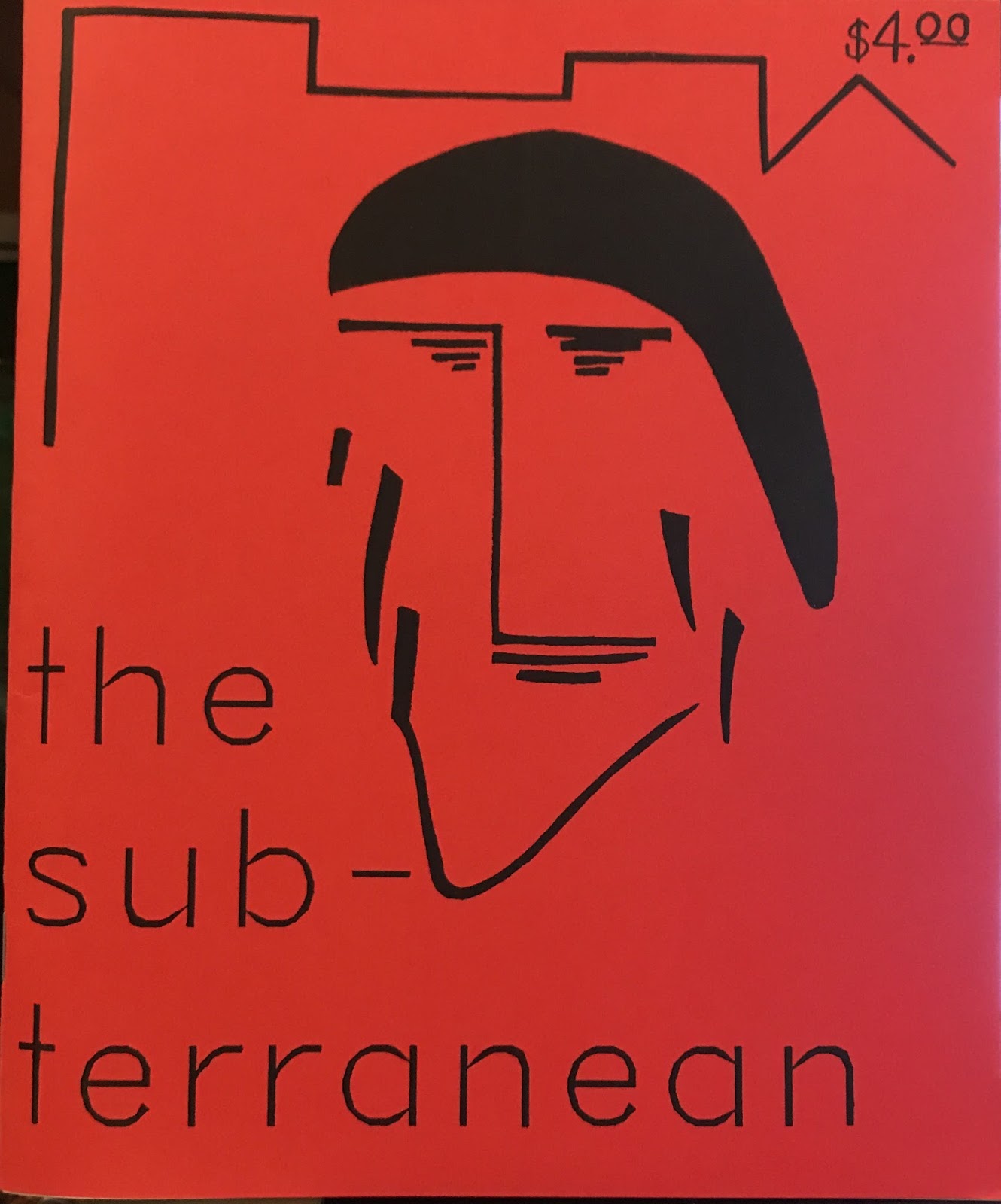
The cover of my first attempt at a literary zine, named for the Kerouac novel.
I thought I was a beat, but I was just a boy 

Notes on Re-Reading Kerouac in my 50sPart  12

When I was 19, On the Road was a revelation. Like so many boys my age, I was looking for a different kind of validation than the one I’d received from families and teachers, a way to escape the expectations and, at least figuratively, find a new road.

On the Road provided me a figurative  road map, a permission slip, a glimpse into a committed sense of rebellion. Sal and company may have had difficulty committing to relationships, but they were committed to chasing pleasure, to seeking knowledge, to living beyond the confines of what was becoming a staid and stultifying post-war landscape.

As the events of the novel unfold, the nation is emerging from the massive military build-up of World War II. The Depression was still present in the minds of Americans, with enough people remaining left out of FDR’s New Deal and the war’s injection of Keynesian spending into the economy. The nation was on the cusp of change.

On the Road offers evidence of an America slowly receding — hobos riding the rails, a vast migrant economy that was best portrayed in the 1930s by John Steinbeck, still extant farm areas incorporated into medium and large-sized cities. The America of On the Road was already in the rear view mirror when the book was published in 1957. The GI Bill was giving the white working class a way out of the factories. Suburbanization led to white flight from the cities, even as the Great Migration was bringing more blacks to northern cities. The economy was becoming nationalized — not in a Soviet manner, but through the growth of national retail chains and large corporations, which created a need for a new class or at least a larger class of middle managers.

I admit that my short overview of the era is, in many ways, a caricature of the time. I’m distilling a historical period to its broad outlines. But these broad outlines are important, because they define the context into which the novel was born, helping to define for us what On the Road meant to younger readers when it came out. On the Road was both a harbinger of a new cultural order and an effort to preserve something of America’s mythic past.

Sal’s rebellion borrows from an American mythology, and On the Road shares DNA with other classics — Hemingway’s The Sun Also Rises and several of his short stories, Fitzgerald, Twain’s The Adventures of Huckleberry Finn, Thoreau’s Walden: A Life in the Woods, Dreiser — in its central themes and reliance on several key American myths: that America is an unending continent; that we all can remake ourselves, can discard our identities; that we can make new starts by taking to the road; and that, by going back to the soil or he wilderness, we can find something more authentic.

All of these are present in On the Road in different ways and make the book very much a link in the chain of American literature and part of the vast conversation writers have with the past and future.

And it shares DNA with J.D. Salinger’s Catcher in the Rye, as well, which was written at the same time as Kerouac was first working on On the Road but published six years before Kerouac’s novel made its debut. Both are direct attacks on the mainstream. Catcher in the Rye‘s Holden Caulfield is younger and decidedly upperclass, but his rebellion is aimed at the same basic targets: an establishment that he views as enforcing a conformity that is suffocating. Holden runs away after failing out of boarding school, his refusal to go home serving as a statement of purpose and a rebellion without a clear argument; Sal takes to the road, running deeper into a mythic America, chasing authenticity at a time when advertising was rising to art form and the company man (or the man in the grey flannel suit) was the standard.

Kerouac’s writing stood against it — and, in many ways, still does. That it became the model from which both the early hipster and the hippie would grow is not his fault, or not completely. He hated that his readers often missed the sadness in the book, and the painful, grinding reluctance that marks his Big Sur — a book that chronicles his reaction to fame, his efforts to find some piece, and his total descent into alcoholic madness.

Kerouac’s late years are marked by contradictions and a debilitating descent into drink. His underlying political conservatism had always been there. Burroughs describes him in Jack’s Book, the Gifford/Lee biography, as an “Eisenhower man” who “believed in the old-fashioned virtues, in America, and that Europeans were decadent, and he was violently opposed to communism and any sort of leftist ideologies” (Gifford 303). And he railed against the new anti war protesters, not because supported the violence in Vietnam, but because they were not showing sufficient respect for the country he loved.

But Kerouac’s On the Road — along with The Dharma Bums and The Subterraneans — also served as a template for this new generation. These were Kerouac’s kids, in a literary sense, taking to the road, seeking kicks, doing what they could to slip the grip of ’50s conformity and to dull the knowledge that we were living under the existential threat on nuclear annihilation.

The context, again, is significant. Norman Mailer, in his essay “The White Negro,” attributes the hipster urge typified by the Beats to a sense of doom, a fear of impending atomic calamity. He likens it to the fatalism of an African American population that lived everyday under existential threat, i.e., the purposeful and arbitrary violence of the Jim Crow South and equally racist North. Both the hipster — whom he dubs the “white negro” — and the African American seek pleasure as a way of fending off the doom. The difference, he says, is that African Americans were also responding to fatalism with political engagement; the hipster was not.

It’s a simplistic analysis that idealizes black Americans as a type, but it does offer an explanation as to what might be underlying this revolt, one that ties into the philosophical debates of pre-war and post-war Europe. Existential dread does appear to trigger some of the hedonism of the Beats — Ginsberg’s poems “Howl,” “America” and “A Supermarket in California” are thick with it, as is the work of Gregory Corso and the madness of Burroughs’ novels.

The baby-boom generation grows up in the shadow of the bomb — I can remember air-raid drills at my New York elementary school in the late-1960s — and with a sense of unending prosperity that creates a new sense of boredom. Dean is key to this analysis, I think. He is about 20 when On the Road begins. Sal was about five years older. They are, in so many ways, still kids, as is the rest of their crowd. Theirs is partly a youthful, hedonistic rebellion that grows from the natural need of the not-quite-adult to make his own way, while also fighting a sense of ennui that hangs over this first generations of teens to not be forced into the workforce.

Rebel Without a Cause — along with a number of scare films about juvenile delinquency, a genre that has had a long history — offers a glimpse into this: knife fights and games of chicken, a sense of teen invincibility crossed with a sort of desperation for belonging and control. It’s not just the James Dean character, Jim Stark, but the entire youth subculture in the film that seems to be struggling for some kind of purpose, for an existence of its own.

Sal Paradise faces the same struggle, fighting a deep ennui as On the Road opens. Sal has just gone through a break up and a “serious illness that I won’t bother to talk about, except that it had something to do with the miserably weary split-up and my feeling that everything was dead” (3). It’s an often overlooked element of the novel, which too often is portrayed solely as a precursor to the buddy-film genre, or as a joyful expression of new identity. The book, while tilting at expansiveness, is really about limits — the limits that exist in relationships, the limits of a continent, the inability, ultimately to escape one’s self. 

And yet, rebellion and motion are the underlying motifs, the foundation on which failures of its characters lie and from which its language draws its energy. When I first read the book, what drew me in was the language — which has an odd sense of swing and can have the feeling that it is rushing forward, while slowing to a crawl as Sal becomes contemplative.

“In no time at all,” he writes as Dean guns a massive Cadillac limousine toward Chicago and the book’s decisive events,
we were back on the main highway and that night I saw the entire state of Nebraska unroll before my eyes. A hundred and ten miles an hour straight through, an arrow Road, sleeping towns, no traffic, and the Union Pacific streamlined falling behind us in the moonlight. I wasn’t frightened at all that night; it was perfectly legitimate to go 110 and talk and have all the Nebraska towns — Ogallala, Gothenburg, Kearney, Grand Island, Columbus — unreal with dreamlike rapidity as we roared ahead and talked. (228)
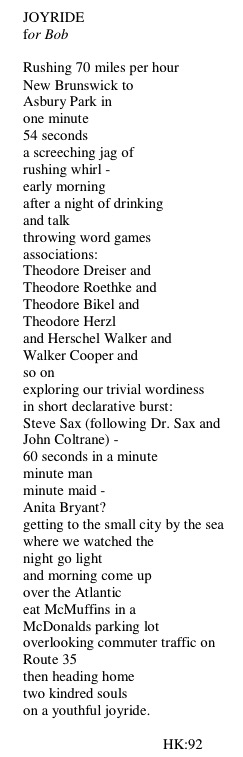
The speed, the way the towns exist in name only, as highway signs, the night, the talking — this is the romance of the novel, it’s magnetic allure. I remember drinking tequila and smoking dope one night with my pal Bob in the house we rented. It was a night of big conversation, as every night was. We were 20, unformed, gazing ahead, and sometime deep in the night we decided to head to Asbury Park, racing east on the highway, doing 70, 80, arriving in the decaying Shore town made famous by my idol, Bruce Springsteen, hitting a McDonald’s for breakfast, realizing we had no cash, fleeing without our food, and racing home in the same burst of energy and youthful exuberance that had us up all night in the first place. This is what 20-year-olds do — or did, or maybe it was just us. We lived that way, alternating between the frenzy, partying at night, and the doldrums (to borrow a word from Ginsberg), working boring day jobs and doing the things you need to do to survive. And we read and wrote and played our music loudly, and “tried to walk like the heroes we thought we had to be” (Springsteen, “Backstreets”).