
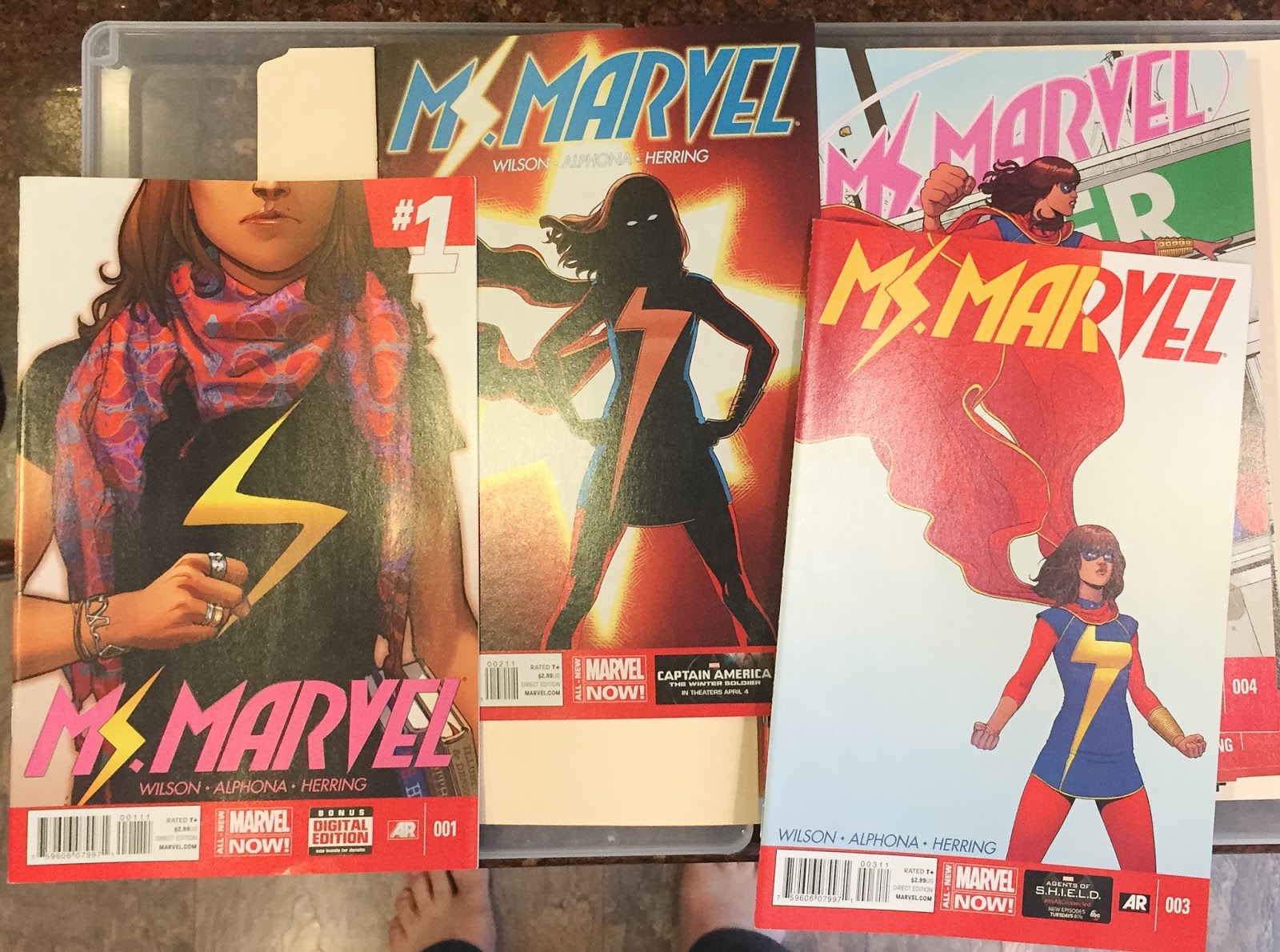
A marvel on many levels

The new Ms. Marvel, from Marvel Comics.

I’m reading the reboot of Ms. Marvel, Marvel Comics’ modernization of one of its older titles that started running last year and that is now in book form. I’m relatively new to comics — I read them as a kid, but moved away from them, retaining an affinity for superhero movies and graphic work, but not staying current. I started teaching a unit on Comics and Superheroes in one of my composition classes a couple of years ago, however, and that has led me back to the comics.

I’m only a few issues in, but the reboot has quite a lot to offer — a surprisingly complex and nuanced take on teen angst, Islamaphobia and racism, and the difficulties that both teens and immigrants (and immigrant teens more specifically) have fitting into majority culture. Kamala Khan, a Pakistani-American Muslim teen in Jersey City, is disconnected from her white classmates, feels constricted by her religiously conservative parents, is uncomfortable in her skin, so to speak. She idolizes the former Ms. Marvel, the blond and powerful Carol Danvers, who she sees as a more genuine American, one she wants to be more like. She is engulfed in a strange mist and she transforms, becomes the new Ms. Marvel, a shape-shifting teen who has to come to grips with her ability to be pretty much anything.
It is a storyline that contains echoes of everything from The Catcher in the Rye to other coming-of-age tales, to things like Anton Shammas’ novel Arabesques, which explores the sometimes wide canyons that exist within the immigrant mind between their competing cultures, the one they have left behind and the one into which they are trying to assimilate.

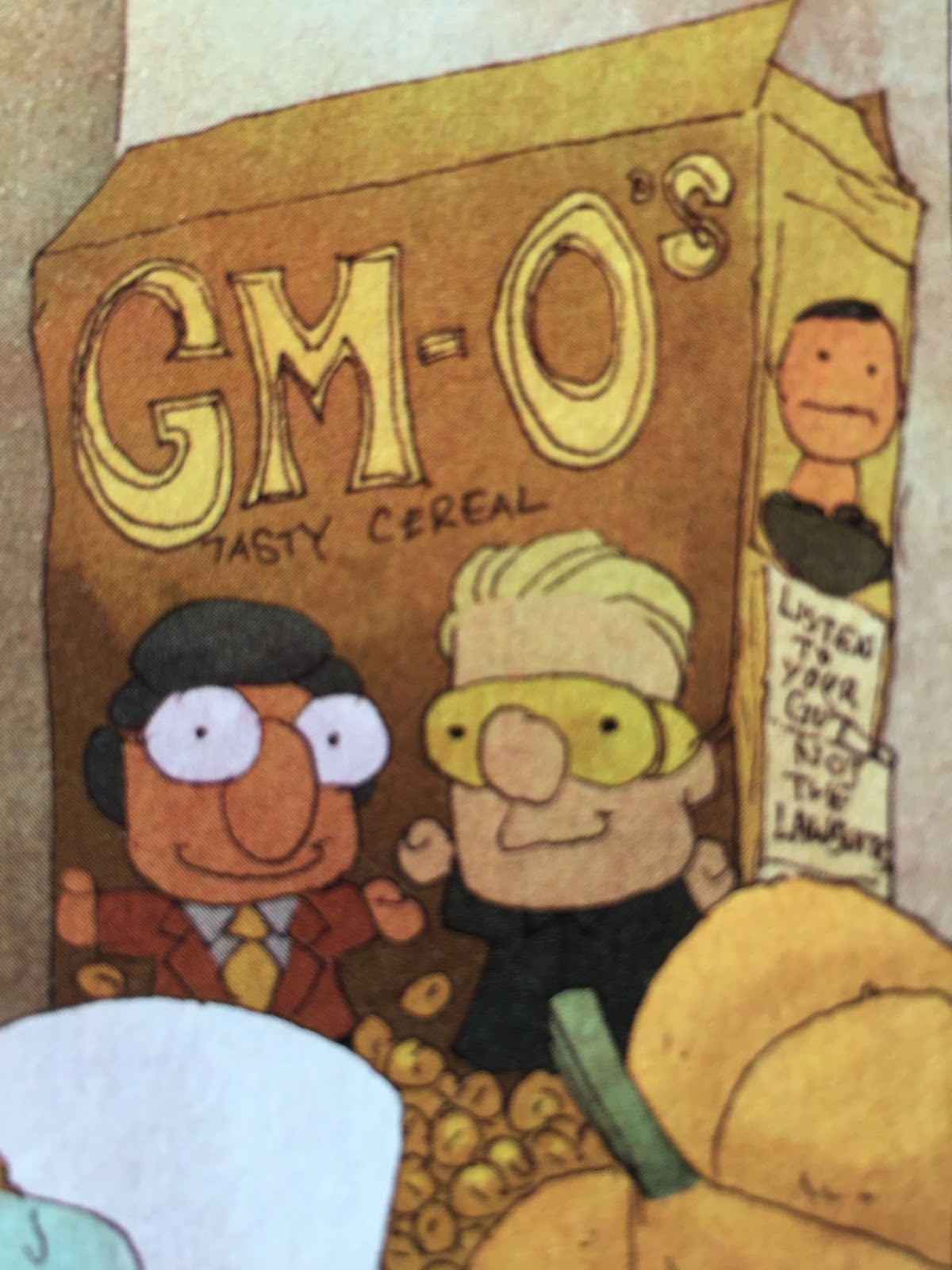
The comic’s vision, however, goes beyond this — using its art to make subtle critiques at the margins. Consider this (to the left) subtle jab at corporate capitalism, in the form of product packaging.

This is a portion of a panel early in the third issue (Kamala Khan, the new Ms. Marvel, is eating breakfast the morning after she saves a classmate from drowning. It is not just the cereal’s name — a play on both Cheerios and the GMO debate, but also the disclaimer on the side of the box: “Listen to your gut, not the lawsuits.”

There are other examples of this kind of lampooning throughout, which connects the new series to a cheekier and more subversive strain in American comics and animation — think the original RoboCop film, the first couple of seasons of The Simpsons or Matt Groening’s work, more generally, or the biting Hark, a Vagrant strip, or the work of so many others.

This is no small matter, given that Ms. Marvel is part of the larger and incredibly lucrative Marvel Universe, which is part of the larger entertainment-industrial complex. Vertical integration has become the key monetary driver of profit for most media entities. In this case, you have Marvel, owned by Disney, pushing books AND films and TV shows and animated series and collectibles and other product tie ins, including Marvel-marketed cereals. So, satirizing the cereal industry is an interesting artistic choice that would seem to offer a small glimpse into the mind of the creative team working on the new books — G. Willow Wilson, Adrian Alphona and Ian Herring.

Irony, of course, has become a tool of the advertising and marketing industries, so any praise for this kind of subtle subversion must be tempered by the knowledge that it has the stamp of the larger corporate system that structures modern life. Still, these kinds of (assumed) trivialities, these minutiae, are telling and lend character to a work of art. And make no mistake, taken in its totality — which is how we have to judge any comic or graphic novel — Ms. Marvel qualifies as art.

Send me an e-mail.
Little guys and the big win

Love this differentiation between the Mets and Yankees, from Bob Brody in Newsday:

In my heart of hearts, here’s what I suspect explains my change of attitude. I’ve now lived long enough to understand, to appreciate, that most of us are inherently more Met than Yankee. Yes, we may win a championship now and then. But more likely we’re underdogs, ever lagging, our lives more struggle than success.

And that may compel us to prefer humility over arrogance. That’s why most of us would probably rather bet on David than Goliath. We hunger for the impossible to become the probable.

I don’t know that this covers my longtime love of the Mets — I lived in Rockaway Beach in Queens when I discovered baseball, the year before they shocked the Orioles and the world. But it does explain my disdain for the corporate, big-money Yankees and their (mostly) spoiled fans.

To that point, this piece in The New York Times is worth reading.

Send me an e-mail.

IDs for the hidden

Here is a press release I received this morning (I edited out the contact info):

Roselle to Pass Municipal ID Program at City Council Hearing Tonight
Roselle Will be the Second Municipality in New Jersey to Implement  Critical Immigrant Inclusion Program

What:  In an ongoing effort to address the needs of the Borough’s immigrant community, Roselle Mayor Christine Dansereau and Borough Council will take a final vote on a program that would produce and issue municipal identification cards for all Roselle residents, and particularly for the Borough’s fast-growing immigrant community.
When: Wednesday October 21st at 7pm

Where: Roselle Borough Hall, 210 Chestnut Street, Roselle, NJ.

Who: Make the Road New Jersey members, including dozens of immigrant residents of Roselle, New Jersey Alliance for Immigrant Justice, the Roselle Office of Hispanic-Latino Affairs and other community and faith groups.

Visuals: Community residents, elected officials, small business owners, and clergy, with large signs. Immigrant comunity members available for interview.

It isn’t clear that Roselle will be the second — Asbury Park, Newark and Plainfield had either created or considered creating ID card programs and Mercer County has had a functioning system that has helped the undocumented primarily in Trenton, Hightstown and Princeton — but Roselle’s efforts mean that the program is growing.

I’ve written about this before — see my report on the Mercer County cards in NJ Spotlight — though I haven’t weighed in on where I stand. Given my reporting, which has put me in contact with dozens of undocumented Latinos mostly in Trenton, these ID programs allow the undocumented to come out of the shadows.

That’s precisely what Carmen Barbosa told me in 2013 (all of the pull quotes are from my NJ Spotlight story):

Carmen Barbosa says she has felt invisible since coming to the United States about eight years ago.

Speaking through an interpreter, the diminutive Costa Rican immigrant explained that she lacked identification, which has made it difficult to interact with the larger community.

“Everywhere you go you need an ID,” she said on a recent Saturday afternoon in the offices of the Latin American Legal Defense and Education Fund in Trenton. “I get rejected a lot, even at the hospital. I went in for an emergency and I didn’t have an ID to show.”

Critics of the ID program are concerned that IDs will make it too easy on the undocumented, which in turn will lead to more immigrants who are hear illegally coming to the state. I don’t see that happening, though I don’t know that we have strong evidence either way.

What concerns me more is that, by pushing the undocumented into the shadows, we are endangering those immigrants and the communities in which they live. Maria Juega of LALDEF told me that the undocumented “experience significant barriers to accessing necessary services, like healthcare and food security, because they lack a way to identify themselves or show themselves as a member of the community.”

The cards, she says, help residents of the communities in which they are distributed by providing them with identification that is accepted by most police departments, healthcare facilities, and banks and businesses. But the need for the cards points out flaws in both federal and state law. Only two states allow undocumented residents to get driver’s licenses, she said, and most states do not offer access to identification to the undocumented population.

ID cards like this, Juega said,

send a message to the undocumented community that the police are willing to work with them and that they can come forward when they are victims or witnesses of crime without fearing that their status will become an issue.

It’s an argument that at least some in the law enforcement community can get behind.

Pedro Medina, a Mercer County undersheriff, was the public information officer for the Trenton Police Department in 2009. He says the program made sense on a lot of levels.

“For [the Trenton police], it was good because it builds trust and confidence within the immigrant population,” said Medina, who wanted to make it clear he was only speaking as a retired police officer

“A victim is a victim,” he said. “We would try to tell them that, but there was a lot of mistrust . . .
He said that, at least at the beginning, there was a change in the immigrant community.

“Sometimes perception is greater than reality. We always wanted to work with them, but the ID showed that . . . we wanted them to report crimes and that we were there for all citizens of Trenton.”

The IDs are not a perfect solution. They are only good in a small number of jurisdictions and they are dependent on the largesse of local politicians and police. A better solution — one that recognizes that there are about 11 million undocumented immigrants in the country, about a half million or so in New Jersey, who are not going anywhere, who cannot be deported en masse as some might want — would be to issue driver’s licenses or driving privilege cards to anyone who can prove residence.

In the meantime, Roselle’s decision should be applauded and other communities should get on board.

 Send me an e-mail.

Back to the blog

OK. It’s been a while. I am going to try to be more consistent posting here.

A quick update:

  • Classes have started for me at Rutgers and Middlesex, so grading is crowding is taking up much of my time. Check out our hyperlocal site, the Raritan River Review.
  • The Mets are a win away from the World Series — more on that in a later post — and the Knicks are about to start what is likely to be a season of losing (though less frequent losing than last year).
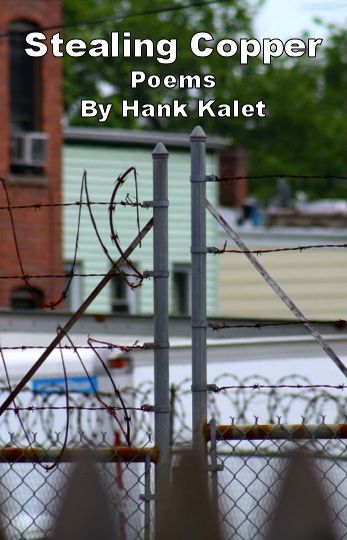
  • My book, Stealing Copper, has shipped — send reviews my way. I have another book coming — my book on homelessness and Tent City in Lakewood — and some other creative projects on my plate.
  • And we are closing in on the meaningful portion of the 2016 presidential race — i.e., the actual caucuses and primaries.

 Anyway, more posting to come. I promise.

Send me an e-mail.

Poetry News: The latest on books and readings

Upcoming Readings & other poetry news:

HK Stealing Copper cover photo 1ANew Books:

Stealing Copper, my new chapbook from Finishing Line Press is in galleys and should hit the printer soon. Publication and shipping date still to be determined. Email me at hankkalet@gmail.com to purchase, $14.49 plus shipping payable through Paypal, or order from Finishing Line Press.

As an Alien in a Land of Promise, my book-length poem on the now-defunct homeless camp in Lakewood, which will feature photos from Sherry Rubel, is in production and will be published by Piscataway House Press.

A chapbook, From the Latin, also will be published by Piscataway House Press.

 
Upcoming Readings:

Saturday, Sept. 26: Marc’s Place Coffee House, Reformed Church of Highland Park, 19 S. 2nd Ave., Highland Park; 7:30-10 p.m. Sponsored by Central Jersey Coalition Against Endless War. The event will feature the discussion “What the Frack? Capitalism, Empire, Climate Change, and the Pope,” speakers, Toby Jones, associate professor at Rutgers, and Kelly Moltzen, climate and food justice.

Tuesday, Dec. 8, Somerset Poetry Series, Somerset County Library, 1 Vogt Drive, Bridgewater; 7-9 p.m.

Send me an e-mail.