Bad Dylan — in ‘Triplicate’

The best way to describe Bob Dylan‘s latest release, Triplicate, is with one word: unlistenable.

This maybe surprising coming from me, a devote fan on the rock bard, but Triplicate is everything a good Dylan album isn’t. It’s musically trite and pedestrian. It has neither energy nor pathos and, if you stripped away Dylan’s broken voice, which sadly is not up to these songs as they’ve been arranged, it is of a piece with Rod Stewart’s absolutely soulless American songbook project.

It didn’t have to be this way. Triplicate is Dylan’s third “Sinatra” album, and easily the weakest. The first, Shadows in the Night, was a surprise — the news that Dylan would be releasing a collection of songs associated with the Chairman of the Board sounded like a joke or something artists release when they are looking to close out a contract. But it turned out to be a flawed but strong record, as Dylan opted for spare arrangements that allowed his fragile rasp to sound weary and lived-in, granting the record an unexpected delicateness.

The second, Fallen Angels, was probably unnecessary, but it maintained the basic charms of Shadows in the Night. Triplicate is both unnecessary and without charm. It is three records of Dylan growling his way through the American songbook over well-played but pedestrian, even cute arrangements — with little emotion and no sense of irony. The only reasons for an artist like Dylan, who has such a keen understanding and connection to American musical history and has written some of the most important songs in rock and folk history to dip his toe into the pop canon is to remake it emotionally or to show off one’s voice. See Cyndi Lauper, who manages to do both. Dylan’s vocals, as I said, feel perfunctory, and it has been a long time (if ever) since anyone thought the bard could sing.

Readers might notice that I’ve not mentioned any of the album’s individual songs. The reason? The album is of a piece, a long slog of a listen, with nothing in particular standing out. This is just a bad record. Take my word for it and stay away.Send me an e-mail.

Like a black person — racism in the languge

Yes, we hang our clothes in the backyard — what does that say about us?

We ran into a neighbor last night who complained about a broken clothes drier. I won’t get into the full complaint, which involved other members of his family. What struck me was how he framed his complaint. The drier was broken and, while they fought among themselves about a new one, his family had to “hang clothes from the back of the house like a black person.”

I was dumbfounded. I should have responded, called him out on it. I didn’t — out of shock, cowardice, a need to maintain neighborly relations, take your pick. He didn’t necessarily mean anything by the comment, but the comment carried a lot of weight and is part of a larger cultural narrative that whites have relied on since before slavery to elevate whites and justify the denigration and oppression of brown-skinned people.

I doubt my neighbor considered this narrative when he spoke, thought about the history of race in America or about the ways in which language structures our reality, defines, it, creates the basic rules by which we interact. I doubt there was any specific animus, either. But it’s important that we unpack the layers of meanings in play here so that we can understand how casual racism underpins the broader way in which race organizes our society.

Several things are in play here. First, let’s consider the specific remark. He was “hanging clothes from the back of the house like a black person.” Not a poor person, but a black person — the stereotype of the poor black family from down South, perhaps, or the image of clotheslines spanning poorer urban (read black) neighborhoods. And, remember, this was a complaint built on the assumption that he and his family were above hanging their clothes out in the yard. Put another way, black people hang their clothes outside; we (I.e., white, perhaps middle class) do not. The absurdity of this should be apparent — I write this after hanging wash on the line in my yard. And so should the racism, which is built on false class and racial divisions that my neighbor apparently buys into.

A second layer exists, which implicates my own feeble and impotent response. My wife and I are white. My neighbor is white. This shared identity — or lack of racial identity — is important to understanding his comment and allows us to delve deeper into the assumptions he made and the way race may affect his larger thinking. I don’t know him that well — this was probably only the second time I’d talked with him — so I can’t say what he holds in his heart. But I doubt he would have made the same off-hand comment were he talking to an African American. Assuming I’m right — I can’t be sure because my only point of reference for his behavior was this brief conversation — we have to ask why. My assumption — and I can only assume — is that he knows on some level that his comment would be viewed by blacks as racist. Again, I don’t know for sure that he wouldn’t make the same comment to an African American, but he certainly had no trouble making it to my wife and me.

I should have said something but, for whatever reason, I didn’t. I didn’t need to. I was not the target of this casual racism. I could avoid the subject, comment on it later, and move on. Were the comment to have been about Jews, I doubt I would have stayed silent, so I can assume that, were I black, I would have responded differently than I did.

Whites and blacks have a different relationship to racist language. For many whites, casual racism is a part of their DNA, as is the assumption, perhaps a subconscious one, that all whites understand and buy into these racist canards. It’s part of what makes Claudia Rankine’s Citizen: An American Lyric such a powerful statement, or,why my friend and mentor Jeffrey Renard Allen‘s essay, “Urgently Visible: Why Black Lives Matter,” is so significant. Both lay bare something the existential dread African Americans are forced to deal with in even the most mundane of situations.

For African Americans — and other minorities — this kind of language, when used by the white majority (and sometimes by other minorities), has an existential quality — it is a threat, part of the foundation of the structure of racism that manifest itself in numerous ways. I’m not talking about the use of the word “nigger,” which thankfully has been struck from use by all except the most racist of whites. (I won’t weigh in on its use among African Americans, which is complicated and tied to questions of power, authority, and reclamation that I am just not equipped to address.)

My concern here is the seemingly offhand use of racial stereotypes and language that too often is dismissed as lacking animus but which maintains an elaborate set of stereotypes that endorse and maintain the underlying systemic racism that continue to influence housing patterns, policing, education, etc.

Consider the post-election analysis, which has focused on how the Democrats have lost “working class” voters. Thomas Edsall, for instance, is usually one of the most astute observers of American economic and social trends. In a post to The New York Times website the other day, he explores the urban-rural and professional-blue collar splits — all but ignoring race as a factor. In doing so, he makes the same assumptions that too many policy analysts are making — that working class equals white, which marginalizes the black working class and consigns them to invisibility.

Basically, language matters. The working class is a vast polyglot of races and ethnic groups, but it has been deracinated in our post-election efforts to save the Democrats from themselves. “We have to help blue collar Americans,” read white workers. Helping workers as a broader constituency, uniting workers across racial, ethnic and gender lines — well, that’s not on the table, which is just fine with the people who’ve been the prime beneficiaries of our economy for decades.

Edsall — and much of the commentariat — has fallen into the standard trap. We assume white as a default. Whiteness is the norm. Whiteness equals American. It’s why the history of assimilation in the United States is, to a large extend, a history of race. At varying times in our history, the Irish, Italians, Poles, and other light-skinned others, have been excluded from whiteness. These immigrant groups were the great unwashed, with foreign, inferior customs and behaviors — that is, until there was a need on the part of the majority to assimilate and incorporate these groups. Italians are now white, which means they are not black, which in turn allows the descendants of the first major wave of Italian immigrants to view themselves as superior to darker people and later newcomers.

It also has allowed a shift in the national race conversation from a segregationist, overtly hostile explanation of racial difference as being based on genetics to one in which darker races are inferior because of cultural and economic causes. Blacks are uncouth because they are poor, because they have been degraded, because they come from Africa, the Caribbean, and so on. Ibram X. Kendi, in his recent book Stamped from the Beginning, describes those with this approach to race as “assimilationist racists,” who embrace “biological racial equality,” but “point to environment — hot climates, discrimination, culture, and poverty — as the creators of inferior Black behaviors.”

For solutions, they maintain that the ugly Black stamp can be erased — that inferior Black behaviors can be developed, given the proper environment. As such, assimilationist constantly encourage Black adoption of White cultural traits and/or physical ideals (3).

See the debates over baggy pants, tattoos, respectability politics, etc. (And yes, Kendi argues, blacks can be racial assimilationist — see the hectoring of black youth by Bill Cosby, Barack Obama and others.)

The point Kendi makes is this: There are disparities among people and many of the causes detailed by assimilationists are factors in these inequalities. But viewing an entire race as inferior — whether because of genetics or some other external reason — is racist. “Behavioral differences,” to the extent that they exist, are present among all groups. The issue, therefore, is not collective behavior or even the behavior of the oppressed minority. It is the oppression itself, which in the United States “has made Black opportunities — not Black people — inferior.”

When you truly believe that the racial groups are equal, then you also believe that racial disparities must be the result of racial discrimination (11).

What this means is that we need to address the oppression — which is endemic in our power structures and enabled by our language. And we must focus on opportunities.

10 things I love about baseball

I’m 54, and I’ve been watching baseball since I was 6. My first memories of the game are some TV images of the Mets and of going to Shea with my dad. I apparently was at Tom Seaver’s near-perfect game against the Cubs, and I can remember wanting to be Tommie Agee as a kid, and then later wanting to be Felix Millan.

But why am I a fan. Here are some things I love about the game:  

  • The Mets. You cannot be a Mets fan unless you are a committed baseball fan. The franchise’s history, as Hari Kondabolu pointed out on Edge of Sports, essentially sums up what it means to be human. It was the sad-sack of all sad-sacks, but somehow managed to win a World Series against one of the sport’s most talented teams. It descended into abject ineptitude not just once but several times, because its ownership opted to pinch pennies. It fielded one of the greatest squads to play, winning a World Series and then underachieving. Two of its greatest stars wasted their talents so greatly that they have become cautionary tales. I could go on with this. Suffice to say that being a Mets fan has caused me great joy, pain, agita, anger — which sums up what the game is about.
  • The stolen base. The steal has fallen out of fashion thanks to the obsession with metrics, but there are few things in sports as remarkable as watching the baserunner, pitcher and catcher play cat and mouse, the pitcher hoping to keep the runner close in the hopes of giving his catcher a chance in case the runner takes off. Guys like Jose Reyes and Carlos Beltran in their prime, Tim Raines and Rickey Henderson, Lou Brock, Maury Wills and so on, brought a dynamism to the game that I fear we may lose. The value of the steal when you watch someone like Noah Syndegaard pitch. Thor throws 100 mph with movement and a collection of unhittable secondary pitches that result in fewer baserunners. His weakness? Keeping runners close. So teams run, which means more runners in scoring position and a better chance to score.
  • The triple. Back when Reyes was a baseball pup, his at bats were required viewing. Not  because he might launch one into the stratosphere, but because he might poke the ball into the rightfield corner setting off a race between Reyes and the fielders. Flying down the first-base line, cutting the bag with the precision of a wide receiver, revving to a new gear as he flew into second, peaking over his shoulder to see where the ball was, and then hitting hyperdrive as he exploded into third base — few things in sports can compare.
  • Good pitching. I grew up watching Tom Seaver and then a young Dwight Gooden dominate. I loved it when Seaver and Steve Carlton would match up, when Fergie Jenkins would come to Shea, when a guy like Jack Morris would put his team on his back and pitch it to a title. One of the greatest moments in Mets lore was the game when Gooden and Fernando Valenzuela locked horns, tossing zeros inning upon inning upon inning.
  • Personal flair. Baseball can be a bit corporate at times. Following the Yankee rules — no facial hair, keep your hair trim, and so on, does little more than force the game into a comformity that is unhealthy. Who do we remember, after all? Willie Mays and his basket catch; Ken Griffey Jr. taking batting practice with his cap on backward; Mark Fidrych talking to the ball; Luis Tiant’s crazy pitching windup; Al Hrabosky, the Mad Hungarian, and his aggressive facial hair; Oscar Gamble’s 2-foot Afro; the Red Sox and their long hair; the Mets’ trio of long-haired flame-throwers. I want players who are distinctive and seem to enjoy themselves.
  • The bat flip. Imagine that it is the bottom of the ninth. Your team is down a run and there is a man on. There are two outs. A win clinches the division, or keeps you alive down the stretch, or is just a win. Adrenaline is pumping. You have two strikes on you and the pitcher delivers. You swing, connect and drive the ball into the stands. Two runs. You win. It is your stage. You are the hero. You preen a bit, strut, flip the bat — no different than some of the histrionics witnessed on the football field or basketball court following an important score. But in baseball, it is considered taboo. This is absurd. You just won the game with a dramatic home run and you react with an ostentatious display, a celebration, an expression of emotion. The game is fun. It is meaningful. You’re not a robot. Rock it. As a fan, as I said, enjoy yourself.
  • The move away from artificial turf. While it did create a couple of the more distinctive teams in baseball history — mid-’70s Royals and mid-’80s Cardinals (both managed by Whitey Herzog), it was hard on the legs and appears to have shortened many careers.
  • The pace. Baseball, to those who do not like it, is slow. But for me, it is the deliberate pace that makes it intriguing, gives it a literary feel. The game unfolds as a narrative, play by play. Each at bat is a narrative unto itself, each pitch having a purpose and setting up the next one. Each play leads to the next play. There are not a lot of moving parts. In this way, baseball is both the most team oriented and most individually oriented of the major team sports.
  • The pace (part 2). This pace also allows the game to make sense on TV, radio and the Internet in a way that the other sports do not. The speed of the action in basketball — I love basketball, by the way — and the sheer number of moving parts make describing the action without a picture unsatisfying. Same goes for football — you can watch to see the big pass, but it helps to understand what the offensive and defensive lines are up to and so on.
  • Statistics. I don’t mean the new metrics, which have some usefulness even if I am not a fan (see below). I love old-school stats. I essentially taught myself math and improved and perfected my math skills by being a bit of a stat geek. And I love that, for the most part, the stats are the same across eras. A strike out remains a strike out, even if it might occur in different situations. (The save, a stat category that appears to have undergone some revision over the years, is one of the exceptions.)

And, here are some of the things I dislike about the modern game:

  • Sabremetrics and the influence the new stats have on the game. There are things that can be quantified, but not every action on the field can be. Consider the strike out — it is just an out, many in the metrics community say. But that’s not exactly true. If you put the ball in play, you always have a shot — an error can put you on first, the fielder might opt to let a running move up a base, and so on. When you strike out, you just strike out. My other criticism of the stats-obsessed nature of today’s game is that stats can be as biased as anything else. The numbers are the numbers, true. But the numbers we prioritize, the calculations we opt to make, the analysis of the numbers, all of this is done by humans with their own biases. Every stat involves someone making a choice — WAR assumes we can define an average replacement. Range-factor assumes we can define normal fielding range. Fielding independent pitching — well, that’s just an absurdity. Every pitcher makes use of the men behind him and the ball park in which he is pitching. If you have a stacked fielding team, you can pitch to contact. If not, your approach will change.
  • The lack of complete games. I’m old-school on this. I understand why teams and the sport has moved away from this — getting fresher pitchers in earlier, lessening the number of pitches thrown means a pitcher can air it out more frequently, the batter’s chances grow the more times he sees a pitcher in a game. But I also think the game has lost something that cannot be quantified, something I think contributes to my own love of the game. Baseball has a mythos. The history of the game rises to myth and performances like Jack Morris in the 1991 World Series (a 10-inning complete game 1-0 win to give the Twins the series) are the stuff of legends.
  • Roster construction. This is tied to my previous point, but teams carry too many pitchers, because they tend to use too many pitchers. The Mets at this moment have a four-man bench (one being a catcher who is rarely used off the bench), with 13 pitchers, and this is not unusual. Deep benches used to be the norm.
  • The designated hitter. I think every player should have to play both offense and defense. It just how I feel.
  • Not enough day games. I don’t want to see an end to night games, but it would be nice if baseball could schedule a few more daytime contests.
  • The new intentional walk rule. Meant to speed up the game, it just removes an element of uncertainty.
  • Instant replay. Umpires make mistakes — as we all do. Instant replay hasn’t addressed this so much as slowed the game down.
  • Unwritten rules. Some make sense, but most do not. No bat flipping. No show boating. No bunting to break up a no-hitter. (What if the score is 1-0? Isn’t the batter’s job to get on base anyway possible?) The Latin American game — by this I mean the game as played in Spanish-speaking countries — is flashier. The same was the case with the old Negro Leagues. There is nothing wrong with this. Professional sports are entertainments and a certain amount of showmanship should be expected. Let the players be themselves. Stop trying to squeeze the modern game and the modern world into a 19th/early-20th-century box.
  • ESPN announcers. They are awful. Just dreadful. ESPN would be better off contracting with the local announcing teams and using them.
  • Baseball highlights. They can be fun, but they often distort what is being highlighted. The great catch often — not always — is the result of a bad read on a fly ball (I call this the Bo Jackson/Jose Canseco rule). In his heyday, a guy like Andruw Jones rarely made the highlights despite being acknowledged as the best defensive centerfielder of his era because he made everything look so easy.

Send me an e-mail.

Trump wins ‘serious’ support in Syria

In mainstream political discourse, one cannot be considered “serious” until one endorses military action. We saw this in the wake of the Bush war in Iraq, when critics of the invasion were ruled out as legitimate political actors even after the proved to be the disaster we predicted it to be.

And we’re seeing it again as foreign policy wonks rush to support Donald Trump’s rash and seemingly impetuous response to Syrian dictator Bashar al-Assad’s chemical attack on his own people — giving it a thumbs up and arguing that it turned the buffoonish commander-in-chief into a real president.

Fareed Zakaria, a CNN host and regular columnist for The Washington Post, said Saturday that Trump became president with his air strikes. He remains critical, as Mediaite reports, but doubled down on his original praise. “[I]n the short term, the president struck a blow against evil, for which I congratulate him.”

Zakaria was joined in his admittedly qualified praise by liberal interventionists like Nicholas Kristof, who opposed the Iraq War on what can best be described as practical and not particularly convincing terms. Kristof endorsed the missile strike as a way to deter not just Assad but “the next dictator for turning to sarin” and to maintain the international “taboo on the use of chemical weapons.”

For an overstretched military, poison gas is a convenient way to terrify and subdue a population. That’s why Saddam Hussein used gas on Kurds in 1988, and why Bashar al-Assad has used gas against his own people in Syria. The best way for the world to change the calculus is to show that use of chemical weapons carries a special price — such as a military strike on an airbase.

Kristof also recognizes that Trump’s haphazard foreign policy may have created a “perceived … green light,” which made “it doubly important for Trump to show that neither Assad nor any leader can get away with using weapons of mass destruction.”

Kristof, as I said, is somewhat muted in his praise. Others are supporting the strike, while adding that it does not really address the long-term issues. David Ignatius in The Washington Post, for instance, called it “a decisive step that Obama resisted,” adding that there remains “a dilemma of how to bring political change to a Syria shattered by six years of civil war.”

Robert Kagan, a neocon who calls himself a “liberal interventionist,” agrees. He wrote — also on The Washington Post, which tends to be home to the most hawkish op-ed writers among the mainstream — that Friday’s missile strikes were “a critical first step toward protecting civilians from the threat of chemical weapons.” More tellingly, he gives Trump credit for “doing what the Obama administration refused to do,” while calling on Trump to do a lot more.

Thursday’s action needs to be just the opening salvo in a broader campaign not only to protect the Syrian people from the brutality of the Bashar al-Assad regime but also to reverse the downward spiral of U.S. power and influence in the Middle East and throughout the world. A single missile strike unfortunately cannot undo the damage done by the Obama administration’s policies over the past six years.

Zakaria, Kristof, Ignatius and Kagan do not operate on the same plane when it comes to military intervention and might best be described as offering a continuum on the use-of-force in humanitarian situations. Kristof is by far the least hawkish, reserving military might for very specific humanitarian aims. Ignatius is more hawkish, but still cautious. Kagan, of course, is a full-blown hawk.

What they share is that they are taken as serious voices on intervention in a way that others who should be given broader public platforms — Juan Cole and Andrew Bacevich, as examples — often are not. And they have used their platforms in an attempt to lend credibility to a very uncredible president.

Jeremy Scahill, a veteran war correspondent and critic, was withering in his response to Zakaria — and the resit of the interventionist punditocrisy:

“You know, Fareed Zakaria––if that guy could have sex with this cruise missile attack, I think he would do it,” Scahill argued to Brian Stelter, host of “Reliable Sources.” He also slammed Brian Williams after referring to the Pentagon video of the strike, as “beautiful.” Scahill said Williams appeared as if he was in “true love.”

As we move forward it will be interesting to see how the major media cover the aftermath — not just in their reporting but in their choice of sources. Will they continue their love affair “serious” analysts like Zakaria and Ignatius and their use of retired military (see the Scahill link for more on this), along with granting significant time to Congressional and Senate hawks (enough with John McCain and Lindsay Graham already), while generally freezing out critics? The lineup for the network morning shows this morning was instructive — the closest we got to critics of the airstrikes were the responses from Tim Kaine and Bernie Sanders, both of which focused on process and not on the morality of Trump’s actions.

This, ultimately, leaves military action as the default response, robbing the American people of a fully fleshed out debate over Trump’s actions and what our role — if any — should be in Syria.

Send me an e-mail.

A poem for Passover and Syria

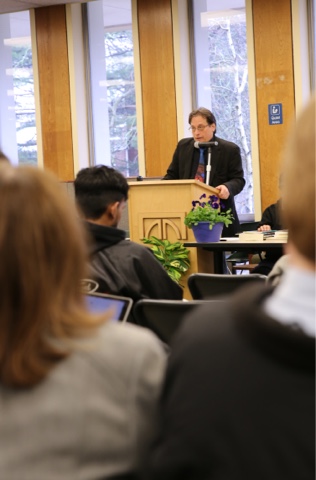
Photo by Thomas Peterson of me reading at Middlesex County College.

I wrote this poem a couple of years ago — I think — in response to a story in The New York Times on the refugees streaming out of Syria. Given this week’s saran gas attack by the Assad regime on its own people, and the unnecessary, immoral, and counterproductive missile attack in response by President Trump, I thought I’d share it today.

I read it yesterday during a spring poetry event at Middlesex County College in honor of the upcoming holiday and the Syrians, who are being blocked by our government from coming here for safety. This was before I learned that the president ordered a missile attack and made it clear he sees war as a viable tool.

Send me an e-mail.