
 |
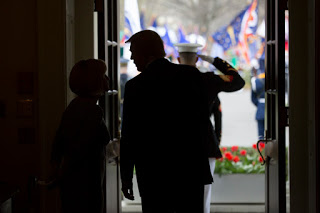
| Moments before Egyptian President Abdel Fattah Al Sisi arrives at the West Wing Lobby of the White House, President Donald Trump talks with a member of staff on Monday, April 3, 2017, in Washington, D.C. (Official White House Photo by Benjamin Applebaum) |
Donald Trump’s response to yesterday’s chemical attack in Syria, likely perpetrated by the Assad government, was fairly boilerplate — except that it spread blame beyond the Assad regime to include former President Obama, damning Obama’s attempt at navigating one of the more delicate foreign policy challenges of his or any administration without offering any kind of direction of his own.
Today’s chemical attack in Syria against innocent people, including women and children, is reprehensible and cannot be ignored by the civilized world. These heinous actions by the Bashar al-Assad regime are a consequence of the past administration’s weakness and irresolution. President Obama said in 2012 that he would establish a “red line” against the use of chemical weapons and then did nothing. The United States stands with our allies across the globe to condemn this intolerable attack.
The response is confusing. Trump calls the attack heinous, connects it to Assad, but essentially blames Obama. We stand with allies, he says, but does not say how. It’s as if this statement was the least he could offer, given his lack of interest in the civil war that has raged in Syria beyond its impact on the growth of the Islamic State — and the increase in American troops on the ground in Syria.
This inconsistency is fairly consistent. The Trump administration seems to be backing away from the Obama era focus on Bashar al-Assad, which theoretically should make it easier to get all sides to the table and potentially negotiate an end to what is now a nearly five-year-long civil war. I say “theoretically,” because President Trump does not appear concerned with the civil war except with how it affects his ability to go after the Islamic State.
Trump has made it clear that the United States’ only concern in the region is the destruction of ISIS. He has increased the number of soldiers on the ground in Syria and has ignored calls from even those in his own party to prioritize ending the civil war.
To be fair, Trump is in a difficult spot. There are no easy answers in Syria — arming the rebels and picking sides, as Sen. Jon McCain (R-Ariz.) advocates, makes little sense, nor does the calls for Assad’s removal, no matter how brutal he has been. That’s just not our call, and any decision to remove Assad would need to come from the Syrian people as part of a negotiated peace.
But Trump’s America First foreign policy, which echoes some of Obama’s language and many progressive arguments against foolish foreign engagements, lacks coherence. Obama’s goals were pretty much in line with long-term American foreign policy interests — a focus on human rights and democracy, but tempered with a real politik concern for impact on Americans. And while power was located in the White House, Obama’s secretaries of state, Hillary Clinton and John Kerry, commanded attention on the world stage and projected a sense of legitimacy. The same, at this point, cannot be said about Rex Tillerson.
I’m not endorsing the Obama approach. He remained too enamored of military means and made far too much of what were minor military successes (I’m in the minority here, but the killing of bin Laden ultimately was more about public perception than anything else). My preference is for multilateral diplomacy that preserves national self-determination, which in Syria would mean bringing all participants to the table.
This may be a pipe dream, as well, but I’m just a local blogger and do not have to do the heavy lifting. Trump is president and has at his disposal all of the tools of the office — and yet, he continues to operate as reality TV star with an overactive Twitter account and extreme sensitivity to criticism.
Trump, essentially, has no plan. This was the criticism of Obama from the right — and was the criticism of Bill Clinton in the 1990s — but there it seems more accurate when applied to Trump. Colin H. Kahl, in Politico, describes the Trump Doctrine (if there is one) as “shoot first” and as lacking in the civilian (i.e., diplomancy) components of a functioning foreign policy.
In charting a new course to combat terrorism across the greater Middle East, Trump has both embraced and rejected elements of the George W. Bush and Barack Obama approaches—but he has done so in an almost perfectly dysfunctional way. He has escalated U.S. military actions, while remaining diplomatically aloof from festering conflicts and de-emphasizing non-military instruments of American power. The result, so far, is a kind of bizarro-Goldilocks approach: not hot enough, not cold enough—just wrong. Left uncorrected, the emerging Trump doctrine will result in more war, but few sustainable gains against terrorism emanating from the world’s most dangerous region.
It also is likely to result in less concern for civilian casualties. Kahl writes that, “as the list of countries considered areas of active hostilities grows beyond Iraq and Syria, we can expect civilian casualties to rise in places like Yemen and Somalia as well,” which has damaging moral implications and “could undermine the efficacy of the U.S. counterterrorism campaign.”
The United States has benefited from the notion that, unlike ISIS and al Qaeda, it does not wantonly kill innocents. That perception could now be put in jeopardy. As Hussam Essa, a founder of an organization that monitors violence in Raqqa, told the Washington Post: “People used to feel safe when the American planes were in the sky, because they knew they didn’t hit civilians. They were only afraid of the Russian and regime planes. But now they are very afraid of the American airstrikes.” If sentiments like this become widespread, it could shift the sympathies of local residents back in the direction of jihadists, complicating the liberation of ISIS’s remaining strongholds and increasing prospects for the re-emergence of extremism in the aftermath.
Our focus, so far, has been on the Trump-Russia connection and Trump’s domestic agenda. This is understandable. We must maintain some focus on military matters.
Send me an e-mail.
 Hank Kalet