
Trump cuts the deepest

(Updated) The Trump budget unveiled today — a $4.1 trillion plan for fiscal year 2018 — will have devastating affects on all but the richest Americans, cutting programs that aid the poor while increasing spending on security and cutting taxes for the rich.

As The New York Times reports, the budget “calls for an increase in military spending of 10 percent and spending more than $2.6 billion for border security — including $1.6 billion to begin work on a wall on the border with Mexico — as well as huge tax reductions and an improbable promise of 3 percent economic growth.”

At the same time, the paper reports that the budget will be balanced on the backs of the nation’s neediest citizens — with massive cuts to Medicaid and the various nutrition and welfare programs. (The Times wrongly refers to these as entitlement programs, a term that should be reserved only for programs like Social Security whose recipients are entitled to benefits because they paid into the programs. Programs for the poor are means based and often include a variety of other qualifiers that limit participation.)

Over the next decade, it calls for slashing more than $800 billion from Medicaid, the federal health program for the poor, while slicing $192 billion from nutritional assistance and $272 billion over all from welfare programs. And domestic programs outside of military and homeland security whose budgets are determined annually by Congress would also take a hit, their funding falling by $57 billion, or 10.6 percent.

The plan would cut by more than $72 billion the disability benefits upon which millions of Americans rely. It would eliminate loan programs that subsidize college education for the poor and those who take jobs in government or nonprofit organizations.

White House Office of Management and Budget Director Mick Mulvaney says the budget will return the nation’s economy to a time of more robust growth. He calls it a

“Taxpayer First Budget,” and he said they worked to jettison any spending that they felt they could not defend. In total, this meant roughly $3.6 trillion in cuts over the next 10 years.

These cuts, White House officials said, would usher in a sustained period of strong economic growth that would grow wealth, create more jobs, and reduce poverty.

“I think what Trumponomics is and what this budget is a part of is an effort to get to sustained 3 percent economic growth in this country again,” Mulvaney said in a briefing with reporters.

This is magical thinking at its finest. Most economists think we are long past the days of 3 percent or better growth, and they view these kinds of projections as overly rosy and potentially dangerous. Assuming growth targets beyond our reach will only inflate our deficits — and it will do so without any discernible economic benefits.

Budgets are priority statements — former N.J. Gov. Christie Whitman famously said they are the place where politicians “put their money where their mouth is.” Budgets tell us what policy makers think is most important, and what they view as unimportant. Trump, in this budget, is underscoring his commitment to security — something I think is overblown — while also highlighting the nastier aspects of his message. His cuts are to programs that assist people in need and, while he claims these are failed programs, he offers no evidence of this. And he makes no real effort to offset his cuts, leaving many to fend for themselves.

Mulvaney said as much, as The Washington Post reported:

Mulvaney said too many of these programs spend other people’s money. He said the government should show “compassion” for low-income Americans but it should “also…have compassion for folks who are paying [for] it.”

“Other people’s money” implies that taxes are illegitimate — a taking of other’s wealth. It also obscures the real issue here, which is that the rich have found ways to pay less and less in recent years, pushing the cost of government onto the backs of the middle class at exactly the same moment that the word taxpayer has replaced citizen as a signifiers of civic connection. Taxpayer in the popular imagination means middle class, which allows people like Mulvaney to claim to be protecting the broad swath of Americans from the poor shiftless folks at the bottom. (There is a racial component to this, but I’ll leave that for another day.)

Trump’s focus on security, especially border security and his targeting of immigrants, is actually of a piece with his proposed gutting of the social safety net. Taken as a whole, the new spending on security and cuts to programs for the poor indicate that those in need are not priorities, that those who have been victimized by capitalism both here and abroad are of no concern.

Trump’s budget, however, is not about “compassion” for the middle class. It is about redistribution upward — and the “folks who are paying” will still get shafted.

Send me an e-mail.
Breeders, welfare and race — an Instagram essay

I posted this the other day on my Instagram account as an Instagram essay. The original (corrected) Instagram version is followed by the text of the essay.

#onbreeders 1/2 The verb “to breed” has several different meanings. The Oxford English Dictionary lists its primary meaning (https://en.oxforddictionaries.com/definition/breed ) this way: “(of animals) mate and then produce offspring,” with the following example sentence: “toads are said to return to the pond of their birth to breed.” It then offers five primary uses, the first two re-enforcing this animal connection: “[with object] Cause (an animal) to produce offspring, especially in a controlled and organized way” and “[with object] Develop (a variety of animal or plant) for a particular purpose or quality.” Other meanings — to rear and train, to produce or lead to an outcome (“success had bred a certain arrogance”) — expand the word’s use beyond the animal kingdom, but they are more colloquial, and their meanings remain dubious. The notion of breeding in humans is usually used in two ways, both of which are focused on creating division among us and creating a human hierarchy. When the wealthy or upper classes — or even the professional classes in our meritocratic society — talk about breeding, they do so to claim exceptional genetic material or to point to the elite opportunities they’ve received that set them apart from the rest of us. While it is growing more common for us to think this way — the expectation that DNA research will allow us to choose traits in our children — our fascination shares some common elements with the eugenics movement and its goal of creating a better breed of human. Historically, this has been a race-based desire, though one that makes its claim without talking specifically about race. #instagramessay @newspoet41
A post shared by Hank Kalet (@kaletwrites) on

#onbreeders 2/2 When we use it as this decal does, it flips the elitism script and turns the focus onto so-called lower classes and the social safety net. But it does not do this innocently. Most of us do not describe our parents or ourselves as breeders, do not say “we’re allowed to breed kids because we can feed them.” But we — in the middle class — do not have to subject ourselves to this thinking — either do to our racial privileges, or because we’re not asking the government for help. We do expect help, of course, through tax policy and other goodies that favor whites and the middle-class, but we’ve classed as something else. This allows us to say we are better or more evolved. We’re Americans, but welfare mothers are something else; they are “breeders,” the equivalent of horses or sheep, the decal and the them Ning behind it implies. That welfare mothers, in the popular imagination, are believed to be a) black and/or Hispanic, and b) abusing the system by popping out babies purely to increase the size of their welfare checks, is left unstated but ties directly into the word’s various meanings. These “animalistic” women, the decal implies, are “produc(ing) offspring … in a controlled and organized way” to achieve “a particular purpose.” The decal also is being produced for “a particular purpose” — to play on and foster racist stereotypes, to dehumanized and ultimately to gut the social safety net. It is racist in its intent, if not specifically in its language. I don’t know the guy who owns the truck, but he’s sending everyone a message about who he is. #instagramessay @newspoet41
A post shared by Hank Kalet (@kaletwrites) on

The verb “to breed” has several different meanings. The Oxford English Dictionary lists its primary meaning this way: “(of animals) mate and then produce offspring,” with the following example sentence: “toads are said to return to the pond of their birth to breed.” It then offers five primary uses, the first two re-enforcing this animal connection: “[with object] Cause (an animal) to produce offspring, especially in a controlled and organized way” and “[with object] Develop (a variety of animal or plant) for a particular purpose or quality.” Other meanings — to rear and train, to produce or lead to an outcome (“success had bred a certain arrogance”) — expand the word’s use beyond the animal kingdom, but they are more colloquial, and their meanings remain dubious.

The notion of breeding in humans is usually used in two ways, both of which are focused on creating division among us and creating a human hierarchy. When the wealthy or upper classes — or even the professional classes in our meritocratic society — talk about breeding, they do so to claim exceptional genetic material or to point to the elite opportunities they’ve received that set them apart from the rest of us. While it is growing more common for us to think this way — the expectation that DNA research will allow us to choose traits in our children — our fascination shares some common elements with the eugenics movement and its goal of creating a better breed of human. Historically, this has been a race-based desire, though one that makes its claim without talking specifically about race.

When we use it as this decal does, it flips the elitism script and turns the focus onto so-called lower classes and the social safety net. But it does not do this innocently. Most of us do not describe our parents or ourselves as breeders, do not say “we’re allowed to breed kids because we can feed them.” But we — in the middle class — do not have to subject ourselves to this thinking — either due to our racial privileges, or because we’re not asking the government for help. We do expect help, of course, through tax policy and other goodies that favor whites and the middle-class, but we’ve classed them as something else. This allows us to say we are better or more evolved. We’re Americans, but welfare mothers are something else; they are “breeders,” the equivalent of horses or sheep, the decal and the the thinking behind it implies. That welfare mothers, in the popular imagination, are believed to be a) black and/or Hispanic, and b) abusing the system by popping out babies purely to increase the size of their welfare checks, is left unstated but ties directly into the word’s various meanings. These “animalistic” women, the decal implies, are “produc(ing) offspring … in a controlled and organized way” to achieve “a particular purpose.” The decal also is being produced for “a particular purpose” — to play on and foster racist stereotypes, to dehumanized and ultimately to gut the social safety net. It is racist in its intent, if not specifically in its language.

I don’t know the guy who owns the truck, but he’s sending everyone a message about who he is.

What NJ Congressmen say about the #ACArepeal vote

The House of Representatives has passed repeal the Affordable Care Act by a 217-213 vote, with all but two New Jersey Congressmen voting “no” on the bill. Overall, all House Democrats and 20 House Republicans voted against the bill.

New Jersey progressives and Democrats are vowing to target the two “yes” votes — Tom MacArthur of the 3rd District and Rodney Frelinghuysen of the 9th.

MacArthur was an expected “yes” — it was his compromise plan on which the final bill was based.

Chris Smith had said beforehand that he planned to vote “no.”

Democrats like Josh Gottheimer and Frank Pallone were united in opposition.

Few New Jersey House districts are competitive, but Leonard Lance is in one that could be.

Bill Pascrell went after the GOP and the repeal bill repeatedly, and with gusto.

This is where Frelinghuysen’s posts would go.

Donald Payne Jr. was just as adamant as Pascrell.

Send me an e-mail.

House GOP plans Thursday vote to gut ACA

Tomorrow appears to be D-Day for health care in the U.S. House of Representatives.

As The New York Times reports, Republicans have scheduled a vote Thursday on a bill “to repeal and replace large portions of the Affordable Care Act after adding $8 billion to the measure to help cover insurance costs for people with pre-existing conditions.”

The bill’s outlines are troubling. It does away with protections for pre-existing conditions, allowing states to “apply for waivers allowing insurers to charge higher rates based on a person’s ‘health status.’”

The bill attempts to offset this change, which will result in many losing their coverage, by setting aside $23 billion for the sickest customers and $100 billion to aide states.

Significantly, according to the Times, the bill also rolls back Medicaid expansion — “a major reason the Congressional Budget Office estimated that the original bill would leave 24 million more Americans without health insurance after a decade.” Tomorrow’s vote comes “before C.B.O. can finish a fresh assessment of its cost and impact.”

To put it kindly, the bill is a disaster.

The most vulnerable in our economy will pay the price for the repeal, while those in the broad middle get nothing. And the rich? They’ll be getting a tax cut, if not in this bill, then later on.

As Chris Hayes of MSNBC and The Nation put it in a tweet:

That’s unconscionable, but it seems pretty clear at this point that the right-wing has no conscience.

In any case, the vote is expected to be close — The Guardian (UK) calls it “a nail-biter” — and there are no guarantees.

The party needs at least 216 votes to pass the measure, meaning they can only afford to lose 22 votes if all Democrats oppose the bill as expected. On Wednesday, at least 18 Republicans publicly opposed the bill and as many as two dozen remained undecided, according to counts maintained by news organizations.

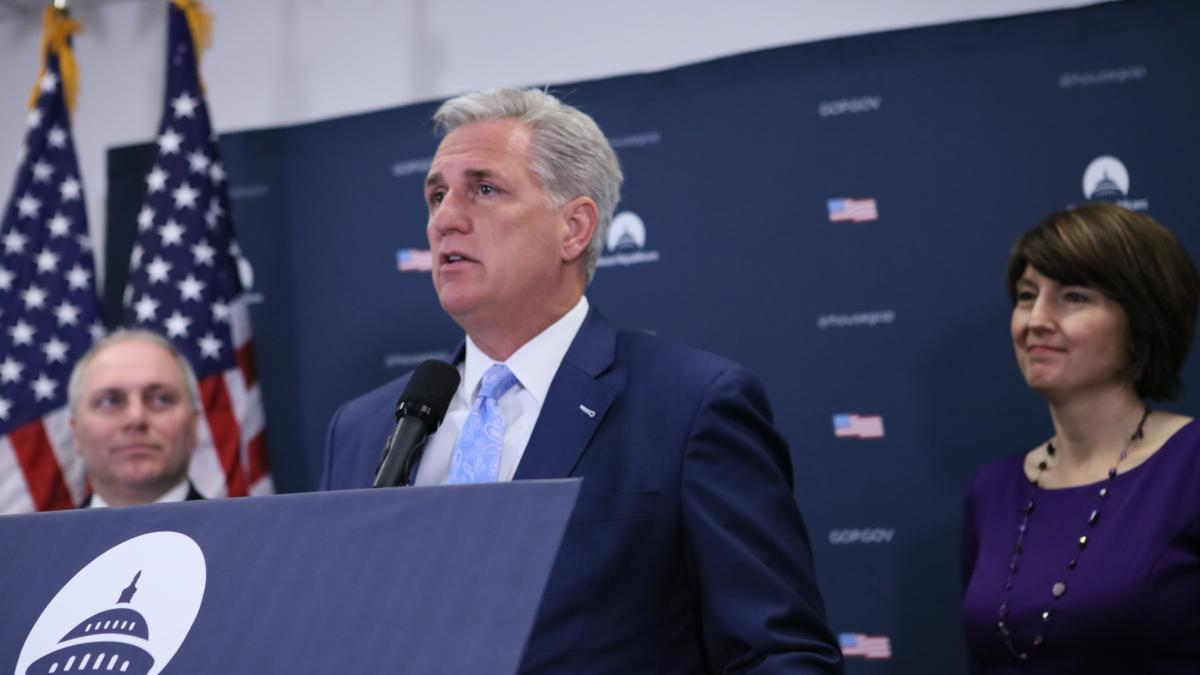
U.S. Rep, Kevin McCarthy, in a photo from his website.

Still, the GOP leadership believes it will pass, according to the Times..

“We have enough votes,” Representative Kevin McCarthy of California, the House majority leader, said Wednesday night. “It’ll pass.’”

Three of New Jersey’s five Republican Congressmen — Frank LoBiondo, Leonard Lance and Chris Smith — have announced they will vote no on the plan. A fourth, Tom MacArthur, of Ocean County, is a chief architect of the compromise plan. Appropriations Chairman Rodney Frelinghuysen, a North Jersey Congressman, opposed the previous repeal, but “refused to talk at all about where he stands on Thursday,” according to The Huffington Post.

If the reports are correct, only four Republicans need to be swayed — and Frelinghuysen could be one. So, if you’re in his district, make your voice heard tomorrow. The Affordable Care Act is far from perfect, but repealing it will leave too many without access to coverage.
Send me an e-mail.

I miss the complete game

Correlation is not causation. But one has to wonder about the shift from starting pitchers pitching deep into games to one in which teams regularly use four, five and six pitchers a game.

There was a time in baseball when pitchers regularly finished what they started — not every pitcher, of course, but the best pitchers would in more than half their starts. Up through the early ’70s, in fact, one in four or one in five starts resulted in a complete game and the best pitchers would regularly finish more than half their starts. (I’m using National League figures to avoid the issues raised by the designated hitter.)

Tom Seaver had 231 CGs in his career.

Today, however, the complete game is rare. So far this year, there have been five complete games — or one every 80 starts. There were 39 last year — one every 60 starts. Johnny Cueto had five complete games last year — which led the National League. Go back 30 years — to 1986 — and the league leader, Fernando Valenzuela — had 20.

At the same time, league ERAs have been higher over the last decade than they had been in the past. National League ERA has exceeded 4.00 20 times in the last 25 years, but only twice in the preceding 25 years.

Again, correlation is not causation. The rise in ERA coincides with other factors — an increase in both homeruns and strikeouts even as hits and walks have held relatively steady, the return to smaller ballparks, steroids, a change in strategy — but the drop off in complete games and the increase in the number of pitchers being used can’t be ignored.

One of the arguments favoring the use of more pitchers, of more relievers, is that it has been driving down late-inning scoring. This piece from 2014 from Slate offers some data on this, though comparing percentage of a games’s runs scored per inning obscures that scoring overall, while experiencing some ups and downs over the years, has actually remained rather stable.

This calls the pro-reliever argument into question — as well as arguments in favor of pushing starters as deep into games as possible. The game, it would appear, exists at an equilibrium, scoring staying within a consistent range regardless of the broader changes that might be happening. One pitcher, five pitchers — teams are still giving up around four runs a game, so maybe it doesn’t matter.

There are other issues — old-school pitchers believe that more throwing makes for better pitchers long-term and prevent injuries, and that may be correct. The number of big-name starters who have missed significant time over the last few years is rather large, and highlighted by what has happened to the Mets’ staff over the last four seasons (each of its big five has now spent time on the DL). Six pitchers last year exceded 200 innings compared with 25 pitchers in 1992, with Greg Maddux throwing more than 260. Compare that to Max Scherzer’s league-leading 228 in 2016, which would have placed him ninth in the league in 1992.

What I find interesting, in our age of pitch counts and innings restrictions is that younger pitchers were carrying those big work loads. Some did have arm troubles later in their careers, but many managed to go through their careers consistently throwing high-innings totals — guys like Maddux, Tom Glavine, Curt Schilling and so on. Glavine pitched until he was 42, threw 200-plus innings 15 times — and that does not account for the 218 innings he through in 12 post seasons. Scherzer — today’s prototypical workhorse — has pitched eight full seasons, the last four of which he has topped 200.

I don’t know if the change in workload or workout routine has contributed to the seeming injury spike. I’m not a player, manager, coach or front-office guy. I’m not a mathematician. I’m not an analytics guy. I respect the use of new stats, but I think we over rely on them — not just as fans, but as team-builders and managers. As a fan, I can only consider what those close to the game have to say. Both Tom House, a well-regarded former pitching coach, and long-time Major Leaguer Jim Kaat (24 years in the league, 14 with 200-plus innings — twice with 300-plus) believe “developing pitchers should throw more, not less.”

The modern industry believes the opposite. Yet pitchers continue to break down.

“What happens in today’s game is kids pitch too much, but they don’t throw enough,” House said. “That’s the simplest way to explain it. They haven’t created a broad enough throwing foundation to handle the pitching workloads.
“My brother and I wore out three garage doors throwing tennis balls against them. We lived at the beach. I bet you I threw a million sea rocks at sea gulls. Not very environmentally friendly, but we were throwing all the time.”
Kaat worked under the renowned pitching coach Johnny Sain, who believed that pitchers should throw at least a little every day. Two of Sain’s pitchers, Kaat and Tommy John, would go on to throw more than 4,500 innings apiece. No active pitcher has worked even 3,300 innings.
“The single most important exercise that I did during my career was throwing the baseball,” Kaat said. “Whenever they would say, ‘You sure you’re not throwing too much?’ I would say: ‘Well, this is how I make my living. I’m just spinning the ball. I’m trying to figure out what makes it move, how can I make it do this and do that?’ So my arm always stayed very flexible.”

These are the same arguments you can hear Ron Darling make on Mets’ broadcasts everytime Manager Terry Collings or Pitching Coach Dan Warthen come to the mound in the sixth or seventh inning to pull a starter because of the 100-pitch limit.

Are these old-school guys right? I’d like to think so — I’m a bit of an old-school fan. Few contemporary games compare with the 1985 duel between Fernando Valenzuela and Dwight Gooden in 1985. Valenzuela threw 11 innings of scoreless ball, Gooden nine and the Mets won it in the 13th on a two-run double. (Another Mets-Dodger duel took place in 1976 — Craig Swan tossed 10 innings of scoreless ball for the Mets, while Don Sutton tossed nine in a 1-0, 14-inning Mets win. I don’t remember this one; it’s mentioned in the LA Times coverage of the 1985 match-up.) Tension and drama still occur, but there is something about seeing starters battle like this, as if it were personal.

This is not where we are today. The game changes and the changes become ingrained. The numbers support some of the changes, though other numbers make it seem a wash. We may see a move back to more complete games and letting starters go deep — at least the top ones — because a tired Scherzer is better than most fresh middle-inning guys, and because it would allow teams once again to carry more position players — and shorten game times, which is sorely needed.

It won’t happen this year, or anytime soon. The thinking would have to change first, and then it would need to trickle down into the training.

I have no illusions, however. I’m old-school when it comes to baseball, but I still love baseball. And while I’d rather watch a tired Jacob deGrom on the mound than a fresh Sean Gilmartin, I have no illusions that it is going to happen anytime soon.

Send me an e-mail.