
Context is everything

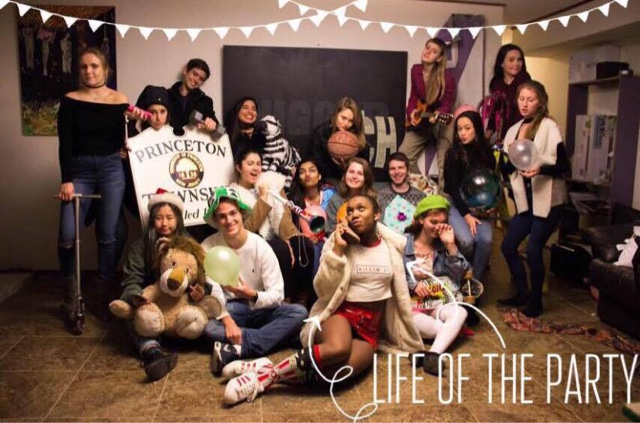
Yearbook photo courtesy of Planet Princeton

I’ll let this report from my friend Krystal Knapp’s hyperlocal Planet Princeton set the scene:

Jamaica Ponder, the high school senior who has chronicled racist incidents in Princeton over the last year on her blog, has been suspended because of a photo she submitted to the yearbook that was then published.

Ponder was suspended for using “explicitly racial language,” in her senior collage photo. The photo in question included two pieces of artwork in the background from her father’s art exhibit “The Rise and Fail of The N-Word.”

Apparently, at least one other student was suspended for a similar offense — the manipulating of photos of North Korea and Nazi Germany (students’ heads were placed on the bodies of marchers). Students, in comments posted to Planet Princeton, have made the case that the photos are symbolic speech, that the images are meant to critique a culture of racism and elitism at Princeton High School — a contention I don’t want to debate. I don’t have any direct knowledge, nothing more than what I’ve read on Planet Princeton and elsewhere. I will leave discussion of the school’s culture to the students and administrators there, to the local press, and to parents.

What I will say, however, is that the paintings that have caused the uproar are artistic critiques of American racism. Rhinold Ponder, Jamaica’s father, told Planet Princeton

The purpose of the imagery is to promote racial literacy and dialogue, he said. “It’s difficult in our society to talk about race, and everyone is so stifled by a word,” he said, noting that teens who visit the Ponder home often ask about the art, which leads to thought-provoking discussions about race.
 
One painting called “Strange Fruit: High Tech Lynching” shows Michael Jackson, O.J. Simpson and Clarence Thomas hanging from trees with televisions around their heads across from an image of a lynching victim. A second painting is the words “NIGGER RICH,” in dark acrylic paint and chopped up dollar bills.

The two paintings are obscured in the yearbook photo (see above), but even if they weren’t they are symbolic speech deserving of more respect and consideration than a school zero-tolerance policy on racial language can apparently allow.

Some want to make this an equity issue — a white kid likely would have been suspended for a similar offense, they say, and that may be the case. But the use of this kind of imagery and language by a white student or white painter is likely to create a very different set of meanings.

As I wrote back in March about a Whitney exhibit that included a painting by a white artist of a famous photo of a dead Emmett Till in his casket, the context in which a work of art is created or language is spoken can be as important as the work itself. Questions of appropriation get raised — who has the right to tell the story, to benefit from the story, can a particular ethnic group own its history or is it broader than that — and the meaning of the language and the images is affected by the context.

Consider the Emmett Till painting. Dana Schutz painted it and, after the uproar surrounding its exhibition, offered this statement:

“I don’t know what it is like to be black in America but I do know what it is like to be a mother. Emmett was Mamie Till’s only son. The thought of anything happening to your child is beyond comprehension. Their pain is your pain. My engagement with this image was through empathy with his mother.” She added: “Art can be a space for empathy, a vehicle for connection. I don’t believe that people can ever really know what it is like to be someone else (I will never know the fear that black parents may have) but neither are we all completely unknowable.”

For the white viewer, this explanation might resonate. But it is reductive. It deracinates the image — Schutz attempts to universalize something that is far from universal, something that is connected to hundreds of years of history, hundreds of years of persecution of Africans and African Americans who continue to be judged, even killed, because of the color of their skin. Till in his coffin will always be a powerful image, but its power derives from its history and the history of a people.

I don’t want to rehash the Till debate — I am somewhat ambivalent about this, because I’m opposed in general to limitations being placed on artists while at the same time understanding the various ways in which privilege influences our understanding of art and our relationship to the tellers of history’s stories.

This is the context in which paintings like these should be judged. “Strange Fruit,” for instance, takes its title from a song made famous by Billie Holiday, but written by a Jewish songwriter, and symbolizes how powerful African Americans are treated by the American news media. It is artistic and symbolic speech that uses imagery and language that, in other contexts, would be offensive.

Context, however, when zero-tolerance is the policy in place. Don’t get me wrong, schools need to crack down on racism within their walls and on their playing fields. But zero-tolerance leaves no room for consideration of context or mitigating factors. In many ways, zero-tolerance policies are designed to protect administrators as much as students.

I also question whether the school administration is even interested in questions of context. Principal Gary Snyder sent out a message to parents that described the images as “insensitive, offensive, and provocative words and symbols of racial bias, bigotry, and anti-Semitism.” There is a difference between using images to critique a school’s culture or to underscore the impact of white privilege and white supremacy, and students using Holocaust imagery — playing Nazi-beer pong — to spice up a drinking game. I suspect the administration knows that that.

Ten thoughts for a Tuesday — on Hillary, Russia and the future of the left

It is possible to believe all of the following simultaneously:

1. Hillary Clinton was a bad candidate and ran a misguided campaign. Believing this does not automatically make one anti-women or anti-feminist.

2. Despite the campaign missteps, Clinton likely would have won had James Comey not intervened. His announcement in the campaign’s waning moments likely altered the race just enough to swing it to Trump, given that Clinton lost three states by less than 100,000 votes total. Had she won those — all won by Barack Obama — she would be president.

3. Third-party helped elect Trump. Those voters had a right to back Jill Stein or Gary Johnson, but were foolish to do so — in first-past-the-post elections, every vote not cast for a major party candidate can be viewed as a vote against that candidate.

4. That said, the right to vote third party — or not vote at all — is just as sacrosanct as the right to vote for the lesser of two bad options.

5. As a leftist — a self-described socialist who is probably to the left of Bernie Sanders — Clinton was a lesser a evil. She was the candidate of the establishment and the corporate order in charge of our economy, but was still our best option for the White House.

6. It’s time to move on from discussing Hillary Clinton and focus on the actual tasks at hand.

7. An independent inquiry into Russian interference in the election is warranted.

8. There will be no impeachment of Donald J. Trump, regardless of what the investigations reveal. Republicans control both houses of Congress and they are not going there.

9. Impeachment may not be politically wise for the left, because it would lead to a Mike Pence presidency, which would strengthen the radical Christian right and allow for a more functional conservative deconstruction of government. The only thing stopping that now is Trump’s abject incompetence.

10. The left should let the investigation run its course and focus on mobilizing a real movement. As I said, the investigation is important, but people power is needed to prevent further damage to the environment, social safety net, labor, women’s, minority and immigrant rights, and so on.

Send me an e-mail.

Why local news matters

Route 1 at Henderson Road. The 7-mile stretch of the highway in South Brunswick is only two lanes.

I have spent half of my adult life in the news business, 22 years of it covering local news. As a reporter, as an editor, my focus was on context. My belief — and it’s a belief I try to impart to my journalism students at Rutgers — is that we have a responsibility to do more than just report on what’s happening. We have to answer the important question and make it clear why the information we bombard readers with matters.

I tell my students that, when they focus on the journalist “five Ws” — who, what, where, when, and why (along with how) — they need to do so not from the perspective of their sources or even of journalists. Their responsibility is to the readers.

Take the first W, “who.” As reporters, we assume The “who” is the star of our stories — who is developing the property? Who was arrested, etc? I ask them to answer those questions, it to treat the “who” a little differently. They need to ask and answer this question: who is affected?

We can answer — and should answer — each of the w-questions in this way: What is the impact? What can the reader do about it? When will it go into effect? When can the reader act? Where will the reader see the impact? Why should the reader care?

These questions expand upon the Ws and get the reporter out of his or her head. Young reporters, in particular, but also most political reporters, tend to be captured by their sources. I don’t mean they do their sources’ bidding, but they do start to see the world through their sources’ eyes. They view he bureaucracy as most important, and end up writing stories for the people they cover, as opposed to the people who read their papers or news sites.

I’m not singling any news organization out — this approach is rampant — but I am being critical. We can do a lot better as an industry. Would this address the revenue and readership issues? I doubt it, but we can’t allow that to be our only concern.

To better understand what I’m talking about, I want to offer five South Brunswick stories I’d assign if I edited the local paper — stories designed to provide context. I chose South Brunswick because of my history as a newsman in the community. I’m curious if there are other stories others might add to this list, and what approach might be taken. Here they are:

1. When will the traffic light on Route 522 at Stouts Lane be repaired?

The light has been out and access to and from Stouts has been limited since a dump truck took out the light April 26. The impact of the light on local traffic patterns is significant — Stouts Lane is a primary access road for South Brunswick High School, the Target shopping center, and for Dow Jones employees. The closure, therefore, creates traffic problems elsewhere. When will it be repaired?

2. What can be done to resurrect the South Brunswick Square Mall?

Bob’s Furniture and the Tilted Kilt have abandoned the shopping center in recent months, Bob’s moving down the road and the Tilted Kilt just shutting its doors. Neither closing should shock locals — both storefronts have seen regular turnover in the mall’s 30 years of existence. As a reporter and editor, I’ve written about the difficulties faced by the mall, and while new stores open occasionally, the prime anchors (aside from Home Depot) have not been able to survive.

I don’t know that anyone will have the answers, but we have to keep asking. Shopping centers without anchors are a drag on their smaller stores, and empty storefronts only make it more difficult to fill storefronts. That means an empty mall, and an empty mall creates the potential for other issues.

3. Has widening Route 1 fallen off the radar?

This has long been a priority for local officials and, while it remains so, the public needs to be reminded why and brought back into the discussion — if for no other reason than public pressure could be brought to bear on state decision makers now that the state has some money available for infrastructure.

4. Will Route 522 ever be extended to Ridge Road near the NJ Turnpike?

Another priority, but one dependent on warehouse construction. What is the status, and is this still a needed project?

5. What might the township look like in a decade, with state courts — as of now — mandating nearly 1,400 new affordable housing units?

This story has a lot of tentacles — a 200-unit development proposed for New Road, the potential for 7,000 to 10,000 new housing units total to offset the cost to developers of building the affordable. Where will these proposed units go? What happens to other township facilities. After all, we are talking about an increase in the number of housing units in the township of about 30 percent. There will be an impact on infrastructure (roads, schools, parks) and there is the broader question of responsibility. There is a desperate need for new affordable units statewide, but they need to be distributed fairly. What is happening elsewhere in the state, and what should that mean for South Brunswick?

All of these are important questions, the answers of which will affect nearly all of the township’s 45,000 residents. Someone should be attempting to answer them. While some of these stories have received coverage, few are getting the deep dives that provide context and allow residents to understand their full impact. More deep dives are needed, but I don’t hold out any illusions. The cut backs at newspapers have taken their toll, making it far more difficult to pull off these kinds of time-intensive pieces. But we should try. We have to try

Rush to judgment

This story is heartbreaking:

Two children in Texas have died after they were locked in a hot car Friday as temperatures soared to 96 degrees, according to police.

The children were young — 16 months and 2 years old — and the deaths are under investigation. But police said,

The children’s mother told police that they “took off.” After searching for them on the property, she found them inside a small four-door vehicle, where they had somehow locked themselves inside, police said.

The mother then broke one of the windows and found the children unresponsive, police said. They were pronounced dead at 4:33 p.m.

This is all we know, but it hasn’t stopped the outrage on social media. A friend, for instance, responded this way:

What the hell kind of mother says her babies “took off?!”

Lock HER up.

Elsewhere, we have this

and this

The reports I’ve read have not cast doubt on the mother’s story, saying only that the deaths remain under investigation. But the tenor of the response is fairly consistent with earlier tragedies — such as the child killed by an alligator in Florida or the child who fell into the gorilla cage in Cincinnati a year ago today. We assume that the mother — always the mother — has failed, and our outrage meters turn to 10. We immediately judge, failing to grasp the unpredictability of these situations.

Basically, children are unpredictable. They run off. They wander. No matter how careful a parent might be, a child can get away. It’s happened to me — with my nephews Joe and Dan (separately), with my niece Kim, with me when I was a kid.

When Joe was 3, for instance, he got away from us at the Quakerbridge Mall. He was teasing my mom, hiding in clothes racks and then jumping out. Until he didn’t. Suddenly we were in a mass panic — what happened, where was he? We contacted security, they locked down the mall, while we fanned out. We found him at the other end of the mall playing with a Spider-Man toy, so it all ended well.

But it could have gone the other way. Those lost seconds, the quickness with which he was able to get away — it could have meant tragedy.

I think most of us understand this and, if we are willing to be honest with ourselves, have experienced this on some level. There is a gender component to this — the judgment always targets the mother — but it is more than that. We judge because we think it makes us better by comparison.

When I read my friend’s post — and some of the responses to it on Facebook. I found myself getting angry. My response:

I love how judgmental we all are. It’s as if none of us has had a kid get away from us. I know it’s happened with my nephews — and it can happen to any of us. If you don’t believe that, you’re either delusional or full of crap.

Send me an e-mail.

The lockout is corporate bullying

Locked out workers protest in Freehold.
(Photo from Democratic press release)

Workers at a New Jersey Shore beer distributor have been locked out — a tactic growing more frequent as corporate managers around the country attempt to gut union protections, slow wage growth and slash health and retirement costs.

As The Nation reported last year, lockouts are growing in frequency. It is the management version of the strike — except that the strike is a tool designed to level the playing field between workers and management, who usually hold most of the cars. The lockout also stops work, but it makes use of management’s unequal power — as a rule, they hold all the cards — to force workers to grant concessions. As Michelle Chen writes,

The lockout is, essentially, a work stoppage initiated by the employer: the boss applies pressure to workers in a labor dispute by suspending operations. The power dynamics of blocking workers from their jobs, however, play out differently than a worker-led uprising. The Century Foundation (TCF) analyzed trends in labor lockouts and concluded that firms inherently wield dramatically more leverage over workers—that is, that lockouts are more damaging to workers than strikes are to employers—due to sheer volume of political and economic clout, beyond the bargaining table.

This may seem to fly in the face of current thinking. There are many who view unions as too strong, their workplace rules as an impediment to business. But unions are at their weakest point in decades, perhaps since they first popped up in the United States. The percentage of unionized workers in the private sector has dropped into the single digits, while public employee unions are battling just to maintain their limited power (see Wisconsin). Pro-management, pro-corporate politicians have drafted and passed so-called “right-to-work” laws, laws that allow workers to opt out of joining unions or paying dues for services unions provide.

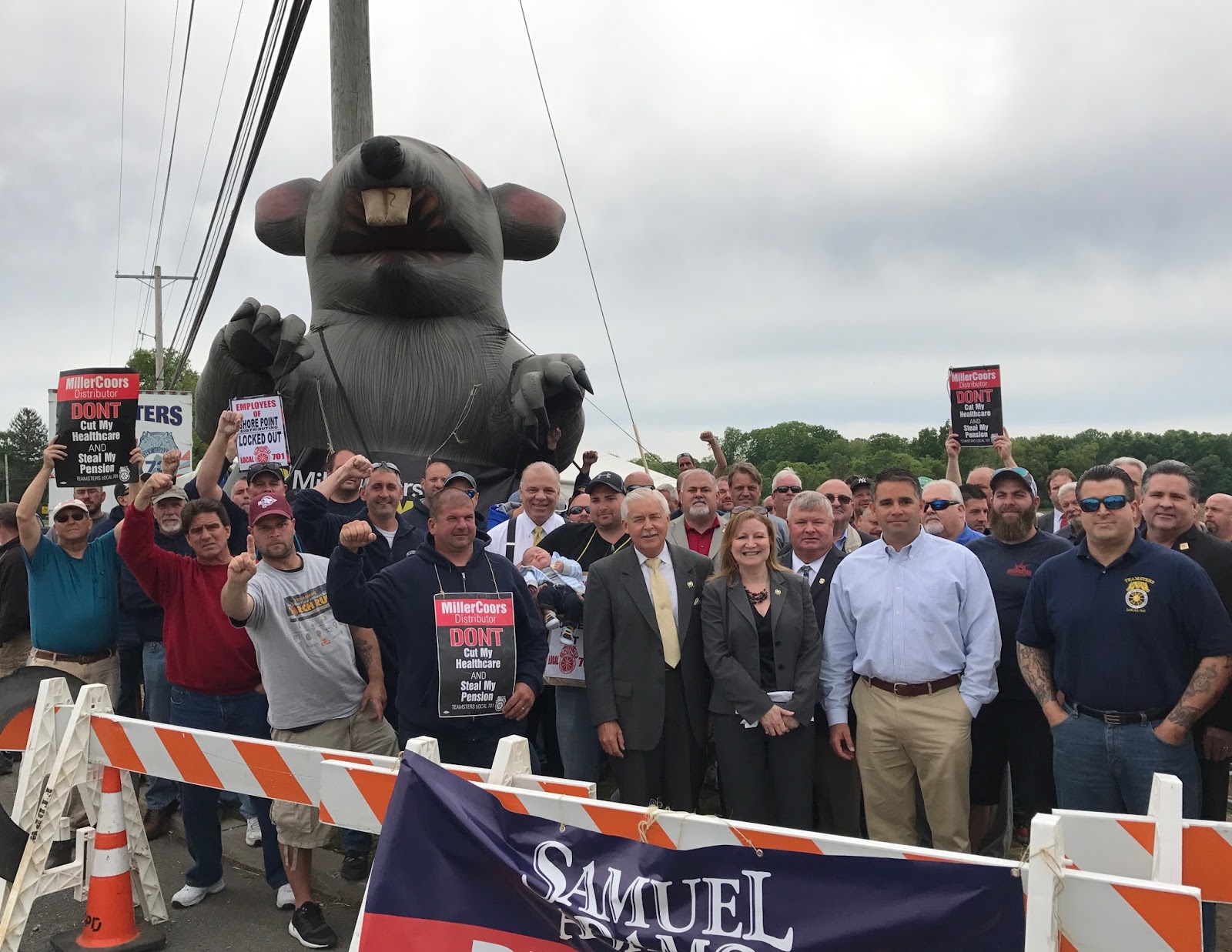
The Shore Point lockout occurs within this climate. The North Brunswick-based company locked out 113 workers on April 30, “in an attempt to force them to give up their pension, agree to a three-year wage freeze, and agree to give the company permission to change their health insurance plan and healthcare costs at any time,” according to a press release from Teamsters Local 701.

Workers are fighting back by protesting at Shore-area festivals and by convincing local restaurants and bars to stop serving MillerCoors products until the lockout ends — at least according to the Teamsters. Three Democratic state legislators — Senate President Steve Sweeney and Assembly members Joann Downey and Eric Houghtaling — joined a protest in Freehold yesterday and announced legislation designed to help workers during lockouts. The bill, if approved, would “help workers cover the cost of health care during a lockout” by offering “funding assistance to pay for COBRA health benefits.” The chances of such a bill getting through the Legislature are unclear, but it is unlikely that, if it makes it to his desk, Gov. Chris Christie would sign it.

The bill would be an improvement on current law, which forces locked out workers to pay their own and their employers share of health coverage costs, but it does not go far enough. Current law tilts the playing field toward management, making it easier for companies to use the lockout as a negotiating threat. Employers lose potential revenue when they initiate a work stoppage, but they also avoid paying out salaries and benefit costs, limiting their exposure during a lockout, and they control the lockout’s duration. When workers strike, however, they control duration, but they give up everything — a sacrifice they make willingly. Employers should have to put more on the line when they lock out workers, including covering both their portion of benefit costs and those of their workers. They also should have to pay something into union strike funds, if not be forced to continue meeting their payroll.

I don’t expect changes of this magnitude to occur anytime soon — workers are too fragmented and the labor movement is too weak. The threats of outsourcing and company relocation remain strong, and labor has yet to develop a national and international mindset to address these issues. And rebuilding the labor movement during the age of Trump is likely to prove difficult, given his empty promises on jobs, and the Democrats’ lack of attention to union issues.

Send me an e-mail.