Journal entry: Thoughts on kneeling, race and the NFL

Colin Kaepernick and his former teammates take a knee before a 2016 game.

Colin Kaepernick began what was at the time a lonely protest in the summer of 2016. Barack Obama was president. Hillary Clinton was expected to succeed him.

At first, he just quietly sat during the national anthem, didn’t make a fuss, didn’t announce his intention, didn’t call attention to his action. He just opted to sit as a silent and personal protest against the shootings of black men and women by police. As a protest against a legacy of racism that infects all of our institutions, that continues to deny opportunities to the vast majority of African Americans, that can best be summed up in a comment made by the noxious Jeanine Piro on Fox: “America has been incredibly good to you. From the time you displayed talent in sports as a youth America allowed you to shine and become financially prosperous.” Good to you. Allowed you. This is the language of privilege, language structured around the idea that African Americans must be granted permission to prosper, that we — white Americans — have ultimate control over their economic fate.
Sadly, we do. The history of racism in the United States may appear to State with slavery and end with the end of Jim Crow, but the legacy of those institutions still runs deep in the systematic stripping of wealth from African American neighborhoods — redlining and white flight created a de facto segregation that still haunts us. African Americans — along with other poor brown people— are still overwhelmingly packed into urban ghettos that have been stripped of funding by archaic tax systems that ignore need and generate revenue based on property wealth.
This creates a structural impediment — some can rise above poorly funded education systems and the lack of everyday opportunity. Ice Cube in “It Was a Good Day” paints a brilliant picture of a dysfunctional community by recounting the events of a good day — one most of us would also view as a normal, unremarkable day.

History shows that dysfunction follows poverty. Crime, drugs, alcohol, violence — the very “sins” railed at by politicians of all stripes in the United States today — are not modern inventions. Read Charles Dickens. Read William Thackeray. Look up the Five Points neighborhood in New York in the early 1800s.
These “sins” follow desperation and lack of opportunity, though I won’t go so far to describe them as cultural (Michael Harrington was right about many things, but he erred in introducing the phrase “culture of poverty” to he modern sociological and political lexicon). That would imply something endemic, when I don’t think it is, and it allows for the economic scolds — on the right, to be sure, but also among Wall Street Democrats like Bill Clinton — to blame the victims of an economic system that can only function by creating winners and losers. Poverty like racism is systemic. It is the result of choices — and not just those made by the poor themselves. Yes, each of us can fall through the cracks, but the decisions made by the larger political culture on how to structure the economy magnify these individual choices. The lack of wealth in African American communities, which is a result not of individual decisions by black Americans but He intended outcome of hundreds of years of political and business decisions designed to control where and how African Americans can live, work, and go to school — means there is little in the way of a safety net for African Americans or the poor of all races.
In terms of the “sins” — my quotation marks are intentional because we only view these behaviors as sins among those without privilege. Crime is perfectly acceptable when the criminal is a banker or a big company and it is committed in the service of profit and stock value. Occasionally, we will make an example of one or two of these corporate criminals, either with a criminal prosecution or a civil case, but more often we respond by saying these corporations and their executives are “too big to fail” and “too big to jail.”
Take the “opioid crisis,” which had caused a massive mobilization and a response that is different in its focus than earlier “black” or “urban” epidemics like the crack scare of the ‘90s or the heroin crisis of the ‘60s and ‘70s. Opioid abuse is a genuine public health issue — the Centers for Disease Control say 91 Americans die everyday from opioid abuse, but opioids are used far less than other drugs and their impact pales in comparison to tobacco and alcohol, both of which cause more widespread damage and cost the healthcare system millions of dollars. My point is not to minimize opioids as a danger, or to press for prohibition of alcohol, but to call attention to the way race has informed our response.
Opioid use has elicited a legitimate call for treatment. It is rightly seen as a public health problem and not a law-enforcement one — in marked contrast to the earlier epidemics, which were met with war rhetoric, a ramping up of criminal penalties and the militarization of police. Part of the reason for this shift is that we may be smarter about drug abuse, and we can pat ourselves on the back this evolution. But we should not ignore the racial dynamics — opioids are seen as a white problem, crack and heroin as black ones. Opioid users get our empathy and treatment; crack and heroin users are met with no-knock raids, threats of military-style round ups (see Ross Perot’s comments on condoning off black neighborhoods to “vacuum up drugs”), and increased penalties for even the smallest quantity of drugs as part of a broader “war on drugs.”
The rhetoric of war and the targeting of black communities remains a central facet of American political and police culture. President Donald Trump has made Chicago the poster boy for his argument that American cities are “war zones” experiencing “carnage,” even though crime is down. We can dismiss Trump’s language as campaign hyperbole — except he continues to make these claims and, more importantly, he does not offer this argument in a vacuum. His comments are the logical culmination of a five-decade effort to paint American cities as war zones and to turn police departments into occupying agencies. It’s why the focus on individual officers’ racism so misses the point. It is systemic. The war on drugs and a culture in which the safety of individual officers outweighs that of all else has led cops to police communities of color as though they are occupied territories and the denizens of these zones as potential enemies. James Baldwin wrote about this dynamic as far back as the 1960s. Ta Nehisi Coates and others continue to make this argument. This is a recipe for violence by police — and the list of the dead makes clear this is far from theoretical.
This is what NFL players protest when they take a knee. Kaepernick was not protesting Trump. Michael Bennett, who was assaulted by Las Vegas police, has not been protesting Trump. And it’s why we miss the point — and much of the NFL missed the point this past weekend when it opted for unity in the face of Trump’s rambling attack at an Alabama rally on the free speech of players and his ignorance of the racism that has forced many to use their platform to draw attention to what has been happening in their communities.
This is not about Trump. This is not about the military. This is about the systemic murder of African Americans on American streets, about the persistence of de facto segregation and the racist assumptions of a society that refuses to truly come to grips with its history and the effect that this history has on the present.
This is about racism and whiteness, about the continued subjugation of much of black and brown America and the unstated and too-often unexamined benefits that come with having white skin.
This is America. Anyone can make it. But we should be honest and admit that some of us get to start the marathon of existence at the 13-mile mark, while others are expected to run a 35-mile race.

I inadvertently neglected to give credit to Greg Popovich, the Spurs’ coach, who used this same basic metaphor earlier this week. Here are his comments during NBA media day, which are worth hearing in their entirety.

Tragedy in Point Pleasant: A true story


He was older. Scar down the center of his chest and white, bloated belly. Overweight, yes, but taken on water. The salt turns gas, inflates the body or blows through like lava. They had him laid out on the sand. Pressing on his chest. Alternating breaths into his larynx, into his lungs. Waiting.
The crowd was restless. None of us wanted to be here. Watching this. But we couldn’t not watch. We had to.
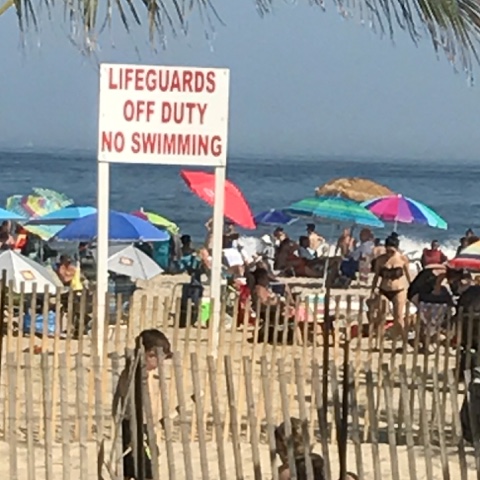
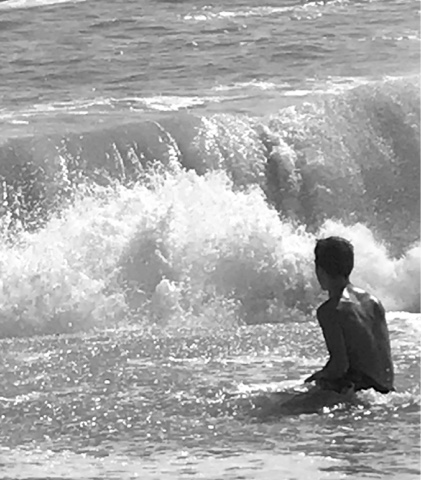
The beach was packed. Early fall masquerading as summer, but there were no lifeguards, no swimming was allowed. My nephew hovered at the water’s edge. He’s 14, would run with the others, the kids he just met, into the water and back out as the waves crashed in. We told him no swimming. Rip currents. Rough surf.  The undertow was stronger than I’d ever seen.
I had walked down to the water from my chair, left Annie sitting on a blanket, so I could check on Dan. I couldn’t find him  at first, but everyone was standing at the water’s edge. Everyone was staring at the same point about 50 feet out. A head bobbing on the waves. A swimmer beyond the reach of safety.
No one could say how he ended up so far out — did he lose his sense of place? Was he dragged out beyond the breakers? Did he venture into the deep knowingly? We watched the head rise and fall. Someone said he called for help. I never heard it. We all knew what we were watching, most of us frozen in place, most of us holding our breath.some wept. Then the head went under. We could see it, but it didn’t rise above the surface. Five minutes. Ten minutes. I can’t say how long.
Annie came running from the chair. Someone had been funning toward the boardwalk screaming for help. Annie thought, “Dan. Hank.” Couldn’t find us at first, nearly panicked, but found us. Others ran to the water from their chairs, fear in their eyes.
A woman with a surfboard swam out, several men followed. They reached him, wrestled him onto the board, worked as a team to bring him ashore. As they approached, a massive wave struck, capsized the board. A dozen people on the beach formed a human chain to stabilize and and dragged them all from the water.
The swimmer was unconscious, not breathing. Police cleared space and EMTs started working. A woman, gray hair, his wife I assume, rushed through the crowd, ran at the body. Police stopped her. She screamed, she cried, she nearly fainted. She swung her arms, she collapsed to the ground.
The crowd was silent. The crowd was pressing in. Police pushed us back. Then there were applause. Someone said the swimmer coughed up water, took a breath. Then another. Then more cheers. They took him off the beach to an ambulance, but someone on Facebook said they needed to do CPR again on the boardwalk.
As they carried him off, the crowd let out its collective breath. Dan was quiet. We all were quiet. “I’m too young,” 14, “to see death that close,” he said. “He isn’t dead,” we told him, but we don’t know. Nothing’s been reported, but a man died in Long Branch yesterday, a woman at Seaside today. Dead trails us. Taunts us. We read about it daily — hurricanes and earthquakes, terrorism and drone attacks, shootings and botched robberies. All of us are in the wrong place waiting for the clock to strike the wrong time.

Vengeance: An Op-Ed in the Form of a Poem

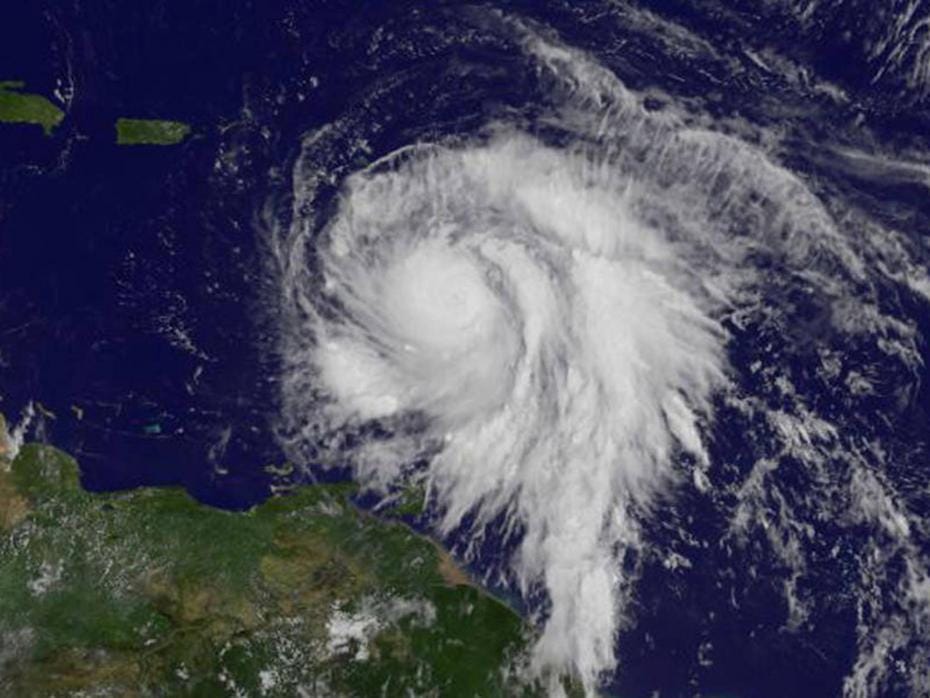
I wrote is after Miami was deluged with flood water, as Irma barreled North along Western Florida. The news since — the second Mexican earthquake, the devastation in Puerto Rico caused by Maria, the war of words between Trump and Kim, another cop acquitted in the shooting of a black man — has not left me feeling more secure.


VENGEANCE
As Irma passes, and I watch on television
from my den in safe-and-dry Jersey,
water rushes down Collins Avenue,
where when I was a kid visiting my
grandmother I sometimes walked and stared
into shop windows to catch the reflection
of my fourteen-year-old self. Nerdy.
Unassuming. Weak. Alone on the avenue
I could be anyone. Strutting false bravado,
funky hat and t-shirt. Dark sunglasses.
Saw Silver Streak there that winter, thrilled to see
bookish-like-me Gene Wilder win the girl and save
the train. That theater’s likely long gone,
and Miami Beach and South Beach
and the intimidating sky line of the city
cast spells on the imagination. I prefer
memory to the incantation of money.
Everything is real estate in Florida.
Now everything is under water. Power
is out. It’s hot. The air is thick, unbreathable.
That’s what Chris tells Annie. They’re lucky.
A generator powers a small window A/C for relief.
Downed power lines block roads. Death toll hits
eleven in Florida, the news reports, but dozens
been killed as the storm blew through the Caribbean.
We don’t talk much about that, Irma leveling islands
we see as play lands. St. Martin, Barbuda, Cuba
left to dig out, just weeks after Houston
was submerged by Harvey. Battering after
battering, storm upon storm upon storm.
On Facebook, friends mark themselves safe. Irma
has passed, turned to rain in Georgia. Jose
hangs in the wings. Those summers and winters
in Miami, in Tammarack — crab-grass lawn
encircling my grandparents’ house felt like
dull little knives on the soles of my bare feet —
so long ago. My uncle was down there
one year, but I don’t recall the visit.
We saw old New York friends and I played
ringolevio with Gary in the courtyard
of his high-rise, a wild game of tag that
had us running up and down stairwells, through breezeways,
and into the summer dark. It rained everyday
at four, so we’d nap or watch TV for an hour
or less, until the showers ceased. They never
lasted long. Florida seemed exotic then,
and still does, brightly colored, and so much
more humid than even the worst Jersey summer.
Businesses battered in Deerfield Beach, awnings
torn, windows shattered. We were there last year.
The East Coast “dodged a bullet,” one mayor says,
but trees are down and power is out. Rain
is meant to be cleansing, washing away
the grime and dirt, the wickedness — or that’s
what the churches say, Noah’s flood their
reference point. If I was religious, believed
in a vengeful god, I might see these storms
as a penance, God’s anger made concrete
in a cataclysm of wind and water, might
interpret western fires, Mexican earthquakes,
tsunamis in the Pacific as “an end to all people.”
Punishment. But the corruption of our souls
is religious, false prophets preaching hate.
The sun is out here and I’ve covered the pool,
summer’s official close. The air is still,
a squirrel flees up the massive maple
that sheds leaves onto our patio. The dogs
bark, and my nephews, here to help pull the tarp
across the pool, recede into their phone screens.
I can’t help but think of the deer carcass
we saw on the highway near Freehold. Neck
twisted, gut sliced open by impact, entrails
visible. To the right, we see a herd of deer,
too young for antlers, just fawns, really.
They eat in an open field that’ll soon be shut off
to wildlife by houses advertised for active
senior living. Pave it all over. Chase the deer
onto the highways, watch the rains wash over
black macadam as the water seeks the soft,
sponge-like ground to soak in, drain off.
Florida was marsh, still is, one long target
on which the climate can exact revenge.
I may not believe in a vengeful god,
but I believe in science, and the planet
is heating up, storms growing stronger from the vortex
of warm ocean waters and rising atmospheric
temperature. Sea levels rise, wash tides
across storm walls and over city streets.
Collins Avenue. The Houston Galleria.
A Seaside Heights Ferris wheel pulled by undertow
into the Atlantic. State’s Island. Charleston. Boston
buried in snow. The planet adapts, pushes
species into extinction. It’s our fault.
Rain falls in the Carolinas. Storms expected her
on Thursday. The geese chatter above, head south.
And we wait, pretending the floods won’t come.

Signs and signification

Here’s a question:

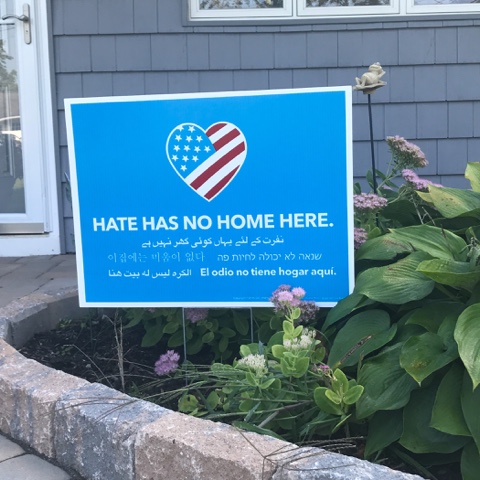
If you post a sign in your yard declaring you stand against hate — which is admittedly a rather small gesture at best — does it say anything about your neighbors?

The answer, I had always assumed, was no. My declaration of belief, whether it is for peace, against hatred, or in support of something like universal health care, begins as a personal statement. I believe. As a writer, I know I need to go farther — as I teach students, the phrase “I believe often is used as a crutch. I believe something to be true, I, meaning it is my belief and only mine and I can believe what I want. Screw the evidence. Forget supporting my arguments. I believe it and that makes it as valid as anything anyone else might say.

This certainly is true of some things: taste, for instance, is deeply personal. I like The Beatles and Kendrick Lamar and don’t like Mariah Carey or Journey. I have a host of reasons, some rational, many not, but it doesn’t mean you have to agree.

There is, as with all deeply held beliefs, a sense of ownership and an implication that the holder of the belief is right and everyone else is wrong.

But does it imply anything more?

A month or so ago, the conservative blogger Matt Rooney commented on the signs this way on Twitter:

I was a bit surprised by his argument. Yes, the signs are merely a small gesture, but “Condescension and tokenism at their worst”? That was just absurd.

I commented in a retweet that it was a small public declaration, which elicited this response:

Again, this is absurd. Why would one assume hat my public declaration of what I believe is an implied critique of my neighbors? The answer, I think, is that Rooney and many on the right who are critical of the signs see them as a threat to their world view. My simple declaration, made public, raises questions about their beliefs that they may find uncomfortable — not that they hate, but that something in their belief system encourages hate? I don’t know. I’m loathe to engage in a pop psychoanalysis of politics and I want to make it clear that this is not about Rooney — he just provides a useful example, even if it is something that is a couple of months old.

Why bring it up now? Well, the sign discussion is an ongoing one. I drove around recently and found a dozen “Hate Has No Home Here” signs in my Kendall Park neighborhood, not including other variations. I also found a couple of pro-Trump signs — rare in Democratic South Brunswick — and a variety of others for football teams, colleges and contractors.

My posting of the sign is about me, about what I believe, about my belief hat I have to make that belief public. Do I hope others will follow suit? Of course. Do I hope it makes bigots uncomfortable? Yes. Does it mean I believe those who don’t post such signs — or the myriad others I’ve seen recently — are “bigots,” as Rooney said? Again, that’s absurd, presumptuous — and condescending, and it’s a variation of an argument that paints disagreement as something nefarious. My sign, which symbolizes something I believe in, which states my belief pretty clearly, is dismissed out of hand as an effort on my part to show my superiority and, because that is all it is, I can be ignored. My instinctive response is to say “Fuck off,” though I usually try to engage.

It’s like when someone says “you just want to be the smartest guy in the room” as a way of diffusing the points you make. (Which happened recently.) It no longer is about what you say, but about who you are. It is a personal attack — I don’t have to listen because you’re just an egomaniac who likes to hear himself speak. The instinctive response, again, is to say “fuck off,” and perhaps that is the best response. After all, why engage when someone seeks not to answer but to demean? Or, I could say, “I don’t need to try. I am the smartest guy” — a joke, though I suspect it is one hat, given the medium (Facebook and/or Twitter) and the sanctimoniousness of both sides of the argument (mine included), it is a joke destined to sink like the proverbial lead balloon.

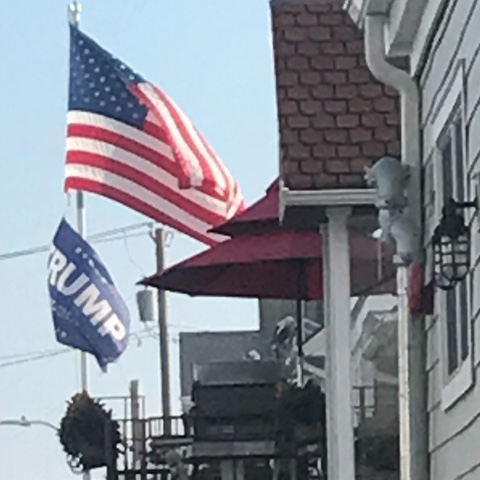
A Trump flag in Long Beach, NY.

“Hate has no home here” signs are really no different than the Trump signs that have popped up since his election — not the election signs, but signs that proclaim support of the 45th president and restate his slogan “Make America Great Again” — or the sign on my neighbor’s yard that proclaims “Proud to Be an American” (like the song). I don’t take either of these signs as questioning my Americanness or my patriotism (even if that might be — I can’t know without asking — the intent of the sign displayer). I know where I stand and I’m glad to know where you stand, as well, even if we disagree, even if it might mean we should keep some distance between us.

The reaction to the signs, like our efforts to dismiss he possibility of debate, is a symptom of a larger problem in American politics and society, one that is making it difficult, if not impossible to create the temporary alliances that need to be created to move the nation forward. I don’t mean we have to give in to racists and white supremacists, but we have to acknowledge those points where agreement can be reached and use those things we hold in common as a launch pad.

And we have to admit the humanity of our opponents, which has become difficult in our hyperpartisan era. Fox News, and more recently, cites like Breitbart, demonized their opponents, seek to take political or philosophical differences, paint their opponents as morally deficient because of these differences, and then bludgeon them with the differences.

I think this is partly why we view signs like “Hate has no home here” as provocations, rather than indicators of what the sign-owners believe.