Garden State Hybrids exhibit to feature poetry and photos

IMG_9618

Garden State Hybrids, an ekphrastic show featuring the photography of Kevin Hinkle and poetry from an array of central New Jersey writers, will run from Jan. 22 to March 9 at the Somerset Cultural & Heritage Center, 20 Grove St., Somerville, NJ. My poem “Invisible,” which is based on Hinkle’s photo “Aftermath no. 6,” will be among those on display.

There will be an opening/reception on Jan. 25 from 6 p.m. to 8 p.m. I should be there, and I hope to see some of you, as well.


Reading and Exhibit at New Brunswick library

23131805_10213451226891688_7740903981119633695_nSherry Rubel will launch her exhibit of photos from her work in Lakewood Tent City on Saturday with a poetry reading by Hank Kalet and a discussion by both Rubel and Kalet.

The event will take place in the Carl Valenti Community Room of the New Brunswick Public Library, 60 Livingston Ave., New Brunswick, from noon to 1:30 p.m. on Saturday, Nov. 4.

See Facebook page.

Disorganized notes on the dangers of political nostalgia

I’ve been thinking a lot about the dangers of nostalgia as a political ideology. I wrote about it in a column last year, focusing on Trump’s Make America Great Again slogan and Bernie Sanders’ call to take our country back. Both are backward-looking slogans — “again” and “back” implying some more Edenic past that is as much myth as it is reality.

Nostalgia is paralyzingly politically — and personally. If we can only look backward, then we lose the ability to function honestly in the present or to look forward without baggage.

Daniel Zamora explains why in a piece at The Jacobin: “a ‘return’ to the past is neither possible nor desirable.”

At most, it’s a fantasy that has no chance of being realized in genuinely emancipatory ways. On the contrary, this feeling of nostalgia is today at the heart of the political success of far-right parties, but also, increasingly, of the mainstream right.

This return to the past is seductive to a non-negligible fraction of the working class. In advocating for a radical reversal of cultural liberalization, and of the cultural effects of neoliberal globalization, these parties have managed to win both the ideological and economic battle. They propose no real alternative to capitalism, while winning the political struggle on the terrain of family values, work, and responsibility.

This nostalgia, with its clearly conservative effects, nevertheless hides within it a progressive dimension. Thus, like religion in Marx’s account, it is “the sigh of the oppressed creature, the heart of a heartless world, and the soul of soulless conditions. It is the opium of the people.” But this opium is “at one and the same time, the expression of real suffering and a protest against real suffering.”

This is why, I think, there was some overlap between the Trump and Sanders’ camps, even if there was almost nothing ideologically that would tie them together. Even on trade, an area that might seem on first blush to be a common bond, the differ greatly. Trump’s argument is not about protecting workers, but about getting a better deal for America, which in turn would help workers. It is a nationalism that promises undefined benefits to a class of people who would continue to lack power under these renegotiate trade pacts.

Sanders’ argument on trade is based on the concept of worker power — the new trade regime robs workers of their ability to control their own fate by making it easier for large corporations to undercut union power. Trade deals that lack worker input only further empower the bosses.

But this matters little in our dumbed-down version on contemporary politics, which relies on accepted narratives set in place decades ago and tends to be visual in a dangerous, omni-directional and consumerist way. We are passive receivers of wisdom, of information, expecting the people we elect to operate on our behalf. And while that is how representative democracy is supposed to work in its broadest outlines, there always has been an assumption embedded in our founding documents that we would be more than passive observers. Not that we’ve ever been the fully engaged polity we need to be for this government of ours to function on our behalf. Part of this is structural, as Howard Zinn points out, baked into the original cake by an elite that was fearful of too much self-government. Part is an inertia created by the stresses of the modern economy, which conspires to keep most of us chained to our desks or machines and focused only on earning enough to pay the rent. And part is a modern version of the Roman bread and circuses — an array of entertainments and distractions that leaves us as passive recipients of pre-digested pablum that, in the political realm, takes the form of cable news, empty slogans (“I’m with her,” “Make American Great Again,” etc).

Nostalgia, as Zamora writes, is an opiate. It insures us to the real questions, keeps us docile by presenting a simple narrative that makes use of our own faulty or biased memories. Yes, there were better times in the past, we can say, when factory jobs were plentiful. When we could expect our kids to do better than we did, and so on. But these good times were not good times for all — African Americans were conspicuously excluded both by law and by a set of unstated rules from this version of the American dream. Barack Obama’s rise to the highest office in the land only proves the point, the inconceivability of his story and the backlash his election caused among many whites are indications of the exceptional nature of his accomplishment. (Exceptional in that he exceeded a limit that had been imposed on African Americans, not that African Americans are incapable, which is a lie racists tell themselves.)

Opiates mask the pain, protect us from the immediate suffering. While they can moderate pain and give the body a chance to relax and heal, they more often end up insulating the user from the reality of his or her existence — until the opiate runs out and the user is left in withdrawal. My pain is go e, so I don’t have to address where the pain comes from; I can ignore the structural issues and pretend it’s all OK. I don’t have to change anything.

We can continue to ignore what has actually happened — the growth of corporate power, the erosion of unions, the willful destruction of the social safety net and social cohesion — and maintain the mythology of the Edenic past.

Even the losers get lucky — notes on Tom Petty

Tom Petty has died. The 66-year-old rocker suffered a hear attack in California, cutting short a long career and leaving fans like me a bit dazed.

It’s been a rough stretch for musical icons — in the last two years we’ve lost Bowie, Prince, Leonard Cohen, Maurice White, Phife Dawg, Merle Haggard, Leon Russell, Glenn Frey, Sharon Jones, Charles Bradley, Keith Emerson and Greg Lake, George Michael, Grant Hart, Glenn Campbell, Walter Becker, Gregg Allman, Don Williams, Chuck Berry, Clyde Stubblefield and so many others.

Perhaps more Han all of these artists, however, more even than Bowie and Prince, Petty is a part of my personal artistic mosaic, a musician whose work has helped remind me to push ahead with my own vision and not to concern myself with fads or convention. Petty was the first of these artists to capture my musical soul (I heard Bowie first, but fell in over with Petty’s music before I fully internalized Bowie’s) and, as such, helped develop my ear and erect the structures of taste that have guided my fanatical interest in rock and roll and soil and their various offshoots.

It was Petty’s third album that first caught my attention. Damn the Torpedoes is one of those rare records, nearly perfect, not a bad song. Released in 1979, the album wasn’t easily placed within the radio music of the time — it wasn’t metalesque stadium rock or disco, which was dominating the airwaves. It was something else, something a bit closer to rock’s roots. Like Bruce Springsteen, Petty had stripped things down — guitars, drum, bass and organ. Push the tempo. Write about love. It was a formula as old as rock, owing more to Buddy Holly than most of what could be heard on the radio at the time.

Keep in mind that 1979 was also the peak of punk and new wave’s first movement. Petty wasn’t punk or new wave, but he fit within the broader confines of this shift in sound. Damn the Torpedoes opens with a drum figure that snaps the listener to attention — like Dylan on “Like a Rolling Stone” or Springsteen on “Born to Run” — and quickly moves to a guitar riff that is now instantly recognizable. “We got somethin’, we both know it / We don’t talk much about,” he sings, “Ain’t no real big secret all the same / Somehow we get around it.”

Something shared. Something urgent. But couched in a nonchalance. “We both know it.” Petty’s voice, always a rough instrument, is almost matter of fact, until the music rises in pitch and he follows, his voice turning plaintive, pleading. “Listen, it don’t really matter to me, baby / You believe what you want to believe” he offers, bringing his point home with the chorus, “You see, you don’t have to live like a refugee.”

This line is key to understanding Damn the Torpedoes, an album on which love battles pain and hopelessness and that ends with the singer’s character on the road and profoundly changed and saved by human connection. “Refugee” sets the tone thematically, offers the listener a sense of permission: You can come in from the cold, can engage, be a part of something good. All you need is someone, however temporary.

On Damn the Torpedoes Petty mines the same vein that Springsteen mines on Born to Run — another near-perfect recording — and enters and decodes the American Zeitgeist. Remember, the late-1970s were years of waning American confidence, as we dealt with the hangover from the debacle in Vietnam, a series of oil price shocks, inflation, failing infrastructure and a long-simmering white backlash against the modest gains of the civil rights movement.

A new generation of teens were coming of age post-1960s. The optimism that marked much of 1960s rebellion — that sense that the new generation could remake the nation as a more humane place — remained was giving was to the dark undercurrent that was always a dangerous part of what the decade was about. I’ve written about this before, in an essay on Bob Dylan’s Highway 61 Revisited. The ‘60s too often is characterized as a decade of hope, of joy, of love. But it also was a decade in which political assassination played a prominent role, a decade that gave us Charles Manson and Altamont, a decade in which brutal and violent biker gangs like the Hells Angels were lionized. Yes, change was in the air, but every change and every protest designed to press for change — whether for civil rights or against the war — was met with a harsh backlash. In the end, Nixon had won the White House and Johnson’s anti-poverty programs would fail to reach their potential because of his obsession with Vietnam.

This is how the ‘60s end and the ‘70s begin, the war continuing for five more years, a president resigning, New York nearly falling into bankruptcy, and Americans falling prey to a host of crazy self-help and self-realization movements and cults.

Petty is not writing about these things anymore than Springsteen is, but he is writing within this milieu, he is soaking it up, has no choice but to respond. Petty, Springsteen, Neil Young on the brilliant Rust Never Sleeps, the punk movement, hip hop, even disco’s rush into pure hedonism (partying as a way to escape the terror) were responses.

On “Even the Losers,” Petty sings that, because of a moment of love, “time meant nothin’ anything seemed real.” The losers do get lucky, he says, using a phrase he’d revisit in his ‘82 single “You Got Lucky,” though without the anger he’d later heap on the girl that walked away. In 1979, he’s still thankful on some level that this momentary love “could kiss like fire” and make him “feel / Like every word (she) said was meant to be.”

Yes, “even the losers / Get lucky sometimes / Even the losers / Keep a little bit of pride,” but only if the romanticism is tempered by a bit of reality.

Two cars parked on the overpass
Rocks hit the water like broken glass
Should have known right then it was too good to last
It’s such a drag when you live in the past

Petty release a lot of great albums after Damn the Torpedoes, some that deserve to be discussed as among the best in the rock era. But Damn the Torpedoes is his one unassailable classic, he single record that makes his reputation. Few artists can claim to have created something so pure and direct that it both explains its moment in history and stands above it and continues to speak decades later.Send me an e-mail.


South Brunswick, say goodbye to Best Buy

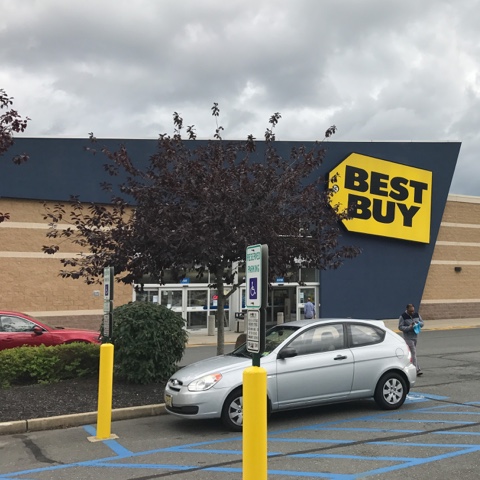
Best Buy on Route 1 is closing, continuing a trend that may best be described as a musical chairs of South Brunswick retail.

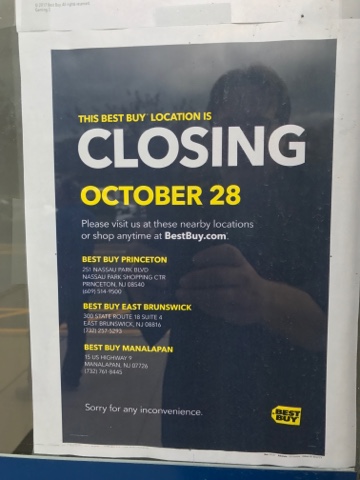
We stopped there today and we’re met with a sign on the door announcing an Oct. 28 closing date and directly shoppers to three other stores in the region.

We were surprised but, given the struggles chain has experienced in recent years as more of the electronic market has moved on line and the recent closing of Staples next door, maybe we shouldn’t be.

Staples is another struggling national chain. Its inventory partly overlapped that of Best Buy. It’s closing, then, made sense. Its storefront was filled quickly — Bob’s Furniture opened recently, but only after leaving the long-struggling South Brunswick Square, which now has to fill yet another vacancy.

More recently, Steinmart on Route 27 announced it was closing, with workers there and others in the shopping center citing a rent hike. Workers at Best Buy could only speculate — one said he had no idea, while another said “real estate,” but neither was in a position of real knowledge.

The Street, a business publication, explained in early 2016 that Best Buy was closing stores “rather quietly” and has been shrinking its footprint slowly.

“A company of our size is going to make the decision not to renew leases or to close or relocate stores from time to time as a normal course of business,” added the spokesperson. “Some stores no longer make sense to keep open for a range of reasons, from the strength of a retail center to the shopping pattern of customers to the cost of a new lease to store performance.”

At the same time, as 24/7 Wall St. reports, annual sales have fallen about 20 percent over the last five years and, while the company says it has turned a corner, 24/7 has a different analysis..

Best Buy is not turned around, at least as measured by revenue and comparable store sales. Fiscal 2018 is shaping up as another in which store sales will drop. It is hard to argue there is enough cash for Best Buy’s current 1,363 stores. If early fiscal 2018 follows the pattern of recent years, the store count becomes a larger problem.

I’m just speculating. The closing of the South Brunswick store could have many causes, from Best Buy’s own difficulties to what appears a tepid retail climate in the South Brunswick area, especially along Route 1.

We would appear to have an ideal location, but we’ve been slow to develop the highway. This has been purposeful — there had been at one time a general political consensus that the 7-mile stretch on Route 1 should not be allowed to develop into an Edison or Route 18 in East Brunswick. Hat has left the retail to open in nearby towns — notably, North Brunswick and West Windsor.

His lack of retail puts pressure on the existing strip malls — he two big ones (the Target center and South Brunswick Square), the lone small strip mall (formerly Carkhuff’s Garden Center) and the stray stores and fast-food restaurants.

We may need to rethink what we want this highway to look like when it’s time to renew the Master Plan, assuming we are interested in housing a vibrant retail presence in the township.