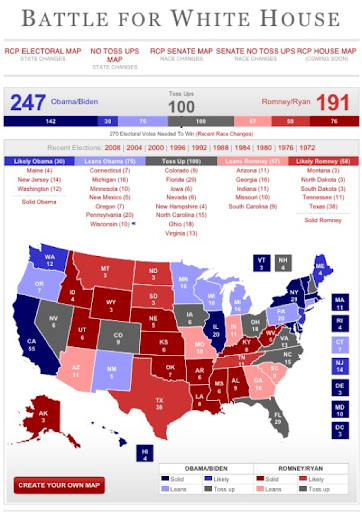
The path to the White House narrows for Mitt

If the current state-level polling holds, it is difficult to see how mitt Romney can win the White House. According to Real Clear Politics, which is where this map comes from, President Barack Obama has 247 electoral votes that are considered either solid, strong or lean blue — essentially states where he leads by better than 5 percentage points. Romney, on the other hand, is at 191.

To win the White House, therefore, Romney needs either to peel off support in states like Pennsylvania, Michigan and Wisconsin or come close to running the table on the rest of the states. All Obama needs to do to win at this point, is keep the 247 and win Florida, or win Ohio and Iowa or some other combination that will get him 23 electoral votes. Given that polls show him leading in Florida, Ohio, Virginia — all but North Carolina among the so called swing states — we could see an electoral romp.

Romney can still win — events have a way of altering the play book — but his downright strange performances in the GOP debates and completely disorganized campaign do not bode well for him.

Christie’s sham comeback

This should sober the New Jersey electorate. Standard & Poor, one of the nation’s major and most influential credit-rating agencies, has slammed Gov. Chris Christie’s budget projections for essentially being built on a foundation of sand.

The credit agency “downgraded the state’s financial outlook to negative from stable,” because “it believed the governor’s revenue projections for the current fiscal year were overly optimistic, warning that the budget was structurally unsound.”
In particular, the agency took note of the administration’s reliance on one-time transfers of money to fill gaps in the state’s $32 billion budget. At the same time, it noted that the state will have to spend more in the coming years to meet pension and Medicaid obligations.
The state retains its AA– rating on general obligation debt and A+ on appropriation debt, “but the lowering of the outlook indicates a likelihood that those ratings will be downgraded in the next two years.”
As the Times reports, the S&P assessment follows a revenue report from the nonpartisan Office of Legislative Services that said the state fell $254 million in revenues, including “a particularly large decline — 9 percent — in corporate tax revenue.” In addition,

Moody’s Investors Service and Fitch Ratings, the two other big ratings agencies, have also recently warned that revenues would lag behind the governor’s expectations, which would require significant revisions to this year’s spending plan because state law requires a balanced budget. Moody’s warned that the revenue shortfalls “leave the state exposed to a midyear structural imbalance.”

The report underscores something that should be clear by now to almost everyone: the governor is far from the new-wave, budget reformer he has painted himself to be. The governor’s claims that he would end the use of budgetary gimmicks like those relied on in the past to balance the state’s budget are no more truthful than his own revenue assumptions. The governor, preparing for his re-election campaign, has been pushing a fiscally questionable tax cut and has refused to raise taxes for those at the top of the income hierarchy. He has withheld payments to the state pension fund, claiming that doing so was part of a reform of the fund and not another gimmick designed to push off obligations into the future.And he has raided an array of funds that had been set aside for other uses.

What the governor has managed to engineer is not the comeback he has been proclaiming, but more of the same — a state-level three-card monte game dressed up in pseudo-libertarian garb.

  • Send me an e-mail.
  • Read poetry at The Subterranean.
  • Certainties and Uncertainties a chapbook by Hank Kalet, will be published in November by Finishing Line Press. It can be ordered here.
  • Suburban Pastoral, a chapbook by Hank Kalet, available here.

Defining freedom: speech, protest and the Middle East

In a perceptive piece today in The New York Times, David D. Kirkpatrick describes the violent protests in the Middle East as something very different than the cliched language we have been getting from many on the right (and some on the left). The issue, he says, comes down to the way we describe freedom:

When the protests against an American-made online video mocking the Prophet Muhammad exploded in about 20 countries, the source of the rage was more than just religious sensitivity, political demagogy or resentment of Washington, protesters and their sympathizers here said. It was also a demand that many of them described with the word “freedom,” although in a context very different from the term’s use in the individualistic West: the right of a community, whether Muslim, Christian or Jewish, to be free from grave insult to its identity and values.

The argument is not a novel one. It is the central tension in a free society — how to define freedom and whether the right of free speech and expression trumps a person or community’s right to be free from insult or injury.

The protests engulfing the Middle East are less about the silly little film produced by a small band of bigots than they are about a larger sense of victimization. They come after a multi-decade assault by the American government on the Muslim world, one that started before 2001. Without being an apologist — violence, especially at the level perpetrated by the terrorists on 9/11, cannot be justified — we have to acknowledge that we have been at war with the Muslim world for decades and that this has not exactly won us a lot of friends in the Middle East.

The anti-Muslim attitude only got worse after 9/11 and is not just the province of crazy extremists like the Rev. Terry Jones. It has become a regular part of our discourse, mouthed by even the most respectable members of the political and chattering classes.

Consider Joe Scarborough, MSNBC morning host and a former member of Congress. His rant this morning is a classic of the culture-clash argument, one that conflates a host of grievances, real and imagined in the Muslim world, into an all-encompassing ideology of hate for the west:

“You know why they hate us?” he said. “They hate us because of their religion, they hate us because of their culture, and they hate us because of peer pressure. And you talk to any intelligence person, they will tell you that’s the same thing, and all those people who think we’re going to go over there and change them are just naive.”

Scarborough said that there had been “unrestrained savagery” throughout the Middle East. “One intelligence person told me, if you scratch the surface, and if you gave every street vendor, from street vendor to prime minister in that region a chance to throw a rock at the U.S. embassy, they would,” he continued.

Scarborough then went through many policies that are deeply unpopular throughout the Muslim world, saying that none of them could have played a part in the protests.

“They hate us because of waterboarding? No they don’t,” he said. “They hate us because they hate us. They hate us because of Obama’s drone attacks? No they don’t. They hate us because they hate us.”

This kind of argument gets us nowhere. It ignores the real issues — our consistent and continued embrace of some of the worst dictators, when it’s convenient; our focus on oil and stability to the exclusion of other issues — and fails to address the actual cultural differences that Kirkpatrick’s quotation underscores.

Just as significantly, it does nothing to make these newly freed people understand the value of the American First Amendment. If the right to speak both verbally and symbolically is going to gain a toehold elsewhere in the world, we need to make it clear why it stands as our most cherished political value — and we need to stop with the hypocritical defenses we tend to make. Democrats have a bad habit of defending speech only when it is convenient to their electoral prospects (Glenn Greenwald offers an excellent summary of Obama’s failures regarding the current crisis here). That has allowed conservatives stand in as defenders. But the people now defending the right of the pastor in Florida to put Muhammad on trial or to allow for the production of a film like the one that ignited these latest protests, are also the first people to push for bans at home on speech that they abhor and to cheer when people they dislike are arrested and charged purely for what they say.

As Greenwald  says, those of us who “ignore or even cheer for the suppression or punishment of views they dislike, while loudly decrying it when it comes to the views they share, are not believers in free speech.”

They are just rank manipulators who exploit free speech values in an attempt to ensure that only their views can be heard while the views they despise are suppressed. This, unfortunately, is the clear history of the American right, now marching so flamboyantly behind the free speech banner in order to protect hateful anti-Islam speech.

It is also the history of many on the left (I am talking about so-called liberal mayors who have wear their crackdowns on the Occupy protests as a badge of honor).

We need to remember that protest is a legitimate response to an affront — protected by the First Amendment here and the most effective tool historically to make change. The protests in the Middle East come from that tradition. Advocates of free speech need to stand up for the makers of this absurd film and for the protesters, while condemning the violence.

  • Send me an e-mail.
  • Read poetry at The Subterranean.
  • Certainties and Uncertainties a chapbook by Hank Kalet, will be published in November by Finishing Line Press. It can be ordered here.
  • Suburban Pastoral, a chapbook by Hank Kalet, available here.
See Basil Rouskas and Hank Kalet read this afternoon

cropped-sblogo_smaller_180InstalledHeader19Apr12-1


What: Poetry reading featuring Basil Rouskas and Hank Kalet

When: Sunday, Sept. 16, at 2 p.m.:

Where: South Brunswick Public Library, 110 Kingston Lane, Monmouth Junction

Free. A donation of a nonperishable food item for the South Brunswick Food Pantry is requested. Open reading to follow.

Contact: otherhalf@comcast.net

History and mythology: Clinton and the Democxrats

I want to continue on the theme of last night’s post, which essentially is that those who do not remember their history are doomed not to repeat it but to never escape it.

I took some flak on Facebook for a comment I made about Bill Clinton contributing to the financial meltdown because of his role in taking down the firewall between investment firms and banks that had been created during the New Deal.

The New York Times describes the Glass-Steagall Act (aka, the Banking Act of 1933) “as an emergency response to the failure of nearly 5,000 banks during the Great Depression.”;

It gave tighter regulation of national banks to the Federal Reserve System; prohibited bank sales of securities; and created the Federal Deposit Insurance Corporation (FDIC), which insures bank deposits with a pool of money appropriated from banks.

The law, part of the New Deal, was a response to the public loss of confidence in the banking system after the stock market crash and bank runs that led to hundreds of banks shutting their doors.

Beginning in the 1900s, commercial banks established security affiliates that floated bond issues and underwrote corporate stock issues. (In underwriting, a bank guarantees to furnish a definite sum of money by a definite date to a business or government entity in return for an issue of bonds or stock.) The expansion of commercial banks into securities underwriting was substantial until the 1929 stock market crash and the subsequent Depression. In 1930, the Bank of the United States failed, reportedly because of activities of its security affiliates that created artificial conditions in the market. In 1933, all of the banks throughout the country were closed for a four-day period, and 4,000 banks closed permanently.

As a result of the bank closings and the already devastated economy, public confidence in the U.S. financial structure was low. In order to restore the banking public’s confidence that banks would follow reasonable banking practices, Congress created the Glass-Steagall Act. The act forced a separation of commercial and investment banks by preventing commercial banks from underwriting securities, with the exception of U.S. Treasury and federal agency securities, and municipal and state general-obligation securities. Likewise, investment banks may not engage in the business of receiving deposits.

The legislation was never popular with the banking and investment sectors, but the New Deal was considered sacrosanct for years preventing the rule from coming under attack.

Beginning in the 1970s — with Nixon and then Carter — there was a shift in attitudes on regulations and the transportation sector was deregulated. The energy sector followed, along with the easing of some regulations in banking (a factor in the Savings and Loan crisis of the ’80s). Every president from Nixon through George W. Bush engaged in the deregulatory fever, which gave more power to industry by stripping some legal oversight from government but also by creating an atmosphere in which oversight was considered anti-business.

This brings me to Glass-Steagall and Bill Clinton. The Glass-Steagall rules already had been weakened by the time Clinton’s treasury secretary, Robert Rubin, and Congressman Jim Leach (R-Ia.) starting working to remove these prohibitions from the law. The Clinton administration already had approved several mergers of investment and commercial banking entities, so the passage of the Gramm-Leach-Bliley Act was seen as a logical next step.

It also was part of a larger philosophical push in the Clinton administration to allow for more “creativity” in the financial sector, an effort that resulted in more mergers and a host of new — and questionable — banking products.

Here is how Time Magazine described the Clinton era in a piece on “The 25 people to blame for the financial crisis“:

President Clinton’s tenure was characterized by economic prosperity and financial deregulation, which in many ways set the stage for the excesses of recent years. Among his biggest strokes of free-wheeling capitalism was the Gramm-Leach-Bliley Act, which repealed the Glass-Steagall Act, a cornerstone of Depression-era regulation. He also signed the Commodity Futures Modernization Act, which exempted credit-default swaps from regulation. In 1995 Clinton loosened housing rules by rewriting the Community Reinvestment Act, which put added pressure on banks to lend in low-income neighborhoods. It is the subject of heated political and scholarly debate whether any of these moves are to blame for our troubles, but they certainly played a role in creating a permissive lending environment.

Barry Ritholtz, writing at The Big Picture, a financial blog, makes a similar point. It was part of a larger effort that implicates at least seven presidents and hundreds of politicians of both parties who were pushed by an industry that has come to have an outsized role in funding our political campaigns and, therefore, in making rules.

The repeal of Glass-Steagall may not have caused the crisis — but its repeal was a factor that made it much worse. And it was a continuum of the radical deregulation movement. This philosophy incorrectly held that banks could regulate themselves, that government had no place in overseeing finance and that the free market works best when left alone. This belief system manifested itself in damaging ways, including eliminating regulation and oversight on derivatives, allowing exemptions for excess leverage rules for a handful of players and creating dangerous legislation.

As the events of 2007 to 2009 have revealed, this erroneous belief system was a major factor leading to the credit boom and bust, as well as the financial collapse.

I have been unable to find any evidence that the Gramm-Leach-Bliley Act — the legislation that repealed Glass-Steagall — was a primary cause of the financial crisis. Imagine a “but for” scenario where Glass-Steagall had not been overturned but the rest of the deregulatory actions had still taken place. Would the crisis have occurred? Without a doubt, yes.

The Fed still would have taken rates down to unprecedented low levels. This would have led to a global spiral in asset prices. The nonbank, lend-to-sell-to-securitizer mortgage originators were still going to make subprime-mortgage loans to unqualified borrowers. Bear Stearns and Lehman Brothers would still have overwhelmingly increased exposure to subprime mortgages. AIG would still have written trillions of dollars in credit-default swaps and other derivatives with zero reserves set against them. The largest security firms and deposit banks would still have charged headlong into the subprime securitization business. And Fannie Mae and Freddie Mac would still have belatedly chased these banks into the same subprime market, just at the peak of the housing boom.

Lastly, housing prices would still have run up to absurd levels and then collapsed.

He goes on to make clear that “Glass-Steagall’s repeal allowed the credit bubble to inflate much larger” and “banks to be more complex and difficult to manage.”

When it all came down, the crisis was broader, deeper and more dangerous than it would have been otherwise.

The repeal of elements of Glass-Steagall helped facilitate the growing financialization of the economy and a crony capitalism that gives the leverage and investment firms and big banks more power over the economy than people who actually build things.

Clinton played a major role in all of this, as did every president starting with at least Jimmy Carter and running through George W. Bush. The point here is not to trash Clinton, but to insert a bit of historical perspective into the mix at a time when he is being lauded in the press and being loved by Democrats who insist on viewing the 1990s through rose-tinted glasses. Clinton has become the Democrats’ rock star, and the assumption is that criticism of his tenure in the White House either makes you a Republican or a crank.

We cannot begin to rebuild our economy unless we understand the failures of the recent past and honestly assess those in leadership positions.

  • Send me an e-mail.
  • Read poetry at The Subterranean.
  • Certainties and Uncertainties a chapbook by Hank Kalet, will be published in November by Finishing Line Press. It can be ordered here.
  • Suburban Pastoral, a chapbook by Hank Kalet, available here.
