
The headline to this post — “It’s Official: We’re in a Recession” — from The Washington Post’s Ticker blog may be accurate, but it really isn’t very surprising. The economy has been sputtering like an over-stressed engine for a long time and most of us in the working world have been feeling stuck on the highway for a long, long time already.
The Return of Keynes, Krugman edition
Paul Krugman’s column in today’s Times travels some of the same terrain trod by Robert Reich late last week, offering a concise rebuttal to the deficit/inflation hawks and a compelling defense of public investment as the b est way out of our current economic mess.
Krugman says that “the deficit worriers have it all wrong” and that “strong fiscal expansion would actually enhance the economy’s long-run prospects.”
The claim that budget deficits make the economy poorer in the long run is based on the belief that government borrowing “crowds out” private investment — that the government, by issuing lots of debt, drives up interest rates, which makes businesses unwilling to spend on new plant and equipment, and that this in turn reduces the economy’s long-run rate of growth. Under normal circumstances there’s a lot to this argument.
But circumstances right now are anything but normal. Consider what would happen next year if the Obama administration gave in to the deficit hawks and scaled back its fiscal plans.
Would this lead to lower interest rates? It certainly wouldn’t lead to a reduction in short-term interest rates, which are more or less controlled by the Federal Reserve. The Fed is already keeping those rates as low as it can — virtually at zero — and won’t change that policy unless it sees signs that the economy is threatening to overheat. And that doesn’t seem like a realistic prospect any time soon.
What about longer-term rates? These rates, which are already at a half-century low, mainly reflect expected future short-term rates. Fiscal austerity could push them even lower — but only by creating expectations that the economy would remain deeply depressed for a long time, which would reduce, not increase, private investment.
Krugman offers some historical parallels — the mid-point of the Great Depression, Japan in the 1990s — that offer glimpses into what happens when “tight fiscal policy” becomes the overriding approach during a harsh downturn: Reduced public investment “reduces private investment.”
What made fiscal austerity such a bad idea both in Roosevelt’s America and in 1990s Japan were special circumstances: in both cases the government pulled back in the face of a liquidity trap, a situation in which the monetary authority had cut interest rates as far as it could, yet the economy was still operating far below capacity.
And we’re in the same kind of trap today — which is why deficit worries are misplaced. One more thing: Fiscal expansion will be even better for America’s future if a large part of the expansion takes the form of public investment — of building roads, repairing bridges and developing new technologies, all of which make the nation richer in the long run.
Krugman is not advocating for a “permanent policy of running large budget deficits,” but rather for policies to reverse the “fundamental shortfall in private spending” that is tethering us in place.
Let’s do the time warp again
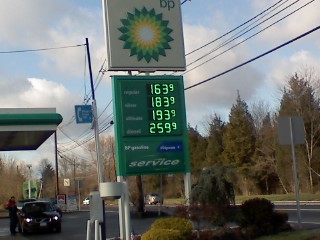
When was the last time gas prices were at $1.63 a gallon for regular? Is this a time warp or have the last several years been a series of bad dreams?
This message was sent using the Picture and Video Messaging service from Verizon Wireless!
To learn how you can snap pictures and capture videos with your wireless phone visit www.verizonwireless.com/picture.
To play video messages sent to email, QuickTime� 6.5 or higher is required. Visit www.apple.com/quicktime/download to download the free player or upgrade your existing QuickTime� Player. Note: During the download process when asked to choose an installation type (Minimum, Recommended or Custom), select Minimum for faster download.
Advice to the president-elect
Here is advice from progressive columnists for President-elect Barack Obama that is definitely worth reading.
Money, that’s what I want
I’m sitting here doing our bills — or, rather, making a vane attempt to pay what’s due.
There is the mortgage, the credit cards, the phone and cable. Our lifestyles is pretty normal — we spend a bit more than we should, but our debt falls well below the average American’s (total credit card debt is about $3,000 or so) and we make a strenuous effort to pay it down quickly. We always pay more than the minimum, and we’re rarely late with a payment — especially since we started taking care of it online.
Our medical expenses, as well, are rather moderate compared with most — some prescriptions and some co-pays, but nothing dramatic.
And yet, this biweekly ritual always depresses me.
Mostly, I worry that something could happen to alter the current balance — one of us getting sick, for instance, or losing a job.
That’s not out of the realm of possibility, of course. Layoffs are a fact of American life — Citigroup recently announced layoffs that will total almost 75,000 jobs when done (20 percent of the work force), the auto companies are in dire straights and the newspaper industry has been hemorrhaging jobs for years. And that’s just the tip of the iceberg.
Unemployment is up — 6.5 percent — and could continue its climb. There are 10 million Americans out of work who are still seeking work, several million more who have given up or are working part-time because they can’t find anything else. And the unemployed are staying unemployed for longer and longer.
So the income side of the ledger always is in doubt, the balance that allows us to live in this ranch house and drive a nice car always teeters on the edge of failure.
And, yes, it’s scary. Anyone who says it isn’t is deluding themselves.
 Hank Kalet