
Negotiating from weakness

Matt Rothschild offers the most accurate assessment of the healthcare plan unveiled by the House Speaker Nancy Pelosi and House Democrats yesterday. There are good elements likely to improve the system, but it “isn’t near perfect.”

Rothschild offers several points: “it doesn’t allow the government to set the reimbursement rates,” giving insurance companies the power “to negotiate those rates with the government.” That’s a prescription for higher insurance company profits, but not a lot of consumer savings.

And while it creates a public plan, it “would not be open to everybody,” meaning that it cannot act as real competition, making it unlikely that it would keep costs down.

And it doesn’t cover everyone — not the undocumented, who seem to be on the outside no matter who’s writing the legislation, but about 10 million Americans. That’s not just morally indefensible, but foolish. Real reform, as Rothschild points out “must include health care coverage for everybody in America, not just citizens.”

He writes about the undocumented, but his argument is valid for everyone left without insurance, that the uninsured “will end up going to the emergency room for costly care when they could have been treated initially, at much less cost, if they had health care coverage.”

I suspect that the Pelosi will get through the House and then get watered down in the Senate. If that happens, it will once again show that the Democrats do not know the first thing about negotiating — which would leave us with weaker reforms than we need, without much of a chance for a second bite at this apple.

It’s still a numbers game

It’s about numbers, and the most recent number to hit the New Jersey is the registration figure released by Secretary of State Nina Wells (as reported in The Star-Ledger):

New Jersey Secretary of State Nina Mitchell Wells said the state has 5.22 million registered voters, down from 5.35 million in 2008 when the presidential race brought a registration surge.

There are still more Democrats than Republicans — 1.77 million to 1.06 million. But Republicans have closed the gap a bit, adding some 5,000 voters since last year. Meanwhile, the number of Democrats dropped by a similar amount.

Nearly half of the voters — 2.51 million — are registered as “unaffiliated.”

It’s not much of a change, especially when you consider last year’s record registration figures. And it seems pretty clear that quite a few of those still registered will be staying home next week. The question is: Which candidate benefits?

Our best just ain’t good enough

We will have a public option, but it appears that the plan being worked out in Congress will fall short of what it needs to do — leaving more than 10 million Americans uninsured, limiting the public option available only to the currently uninsured and mandating that Americans buy insurance from the insurance companies.

As Dennis Kucinich asked today from the House floor, “is this the best we could do?”

“Is this the best we can do? Forcing people to buy private health insurance, guaranteeing at least $50 billion in new business for the insurance companies?

“Is this the best we can do? Government negotiates rates which will drive up insurance costs, but the government won’t negotiate with the pharmaceutical companies which will drive up pharmaceutical costs.

“Is this the best we can do? Only 3% of Americans will go to a new public plan, while currently 33% of Americans are either uninsured or underinsured?

“Is this the best we can do? Eliminating the state single payer option, while forcing most people to buy private insurance.

“If this is the best we can do, then our best isn’t good enough and we have to ask some hard questions about our political system: such as Health Care or Insurance Care? Government of the people or a government of the corporations.”

Howard Dean may be right that this is a step in the right direction, but with a strong Congressional and Senate majority, the Democrats had a responsibility to stand up for us and not for the insurance companies.

Opening night and it’s already ‘wait until next year’

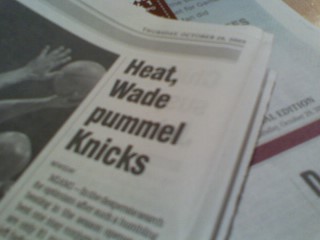
I almost made it to halftime, last night, before the bricklaying by the Knicks sent me scurrying for cover.

It was opening night for what promises to be a long season, one likely to be full of distracted longing for the kind of superstar the team has lacked since Patrick Ewing was in his prime.

Some thoughts: Mike D'Antoni is the right guy to lead the team through this, to get the most out of a cast of supporting players and those biding their time before they'll be searching for work. Donnie Walsh has a plan, which is a novel concept at the Garden.

The Europeans — Darko Mlicic and Dano Galinaro — bear watching and could prove useful when the new era begins next year. Wilson Chandler fits into this category, as well.

What about David Lee? He's certainly worth keeping, but at what cost? He's signed through the end of the year, which means he'll be on the market with the marquee guys. How much of your cap space do you spend on him?

I'll watch — until the bad play stops me,

This message was sent using the Picture and Video Messaging service from Verizon Wireless!

To learn how you can snap pictures and capture videos with your wireless phone visit www.verizonwireless.com/picture.

Note: To play video messages sent to email, QuickTime� 6.5 or higher is required.

The nightmare begins

I can’t watch the World Series this year, not with the two teams I hate most playing against each other. Root for the Yankees? The Phillies? Baseball is over, as far as I’m concerned. I’ll watch the Knicks, knowing they’re not supposed to be very good — and thinking about a 2010-2011 season with LeBron James, Chris Bosch or Dwayne Wade in the orange and blue.