
New legislative map a result of flawed goals

Democrats are happy with the new legislative map approved by the state’s redistricting commission, for no other reason than it is likely to preserve the party’s control of both houses of the state Legislature.
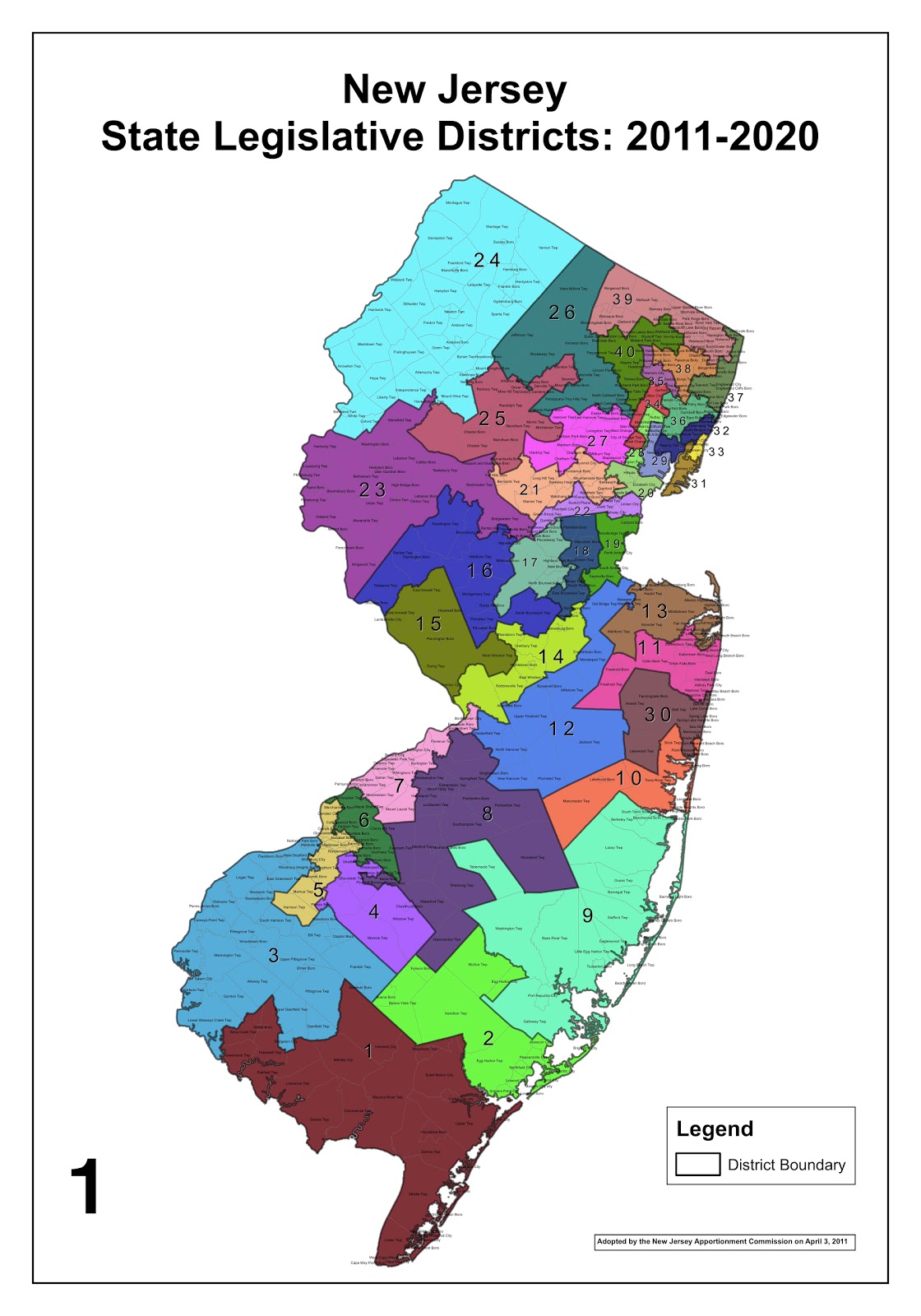
The final map, courtesy of the New Jersey Department of State

The Democrats’ attitude can be summed up pretty succinctly with this quotation from Mark Magyar’s story on NJ Spotlight:

“I’m keeping 24!” said an elated Senate President Stephen Sweeney (D-Gloucester), whose party holds a 24-16 majority.

Alan Rosenthal, the Rutgers professor brought in as the 11th member after it was clear that the two parties had deadlocked, listed his goals for the process early on, so the outcome here should not surprise anyone.

But Rosenthal’s goals — like the entire process —  were badly flawed. Rosenthal privileged continuity of representation above nearly every other goal, which meant that any map he was likely to back would be one that would safeguard incumbents.

In a state as dysfunctional as New Jersey, however, one has to wonder why anyone would want to make it easy for the majority of legislators — the people who have helped create the mess the state is in — to keep their jobs.

The result is a map, as Magyar points out,

makes it likely not only that Democrats will continue to hold their majorities in both the state Senate and the state Assembly in next November’s election, but also that 90 percent of incumbent legislators will be reelected with relatively little difficulty.

The goals should have been:

  • increased minority representation in the state Legislature
  • districts that are compact geographically (there are too many districts under the new plan in which towns — see South Brunswick in the 16th — are connected to the rest of their district by only a sliver of common border)
  • competition in as many districts as possible

These goals, however, would challenge the status quo and endanger too many sitting legislators.

Republicans, at the moment, are crying foul, but their map was only nominally better — it was designed to increase the number of Republicans and would have committed some of the same sins committed by the new map.

The effort raises some additional questions about the composition of the state Legislature and whether the static 40-district model makes sense, whether we should experiment with other forms of representation and why we have allowed the public-financing initiative to die.

New Jerseyans might be better served by a constitutional change that ties the number of legislative seats to population rather than apportioning 40 districts across a shifting population. Or, there could be a hybrid arrangement that allows for some members to be selected through proportional representation.

There are numerous possibilities. What the latest round of redistricting proves, unfortunately, is that our system of drawing boundaries is badly flawed and needs to be changed.

  • Send me an e-mail.
  • Read poetry at The Subterranean.
  • Certainties and Uncertainties a chapbook by Hank Kalet, will be published in November by Finishing Line Press. It can be ordered here.
  • Suburban Pastoral, a chapbook by Hank Kalet, available here.

3 players who won’t be Mets when the season ends

Jose Reyes was supposed to be, along with David Wright, the long-term face of the New York Mets. But with the franchise in disarray and a last-place finish likely, and with Reyes’ due a new contract that the team may not be willing to sign, Jose tops the list of Mets whose days appear numbered.

Here’s my list:

1. Jose Reyes
2. Francisco Rodriguez. Why keep a premiere closer when you’re not going to use him like you should?
3. Carlos Beltran. If he proves he can hit, he can help a contending team.

Keep in mind that I’m not advocating any of these moves, but we have to acknowledge the realities.

This one shot is our only shot

Democrats are correct when they complain that the governor’s transportation funding plan amounts to a one-shot solution. But at least it’s a solution.

Democrats have shown little interest in finding a long-term funding arrangement for the transportation fund, which has been broke for several years and funded through a series of other one-shot gimmicks.The fact is, no one in state government has the political backbone to put the one thing on the table that would generate recurring revenue — an increase in the state’s gas tax, which is among the lowest in the nation.

Without it, we are destined to chase one-time funding solutions that will not be able to keep up with our needs and our roads will continue their deterioration.

  • Send me an e-mail.
  • Read poetry at The Subterranean.
  • Certainties and Uncertainties a chapbook by Hank Kalet, will be published in November by Finishing Line Press. It can be ordered here.
  • Suburban Pastoral, a chapbook by Hank Kalet, available here.

Unbiased statistics needed to ensure honest debate on charter schools

There appears to be some doubt about the numbers that the Christie administration has been using to “prove” its contention that charter schools are the panacea to the problems facing poor school districts.

Robert Braun, in The Star-Ledger, took the state to task for its selective approach to statistics a month ago. More recently, Gordon MacInnes does the same thing. In an opinion piece on NJ Spotlight, the former education commissioner, raises questions about the structure of studies cited by Gov. Chris Christie and acting Education Commissioner Chris Cerf to support charter schools. In fact, he writes, the “evidence for this contention is thin.”

To bolster its case, the NJ Department of Education (DOE) released in January tables of test results showing that about three-quarters of charters had higher proficiency rates on state tests than their district peers.

Not so fast.

Columnists, respected academics and public school advocates lost no time in pointing out that meaningful performance comparisons must involve students with similar characteristics — like free lunch eligibility, special education or English learner status.

Failing that, the comparisons cannot be used to decide which schools do the better job.

The department returned on March 11 with much more expansive documentation that — surprise — supported the same conclusion concerning the superiority of charters. Accompanying the multiple charts, tables and bar graphs were statements confirming and strengthening the Christie administration’s policy preferences.

Poverty status is at the core of the DOE’s contention.

Essentially, the department anchors its argument that charters are pretty much like district schools when it comes to poor kids by dismissing the distinction between “free” and “reduced” lunch eligibility.

And that, MacInnes says,  makes little sense. There are significant differences in scores between free and reduced lunch students, as well as between girls and boys in charter and public schools and those of English learners and all of these variables need to be controlled for in order that studies be taken seriously.

MacInnes — who served under Christie Whitman and serves as an assemblyman from conservative Morris County — is not taking sides in the charter debate. Rather, he is asking for an honest accounting, especially given that a handful of national studies offer evidence that directly contradicts what the Christie administration would have us believe.

Before the Christie Administration bets just about everything on charter schools, it should conduct a fair and more complete assessment of the performance of similar students. When Stanford undertook a large-scale evaluation in 17 states, it did just that. It found that only 17 percent of charter school students outperformed their district peers, but 37 percent underperformed them. The rest did about the same.

Eighty-three percent doing worse or about the same does not sound like the answer to New Jersey’s educational woes.

  • Send me an e-mail.
  • Read poetry at The Subterranean.
  • Certainties and Uncertainties a chapbook by Hank Kalet, will be published in November by Finishing Line Press. It can be ordered here.
  • Suburban Pastoral, a chapbook by Hank Kalet, available here.