Dysfunction and delusion in Washington

The lede on today’s sequestration story in The New York Times sums up the problem with the current debate over the federal budget fairly well:

Seventeen months after President Obama signed doomsday budget legislation that was never intended to become law, the sweeping spending reductions in the measure have been imposed.

The issue here is not just that the “sweeping budget reductions,” as the Times calls them, are now taking place, or that they will damage a fragile (at best) economic recovery. The issue is that the entire sequestration process was a sham that underscores how broken our political system has become.

And what better way to express this issue than by admitting that a law passed by both houses of Congress and signed by the president “was never intended to become law.”

To rephrase: The president signed a law that was not supposed to be law. And now we have both sides accusing the other of bad faith as we wait for the painful cuts to take effect — with Republicans like New Jersey Gov. Chris Christie saying it is up to the president to strike a compromise (why is it he only weighs in on national issues, aside from Sandy, when he can do damage to Democrats?) or John Boehner saying the House had done its part (what, by sitting on the sidelines for the last two months?).

Let me say, up front, that I think the blame here is with the Republicans, though I want to add that Democratic failures in 2011 helped lay the ground for a bad compromise.

But none of that really matters now. What we have is foolish legislation taking effect that both sides admit they never wanted to take effect. That, for me, is the definition of delusional.

In school, but without a home

The Times of Trenton editorialized today on the growing problem of homeless students, calling on Trenton schools to make sure they’re providing adequate services. That’s fine, as far as it goes, but it misses the forest for the trees

The 200 or so homeless children are an indication that something very wrong is happening in the region.

Mercer has among the best homelessness programs in the state, but the numbers are proof that even a comprehensive, housing first approach has its limits. The issue is both a lack of housing and, more importantly, the failures of a corporate capitalism that values profit and nothing else. Until we address this breakdown, there are minor enough programs to keep people — or even kids — of the streets.

The endorsement game

Gov. Chris Christie received the endorsement of what is being called a major Latino group yesterday, while his likely opponent is expecting to win the backing the state workers’ union.

These are potentially important moves early in the gubernatorial campaign — but coverage of the endorsements has failed to explain why.

Take this piece from NJ.com — a good piece of daily coverage, but also an example of the failings of traditional campaign coverage. The story, while it offers an explanation for the endorsement —

He said the Hispanic group’s 30-member board voted unanimously to back Christie because he took on the state’s largest teachers union, approved more charter schools and agreed to expand the state’s Medicaid program despite his opposition to the new federal health care law.

“Over the last three years, Governor Christie has listened to our concerns, worked closely with us and given us a seat at the table,” Perez said. “We can count on his commitment to lead the Republican Party towards greater inclusivity.”

Perez said Christie told him he supported “comprehensive immigration reform” and favored a path to citizenship for undocumented immigrants. But Christie did not discuss specifics in his remarks, and declined to take questions after the event.

— it doesn’t really place the endorsement in context. How large is the Latino population? What percentage of it votes? How important a role does
the Latino Leadership Alliance play in the political decision-making of engaged Latinos? And what exactly does it mean that a second group has split from the Alliance?

I don’t have the answers to these questions. My dealings with advocates for the Latino community have been at the grassroots and most of them have been highly critical of the governor’s silence on issues like driver’s licenses and state legislation that would grant in-state status to undocumented students who have graduated from NJ high schools, allowing them to qualify for in-state tuition at the state’s colleges.

The lack of obvious unity among Latinos was made clear today, by a Bergen County group’s very pointed response to the LLA endorsement. The group — Latino American Democratic Association of Bergen County — is very much a partisan entity. But its opposition appears to grow from more than political allegiance:

“Governor Chris Christie would like to think that Latinos have forgotten his three years of anti-Latino policies and his actions that have driven the Latino community backwards, but our community has not forgotten and will remember when we go to the polls on Election Day,” said Bogota Councilman Jorge Nuñez, President of LADA. “Governor Christie had four opportunities to appoint a Latino to the New Jersey Supreme Court and chose instead to keep Latinos off the high court thus leaving the New Jersey Supreme Court without an African American and Latino for the first time in decades.

“Christie threatened to veto tuition equality legislation that would allow all New Jersey college students, regardless of immigration status as children, to pay in-state college tuition,” Nuñez added. “His fiscal policies of cutting support for poor and working class families, many of whom are Latino, while protecting his millionaires and billionaires from his shared-sacrifice policies have resulted in New Jersey having an unemployment rate that is higher than the national average.”

The LLA is probably the largest of the Latino advocacy groups and has earned itself a very positive reputation — deservedly so. But its endorsement seems — at least based on the media coverage — to have been crafted on a very narrow set of issues. (I’m told that other issues, including the tuition issue, came up during its meeting with the governor.)

As LADA — and the Latino Action Network, which has not made an endorsement as yet — point out, Christie’s record includes far more than school reform and Medicaid. It includes promised vetoes of the state DREAM Act, driver’s licenses and an 0-for-4 on Supreme Court nominees. He’s slashed urban education spending, which has an outsized impact on Latinos, and he has been hostile to affordable housing, which could offer many in the Latino community their best chance at educational equality by opening the suburbs to low-income residents.

It makes me wonder just what effect these kinds of endorsements ultimately have on the voters they are supposed to sway.

Housing shortage for those short of income

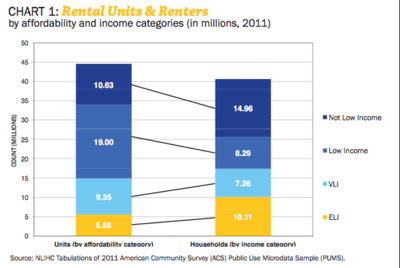
A graph from the NLIHC report issued today.

A shortage of low-cost rental housing means that more and more low-income Americans could be facing homelessness in the future. That is one of the findings of a report issued today by the National Low-Income Housing Coalition, a Washington-based advocacy group.

According to the NLIHC, the four-year-old National Housing Trust Fund, which “was created to address the acute shortage of rental housing the lowest income people in the U.S. can afford” remains unfunded, leading to a growing disparity between the number of units available to the poor and the number needed. Since 2008,

the number of renters in the United States has increased by almost two million households, 44% of whom have incomes at or below 50% of the area median income (AMI). At the same time, the number of homes that are affordable to renter households in this income group decreased by more than 600,000. The number of homes affordable to renters with incomes above 50% of AMI grew by 2.2 million during the same period.

The failure to fund the trust means

that the shortage of homes for the lowest income Americans grows. This shortage places more poor families at risk of homelessness.

The report found that there were about 40 million renter households in the United States, with about one in four being considered extremely low-income (at or below 30 percent of the area median).

And while the supply of rental housing grew by about 700,000 unites between 2010 and 2011, the number of renters grew by about a million — a deficit of 300,000 added to an already large housing deficit. Exacerbating the gap, the bulk of these new rentals — about six in 10 — “were only affordable to renter households with incomes above 80 percent of the (Area Median Income).” Ultimately, “the growth (in units for extremely low-income families) was not enough to keep pace with the growing numbers of ELI renters.”

In 2011, there were 5.6 million rental units affordable for the 10.1 million ELI renters, producing an absolute shortage of 4.6 million affordable units. This is an increase of 300,000 homes from the 2010 shortage of 4.3 million units. In 2011, for every 100 ELI renters, there were only 55 units they could potentially live in without spending more than 30% of their income on housing and utility costs.

In New Jersey, the numbers look like this: 49 units affordable to ELI renters, 31 that are affordable and available. About 75 percent of ELI households suffer “severe housing cost burden” — they spend more than 50 percent of income on housing costs.

This is unsustainable — and completely the fault of big business and government. Municipalities have no incentive to build low-income housing, nor to make it easy for developers to do so. They prefer more expensive housing because it generates more taxes and does not come with the stigma that suburban communities attach to those with low incomes. Builders, for their part, are uninterested in low-income housing, unless it means that they can generate new revenues. So they have conspired to do nothing.

In New Jersey, despite a relatively effective affordable housing regime — one that has been idled by the current governor’s hostility to it — getting affordable housing units built has been nearly impossible.

The level of homelessness has held steady in recent years, but that is only because the annual count generally does not include those who fall outside the technical definition but who also lack stable housing. And while some regions of the state — in counties like Bergen, Essex, Hudson, Mercer, Middlesex, Passaic (i.e., the northern counties) — have worked to keep homelessness in check as best they can, others — such as Ocean — have not and have attempted to deal with the indigent population by chasing them to other locations.

Tent City in Lakewood is not the disease that some on Lakewood see it as being; rather, it is a symptom of a broken economic system that views society’s outcasts as the inevitable and disposable byproduct of economic growth. The homeless and poor are no different than the poisonous emissions pumped out of smokestacks and tailpipes, meaning they are not the responsibilities of those who benefit from the system but costs that must be socialized and paid for by all of us.

I digress, of course. The immediate issue is the lack of housing, which all of us should see as a mark of shame.

Send me an e-mail.

How to build a budget without asking for real sacrifice

While Tom Moran’s full-on man-crush for the governor continues in today’s Star-Ledger, and Gov. Chris Christie begins his annual tour of the state to promote his budget

How exactly has the governor balanced this budget?

He plans to conduct his annual raid on the clean energy fund
— He is planning to delay the payout on property tax credits for three months, pushing its budget impact into a different fiscal year
— And, of course, the one-shot plug-ins:

Nevertheless, Sidamon-Eristoff, who was forced to rely on $1.2 billion in nonrecurring revenues to fill a budget gap last May when tax collections for FY12 and FY13 started coming in $676 million short, acknowledged yesterday that he would have to use $1.07 billion in one-shot revenues in the FY14 budget.

NJSpotlight chart
Click to enlarge.

The treasurer confirmed that the state would once again take $150 million in Clean Energy funds that are supposed to go to energy efficiency programs to balance the budget, but otherwise refused to say what the other one-shot revenues are, saying that they would be included in the full budget that will be released in a week or two. Treasury spokesman William Quinn said last night he did not know what the other one-shots were.

Clearly, one of the additional one-shot revenues is the elimination of the $376 million in pay-as-you-go transportation capital funding that was promised by Christie to reduce future debt when the five-year Transportation Trust Fund extension was approved in December 2011. Sidamon-Eristoff said the state had realized higher proceeds than expected on two previous transportation bond sales, which would enable the state to provide the full $1.6 billion state match for federal transportation dollars without relying either on pay-as-you-go financing or further borrowing.

Another one-shot evidently is the treasurer’s decision to tap $75 million of the expected $375 million end-of-year surplus to help balance next year’s budget. The $300 million surplus that remains is less than half of the $640 million surplus that the state listed on July 1 at the start of the current fiscal year and represents less than 1 percent of the proposed $32.846 billion budget.

One thing has bothered me since the first Christie budget. The state’s press corps has continued to give him credit for local property tax caps that have held down property taxes. Yes, tax growth  have been held in check to some degree, but at what cost? The answer is the layoff of municipal workers, teachers and the like. That may be an acceptable bargain, but we haven’t had that discussion. We really need to.

Send me an e-mail.