
A numbers game

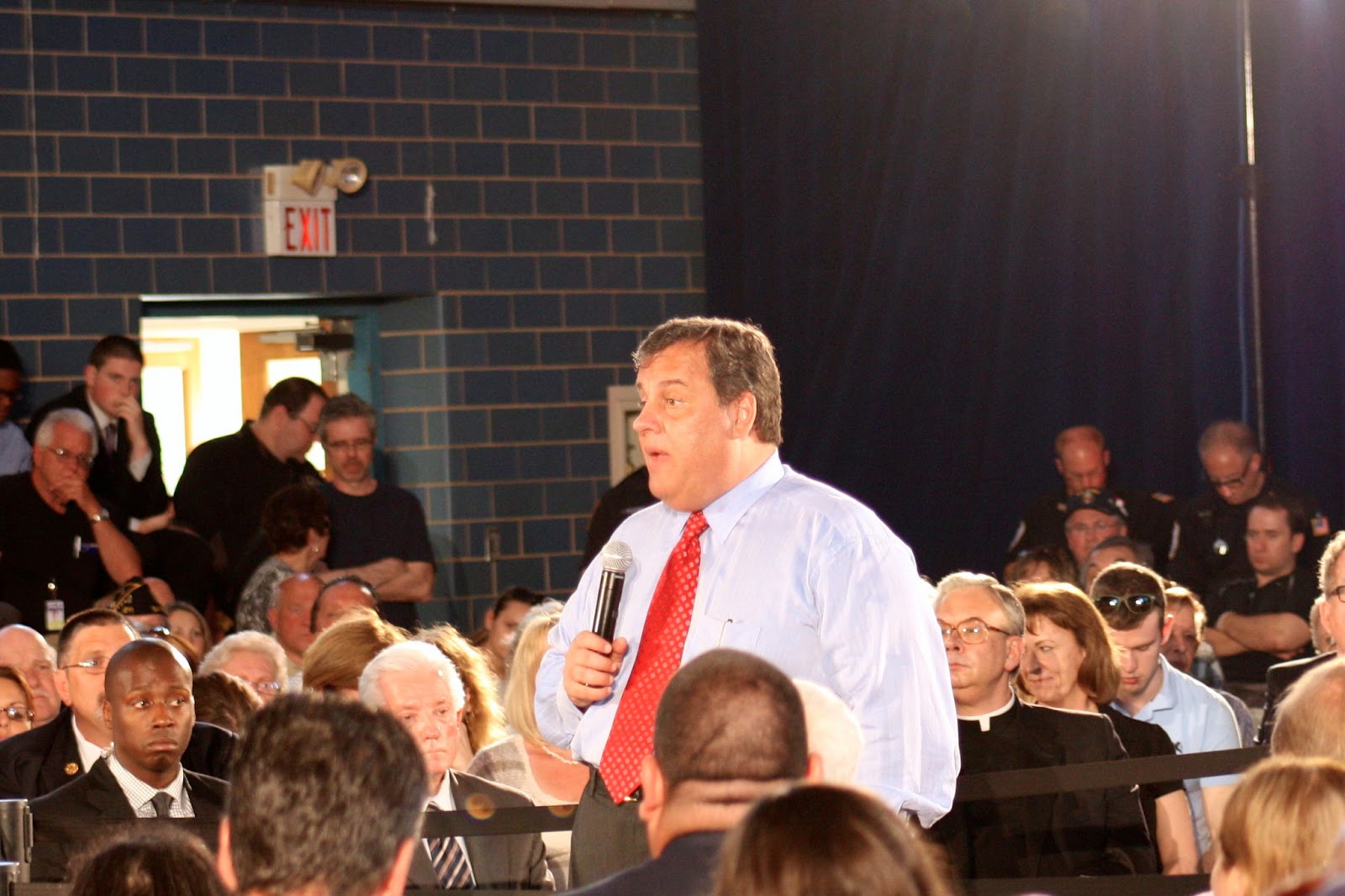
Gov. Chris Christie answers questions during a town hall meeting today in Sayreville.

The state got some good news today as its unemployment rate dropped for the third-straight month to reach its lowest level in four years. The rate now stands at 8.7 percent, the lowest level of the Christie administration.

Gov. Chris Christie, speaking to a packed house at a town hall meeting in Sayreville today credited his tax policies and touted his balanced budget. But it is unclear exactly what is driving the numbers.

According to the press release issued by the Bureau of Labor Statistics at the state Department of Labor and Workforce Development, 4,100 jobs were added in April by the private sector, with a total of 131,500 being added since February 2010.

“The marked decline in unemployment over the last year mainly reflects the ongoing gains in jobs we are experiencing. April saw the largest 12-month gain in the number of employed residents that New Jersey has seen in seven years, with an increase of more than 60,000 compared to April 2012,” said Charles Steindel, Chief Economist for the New Jersey Department of Treasury.

New Jersey Policy Perspective, however, saw the report as mixed, at best. Its president, Gordon MacInnes, issues the following statement:

“While we’re certainly glad to see New Jersey’s jobless rate drop below 9 percent for the first time since 2009, it would be foolish to claim victory and to assume that the state’s economy has recovered. It hasn’t. There remain 400,000 people officially looking for work and many more who have given up, our jobless rate remains much higher than the nation’s, and New Jersey has still recovered less than half the jobs it lost in the Great Recession, while neighbors like New York have recovered all of them plus added even more. Add to that the relatively low-wage nature of our new jobs, and it’s clear: New Jersey needs to do more to create good jobs.”

What I find striking is how easy it is to use the numbers to prove nearly any point you need to make.
The fact is that the state’s economy, like the national one, remains badly flawed and in need of help. Just cutting taxes is not going to do it.
Send me an e-mail.

The IRS scandal: What’s the context?

Context is everything, and David Cay Johnston, the nation’s preeminent tax-policy journalist, provides just that for the IRS scandal. As I said yesterday in a tweet, the issue is only partly about the targeting of GOP-leaning organizations. That, of course, never should have happened. But there also is a question about how 501(c)(4)s are treated more generally.

As Johnston points out, there is supposed to be a “distinction between groups that are ‘primarily engaged’ in politics and groups that really are primarily engaged in ‘social welfare'” and “‘promoting the common good and social welfare of the community,’” though the distinction is “kind of mushy.”

The issue, he said, is that

the social welfare tax exemption is being used by existing 501(c)(4) organizations, including some very large ones, to promote partisan political interests—the very activity Congress has explicitly prohibited for a century.

Of potentially greater concern, however, is that “the IRS is drowning,” with a 17 percent cut in its per capita budget since 2002 and a growing list of duties. Essentially, Congress, which has never been particularly friendly to the taxman, “is demanding that the agency do more and more with less and less,” which has left undermanned at a time it is faced with a surge in the number of 501(c)(4) — 2,774 in 2012, compared with 1,777 in 2011 and 1,741 in 2010.

None of this excuses the targeting of conservative political groups. All indications are that it was a mix of overzealousness in attempting to preserve the social welfare aspect of the 501(c)(3) status and incompetence by managers who failed to set functional policy. These failures, however, have placed the IRS squarely in the crosshairs of the GOP, which sees its chance to tar the Obama administration with scandal.

The Obama administration appears to have moved quickly on this, but it needs to be prepared for the expected — and necessary — Congressional hearings. It need to be open and truthful and the GOP, for its part, needs to avoid the temptation to grandstand and go for political points. The truth of what happened is much more important than the politics and needs to be uncovered so that this kind of thing can be prevented in the future. That likely will mean safeguards against IRS overreach,  but it also should include a reconsideration of the social-welfare tax exemption so that it is more tightly worded and less prone to political manipulation.

Send me an e-mail.

Kill the messenger

Gov. Chris Christie, who remains popular with voters and is still likely to win re-election, does not do well when faced with criticism. As he’s done so often in the past, he answered a report by my NJ Spotlight Mark Magyar that questioned Christie’s claims about his property tax successes by attacking Magyar and not answer questions about the report. That, to me, is the definition of a bully.

Send me an e-mail.

The stock villain delivers — though don’t expect an unbiased investigation

As we finish up the 52nd month of the Obama administration, it seems pretty clear that it has been among the least scandal-ridden in recent memory. No impeachments. No outing of CIA operatives. Just some minor mistakes blown out of proportion by the Republicans but that gained little traction.

Enter the Internal Revenue Service.

The Internal Revenue Service’s special scrutiny of small-government groups applying for tax-exempt status went beyond keyword hunts for organizations with “Tea Party” or “Patriot” in their names, to a more overtly ideological search for applicants seeking to “make America a better place to live” or “criticize how the country is being run,” according to part of a draft audit by the inspector general that has been given to Capitol Hill

The head of the division on tax-exempt organizations, Lois Lerner, was briefed on the effort in June 2011, seemingly contradicting her assertion on Friday that she learned of the effort from news reports. But the audit shows that she seemed to work hard to rein in the focus on conservatives and change it to a look at any political advocacy group of any stripe.

But, and this may be key to the way this scandal will unfold, she was not particularly successful doing so and the IRS appears to have continued with a ideological targeting of conservative groups.

The IRS, of course, offers the perfect stock villain for anti-government fantasists. No one likes the tax-collection agency and most people view it with a level of contempt generally reserved for Congress. (Actually, recent polling shows the IRS to be more popular than Congress.) The IRS is viewed, for the most part, as holding too much power over individual taxpayers and having too great a say over how individual taxpayers and groups function in American society.

So a scandal involving the IRS targeting non-profits for political reasons — a scandal with echoes of Dick Cheney’s outing of CIA agent Valerie Plame and Nixon’s use of the federal government to target his enemies — is likely to have legs.

The difference is that this, at least at the moment, appears to have nothing to do with the White House. Obama can cut the scandal off at the knees by immediately calling for an investigation that goes beyond an audit report and by making it clear that his administration will not stand for this kind of behavior.

This won’t stop a Congressional investigation — and it shouldn’t. Congress must investigate, though I have no confidence that its approach will be any less partisan and ideological than the actions allegedly undertaken by the IRS.

A partisan investigation is not an investigation at all and will do nothing more than add to the noise in the political chattersphere. It will not prevent this kind of thing from happening again, which is what the goal should be, and may instead encourage more bad behavior in the future once the White House changes hands.

Send me an e-mail.

Saturday playlist: The year so far

I’m going to try to kick off a new feature this week, the Saturday Playlist, which essentially will be a musical list. This week, I’m going to offer my playlist of music that has grabbed my attention this year so far. In future posts, these playlists may offer a short summary of what I’ve been listening to over the last seven days or just a couple of top picks from the week’s new releases.

These are not meant to be definitive and I am not trying to be a critic. These are just some of the albums or tracks that move me. So, this is the new stuff that has intrigued me in 2013, listed alphabetically.

  • Black Rebel Motorcycle Club, Specter at the Feast
  • David Bowie, The Next Day
  • Billy Bragg, Tooth & Nail
  • Steve Earle, The Low Highway
  • Hanni El Khatib, Head in the Dirt
  • Frightened Rabbit, Pedestrian Verse
  • Foxygen, We are the 21st Century Ambassadors of Peace and Magic
  • Emmylou Harris & Rodney Crowell, Old Yellow Moon
  • Shooter Jennings, The Other Life
  • The London Suede, Bloodsports
  • Buddy Miller & Jim Lauderdale, Buddy and Jim
  • Parquet Courts, Light Up Gold
  • Pillowtalk, Pillow Talk
  • Son Volt, Honky Tonk
  • Richard Thompson, Electric
  • Yeah Yeah Yeahs, Mosquito

What have you been listening to?

Send me an e-mail.