
The Charlie Hebdo debate distorts meaning of free speech

I want to repeat something I said in a post yesterday, because of the harsh reaction that The New York Times has received in some quarters for its decision not to reprint the Charlie Hebdo cartoons:

I support — and we all should support — any publication that chooses to reprint the cartoons as a show of solidarity. I would encourage outlets to do it if doing so is within their editorial mission. However, free expression requires that we acknowledge that the choice must be left up to each outlet — that free expression includes the right to determine what one expresses, when and how.

Here is what Dean Baquet of the Times told the paper’s public editor:

Mr. Baquet told me that he started out the day Wednesday convinced that The Times should publish the images, both because of their newsworthiness and out of a sense of solidarity with the slain journalists and the right of free expression.
He said he had spent “about half of my day” on the question, seeking out the views of senior editors and reaching out to reporters and editors in some of The Times’s international bureaus. They told him they would not feel endangered if The Times reproduced the images, he told me, but he remained concerned about staff safety.
“I sought out a lot of views, and I changed my mind twice,” he said. “It had to be my decision alone.”
Ultimately, he decided against it, he said, because he had to consider foremost the sensibilities of Times readers, especially its Muslim readers. To many of them, he said, depictions of the prophet Muhammad are sacrilegious; those that are meant to mock even more so. “We have a standard that is long held and that serves us well: that there is a line between gratuitous insult and satire. Most of these are gratuitous insult.”
“At what point does news value override our standards?” Mr. Baquet asked. “You would have to show the most incendiary images” from the newspaper; and that was something he deemed unacceptable.
Did he make the right decision? I think the Times probably should have shown the cartoons as part of its news coverage — to show what the fuss was about (mostly for its print readers). But we also need to acknowledge that, in the Internet age, that may not be necessary. It is rather easy to find the cartoons on the web and the reader who is interested can just do a search.

The Times’ editors have been called “cowards” (by journalist and professor Marc Cooper) and “wimpy” (by cartoonist Ted Rall), with the implication being that the Times — and other outlets — were required to cede any editorial discretion to the larger solidarity movement.

I respect both Cooper and Rall immensely, but I think this line of argument is absurd. It also is a fallacy — an ad hominem attack, or name-calling — and does nothing to shift the debate or add to it.

Free expression, as I said, cuts in more than one direction. We need to support the publications that publish the cartoons, even encourage others to do so. But we also need to respect the decisions made by those editors who choose not to run the cartoons — that is, after all, the other side of the free-speech debate, as Glenn Greenwald tweets:

Editors must have the right to publish or not publish what they want or think is important, as free of outside influence as possible — whether the influence comes from government, big business or the crowd. That is how free speech should work.

Send me an e-mail.
Obama puts free college on the table

President Barack Obama wants to “make community college tuition-free for millions of students,” program that in my experience teaching community college students could have long-term positive effects both on students and the institutions that serve them.

I say this not knowing the details, aside from what The New York Times has reported:

The proposal would cover half-time and full-time students who maintain a 2.5 grade point average — about a C-plus — and who “make steady progress toward completing a program,” White House officials said. It would apply to colleges that offered credit toward a four-year degree or occupational-training programs that award degrees in high-demand fields. The federal government would cover three-quarters of the average cost of community college for those students, and states that choose to participate would cover the remainder. If all states participate, the administration estimates, the program could cover as many as nine million students, saving them each an average of $3,800 a year.

There are questions, of course: Aside from the college GPA, what other qualifications would students need to meet? What happens if a state opts out? Will there be limitations on subject matter or majors?

The impact of a program like this — depending on the details, of course — could be dramatic, with millions of students attending hundreds of institutions. As the Times writes:

About 7.7 million Americans attend community college for credit, of whom 3.1 million attend full time, according to the American Association of Community Colleges, relying on 2012 data. Over all, the federal government provides about $9.1 billion to community colleges, or about 16 percent of the total revenue the colleges receive. Tuition from students provides $16.7 billion a year, or nearly 30 percent of revenue.

From The Washington Post:

The nation’s 1,100 community colleges are the most affordable sector of higher education, with tuition and fees for full-time, in-state students typically less than the maximum federal Pell Grant award of $5,730 a year. Those grants help students in financial need. But there are often other expenses — including housing, books and transportation — that can make the total annual cost far higher.

My experience with community college students has been mixed, but mostly positive. Yes, there are some who obviously are enrolled only to get their aid check and rarely attend classes. But others, the majority, really, are using community college to change the trajectory of their lives. Adults returning to school, for instance, have decided that their job prospects are limited unless they can get a degree, while many younger students attend because the cost of a four-year school is just too high.

And many work full-time while attending school, struggling to cover their regular expenses while also meeting tuition costs and paying for books. If this program can remove tuition costs from their expense ledger, it could give them some breathing room. It also could allow more students to save money in preparation for transfer to four-year schools, potentially lessening the debt they carry down the road.

Critics will say that this is too expensive, but that assumes that the only cost we care about is the cost of government spending. The money is being spent now, but it is being covered by loans creating a dangerous amount of college debt that limits student opportunity, worsens wealth inequality, and could damage the economy when it bursts. We also need to acknowledge that the modern middle class was created, at least in part, by expanding access to college through heavy subsidies (the GI Bill, direct aid both to students and schools).

As for this program, as the cliche goes, the devil is in the details. But there is no doubt that we need to be talking about the cost of college (tuition levels) and who ultimately pays the cost.

Send me an e-mail.

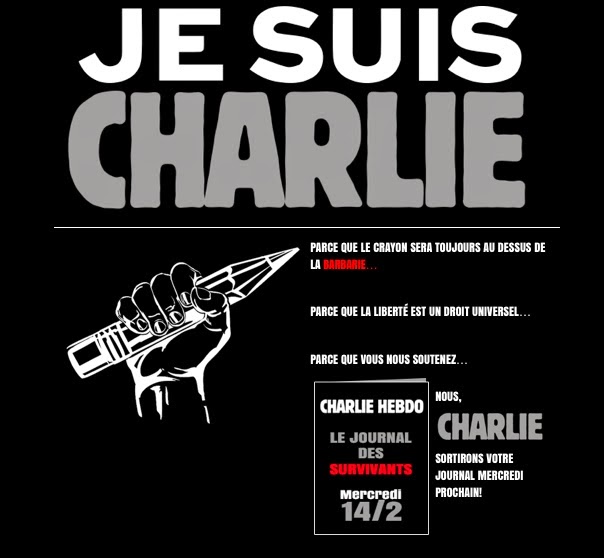
Initial thoughts on the attack on Charlie Hebdo

These are my admittedly disorganized thoughts on yesterday’s brutal attack in France. They are initial thoughts, not necessarily fully formed, but ones I thought worth tossing into the fray.

1. The terrorist attack on the French satire magazine, Charlie Hebdo, was not just an attack on a particular business or publication. It was an assault on the notions of free expression and free thought.

2.  Religious extremism, in general, is a threat to liberty, because it is based on certainty and brooks no disagreement. This goes for Islam, to be sure, but also covers many other religious denominations.

3. This attack may have been perpetrated by Islamic extremists — which has caused some to blame all of Islam. But it is logically fallacious to then equate the work and thought of extremists with the thinking of the larger Islamic community. We do not (or should not), for instance, assume that anti-abortion terrorists (that is what they are) who kill doctors in the United States are representative of the entire anti-abortion movement or of conservative Christianity as a whole. We need to stop assuming that the work of a groups most extreme or desperate members represents the beliefs of the larger group. (Read the second half of this post — Muslim response to this and an earlier bombing.)
 4. I support — and we all should support — any publication that chooses to reprint the cartoons as a show of solidarity. I would encourage outlets to do it if doing so is within their editorial mission. However, free expression requires that we acknowledge that the choice must be left up to each outlet — that free expression includes the right to determine what one expresses, when and how.

5.  Too much of our public discourse has come to be based on absolutes, whether it is religious extremism or fundamentalism or the kind of atheism espoused by people like Bill Maher. We need to admit our own fallibility, acknowledge that we only know so much and respect the views of others.

6. We also need thicker skin — satire is designed to create discomfort and offense. If it doesn’t, then it doesn’t work. At the same time, the satirist needs to consider his or her own motivations — is the goal to dismantle shibboleths or is there something else, a racial, ethnic or religious animus, or a personal attack? (Ross Douthat’s post today offers an interesting discussion of some of this.)

7. Criticism of satire is not an attack on free speech, but an extension of it. Satirists need to acknowledge this and engage with their critics. What happened yesterday, however, was not criticism. It was murder and terrorism designed to stop the discussion.

As I said, these are my initial thoughts. I’m interested in hearing from others.

UPDATE: I wanted to direct readers to this from Alternet and this from Huffington Post.

Send me an e-mail.

Krugman’s ‘valley of despond’

Paul Krugman’s column today doesn’t exactly break new ground, but its message is an important one, nonetheless.

A quick summary: incomes for those at the top have risen dramatically, as have those for middle-income workers in developing nations. While positive on some level — gains by he middle class in India and China, for instance, have helped alleviate poverty in this nations — these gains occur against a backdrop of stagnation and decline for workers in the developed world.

Competition from emerging-economy exports has surely been a factor depressing wages in wealthier nations, although probably not the dominant force. More important, soaring incomes at the top were achieved, in large part, by squeezing those below: by cutting wages, slashing benefits, crushing unions, and diverting a rising share of national resources to financial wheeling and dealing.

This is not news, as Krugman’s says. The issue of growing inequality has been on the table since the Occupy Wall Street protests and was only underscored by the publication of Thomas Piketty’s surprise best-seller, Capital in the Twenty-First Century.

Politicians have given the issue lip service, but as Krugman points out, they have remained wedded to a game plan pushed by the more well-off members of the western economies. As he says,

the wealthy exert a vastly disproportionate effect on policy. And elite priorities — obsessive concern with budget deficits, with the supposed need to slash social programs — have done a lot to deepen the valley of despond.

He then asks — and answers –a key question:

So who speaks for those left behind in this twin-peaked world? You might have expected conventional parties of the left to take a populist stance on behalf of their domestic working classes. But mostly what you get instead — from leaders ranging from François Hollande of France to Ed Milliband of Britain to, yes, President Obama — is awkward mumbling. (Mr. Obama has, in fact, done a lot to help working Americans, but he’s remarkably bad at making his own case.)

The problem with these conventional leaders, I’d argue, is that they’re afraid to challenge elite priorities, in particular the obsession with budget deficits, for fear of being considered irresponsible. And that leaves the field open for unconventional leaders — some of them seriously scary — who are willing to address the anger and despair of ordinary citizens.

What he is describing is a downward spiral for far too many that has the imprimatur of the decision-making classes: the elite class lacks allegiance to anything but its own well-being; the political class takes its orders allegiance from those who have money and access; and this leaves a growing population of economic outsiders who, one might expect, would be looking to upend an economic apple cart that offers them only bruised and overripe fruit.

This helps explain the rise of conservative populism here and abroad, movements that shift the blame for economic division to convenient targets — immigrants and minorities — or alchemize economic issues into social ones.

Krugman makes allusions to the 1930s, which he admits are excessive — different times, different conditions. But the discontent exists and can only be masked by our modern version of bread and circuses (our techno-toys and the array of mind-numbing entertainment options, among them) for so long. Something has to give. You can only let the pressure build for so long before it pops.