
A murder in North Carolina

A terrible story out of North Carolina today:

Police charged a Chapel Hill man Wednesday with first-degree murder in the deaths of three Muslim students in a quiet neighborhood near Meadowmont just south of N.C. 54.

Craig Stephen Hicks, 46, is being held in the Durham County Jail on three counts of first-degree murder

Hicks is accused of shooting his Finley Forest neighbors, Deah Shaddy Barakat, 23, and his wife Yusor Abu-Salha, 21, and Abu-Salha’s sister, Razan Abu-Salha, 19, of Raleigh.

Police are investigating, according to NewsObserver.com, and “have not offered a motive for the shootings.” There has been, according to NewsObserver.com, significant speculation on Twitter and elsewhere about this being a bias crime. We will have to wait for the investigation to unfold for an answer, though some are speculating — based on unverified social media accounts — that Hicks was a radical atheist and that the shooting was anti-Muslim or anti-religious in nature.

The restraint in the major media makes sense — making assumptions about motive without fully investigating make little sense — but I also wonder whether the restraint we are seeing has to do with the ethnic dynamics. Something tells me that, were the shooter Muslim and the three victims not, this story would be playing out very differently in the media. This is speculation, of course, a question for the broader media, but I do wonder.

Send me an e-mail.
A brief thought on the Brian Williams saga

I’ve been trying to think of how to phrase my response to the Brian Williams story.

For the uninitiated here is a summary: Williams has announced that he is taking a hiatus from NBC Nightly News in the wake of revelations that stories he told about being under fire in Iraq were untrue.

NBC had to act — Williams couldn’t continue without further damaging his own and the network’s credibility. But I’ve been uneasy with the righteous indignation in the media and the blogosphere.

In the end, I think my comment on a friend’s Facebook status sums up my initial thoughts:

In the end, he should be removed from his post but we need to end the vitriol. We have no way, at the moment, on knowing exactly what happened — did he lie to boost his resume or innocently misremember? I think that does matter, thought NBC has to address it either way. What I can say is that the vitriol and judgmental yammering is counterproductive. I grabbed this from a bible site: “Let any one of you who is without sin be the first to throw a stone at her.”

Categories, hierarchies and poetry

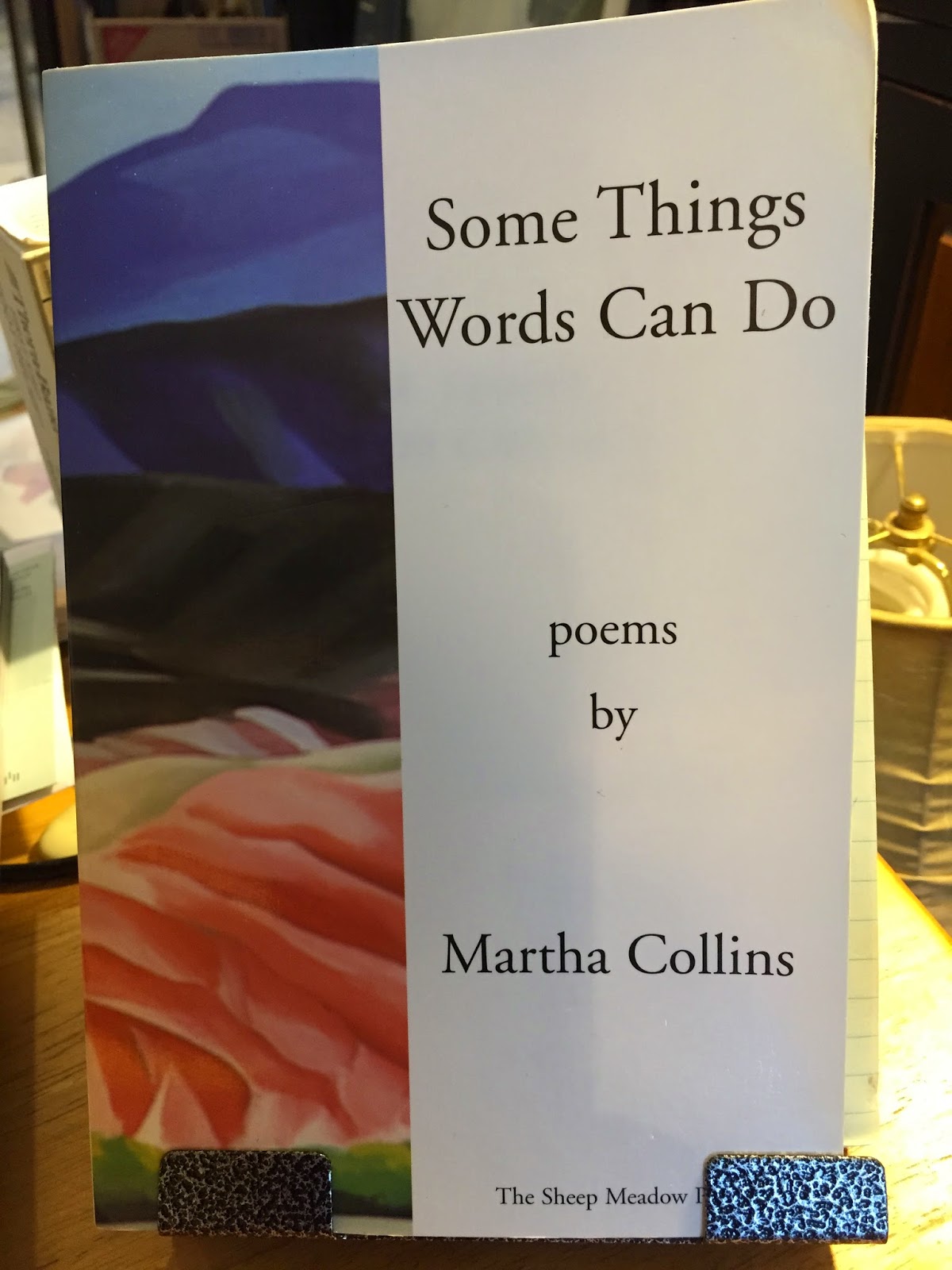
I’ve been reading an early book of poems by Martha Collins over the last few months, taking in a few pages at a time between the grading of papers, the reading of material I’ve assigned to my students and some history and fiction. Some Things Words Can Do — a collection that is actually two collections (STWCD and A History of Small Life on a Windy Planet) — is both an exploration of the uses of language (I’m playing around with a response poem now) and of the violence that seems endemic to our world. It is a work at once playful and angry, contemplative and very contemporary.

And it is a fine precursor to, though not quite as strong as, two of the books that follow — Blue Front (a major focus of my master’s thesis) and White Papers. Both of these latter books, her most recent, focus on race. Blue Front looks at how racial hierarchies and definitions often give to those who define themselves as above racial categories (i.e., whites) permission to do violence to protect these hierarchies, essentially asking questions about both contemporary and historical complicity in these crimes. White Papers, less successful artistically, explores what I’ll call the negative definition — the notion that assigning racial categories and hierarchies to the other (i.e., black Americans) also assigns them, implicitly to the majority.

If I were designing a literature class today that was designed as a response to the bubbling up of long-suppressed racial resentment and anger — brought to the surface by events in Ferguson, Staten Island, Cleveland and elsewhere — I would assign Collins’ work, along with some of the materials we have been reading in my composition class this semester (Ta-Nesi Coates’ “The Case for Reparations,” the Rev. Dr. Martin Luther King Jr.’s “Letter from Birmingham Jail,” Langston Hughes, James Weldon Johnson, Countee Cullen, Gary Soto, Claude McKay, Daniel Okita, recent op-eds on privilege by Tal Fortang and Charles Blow that take opposing points of view) and poetry by Evie Shockley, Robert Hayden’s “Middle Passage” and poems from American Journal, essays on writing by Cathy Park Hong and Jaswinder Bolina (both of which explore questions of exclusion), and some short fiction.

Anyway, this post moved in a very different direction than I intended. My original thought was just to introduce Collins so that I could link to today’s American Academy of Poets “Poem-a-Day” — “Animal / Anima” (it will appear in a future Collins collection).

Census reports food stamp use remains above pre-recession levels

The U.S. Census Bureau issued a report today that found that one in five children received food stamps in 2014 — despite an apparent economic recovery. As the Census Bureau reported in a press release announcing its latest report, Families and Living Arrangements:

The rate of children living with married parents who receive food stamps has doubled since 2007. In 2014, an estimated 16 million children, or about one in five, received food stamp assistance compared with the roughly 9 million children, or one in eight, that received this form of assistance prior to the recession.

What does this mean, given that the economy has been growing in recent years? Well, based on interviews I’ve done over the last several years on the Supplemental Nutrition Assistance Program — i.e., food stamps — the oft-touted recovery has not made its way to lower-wage workers. And while the unemployment rate has been falling, the so-called “participation rate,” or those who are working or actively looking for work remains at an approximately 35-year low. While some of that can be explained by retiring baby boomers — a federal report says about half of the 3.1 percent drop in participation since 2007 can be explained by retirements — not all of it can.

We remain mired in a period of wage stagnation for large swaths of workers, as Market Realist points out:

While hiring has picked up speed, wages continue to stay tepid. Private sector jobs have increased by 10.5% since the US economy exited the recession caused by the 2008 US financial (XLF) crisis in 2010. In contrast, average real wages grew by a meager 0.7% between 2009 and 2014.

This is why we continue to hear stories about families making use of SNAP — along with food pantries and soup kitchens — who never thought they would need to rely on the safety net before. Of course, our response to this has not been to admit that more need means more SNAP benefits being issued. Rather, we cut SNAP in 2014 and the GOP continues to push for more drastic cuts to the program.

This is absurd. There is no doubt that high SNAP enrollment is a bad sign, but cutting just to keep numbers down is foolish. We need to do things to get people off SNAP — create jobs, increase the minimum wage to the $15 an hour range, provide paid sick leave and family leave, etc. Basically, if we want to end reliance on emergency food systems we have to end the economic emergency that exists for so many. We need to make the economy work for everyone.

Send me an e-mail.