Voices of the homeless: An essay

I just posted an experimental essay on homelessness at The Atavist

This essay is an experiment in form, and is based on interviews done in various places over the last five years. All of material — the writing, photos and sketches — is my own, though some may have appeared in other essays or articles published in the past.

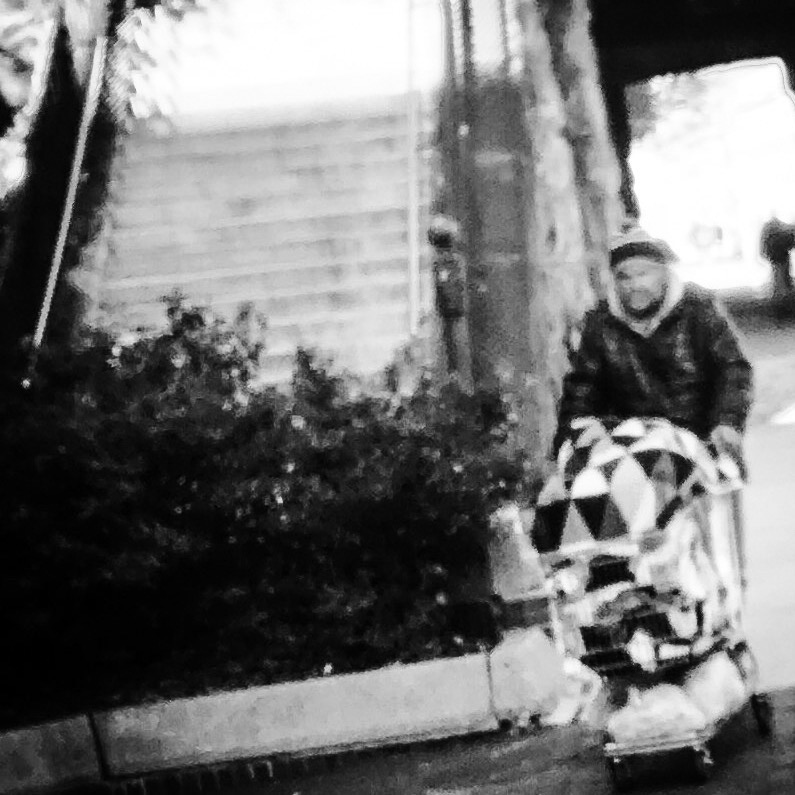
1. It was an unseasonably warm January day and Elijah’s Promise Soup Kitchen in New Brunswick was inundated with volunteers. // The dining room was ringed with an array of social service providers. Everything from health care advocates to housing organizations, and from veterans groups to those aiding recently released felons were on hand to offer assistance not only to the soup kitchen’s regular clientele, but to the city’s homeless who were trickling in as part of the annual Point in Time count. // Harold and Philip – both asked that their last names not be used — took the survey and were eating lunch. Neither is from New Brunswick, but they now spend their time in the city looking for day jobs and trying to stay warm. // “All you can do is keep moving,” said Harold. “You’re going to be out in the weather all day and all night.” // Harold became homeless about two years ago, after he lost his job as a materials handler for Revlon. He had been earning $9 an hour “moving boxes” and was laid off during a corporate downsizing after about five years with the company. He was married at the time, but walked out on his wife and two kids. // “I felt like I was taking from her,” he said. “I was holding them back. The kids would see me not working, laying around all day, and their mom was out working and I just couldn’t stay.” // Philip had been staying with some family members until they threw him out because of his drug use. He had been an upholsterer with a company in the area, but was let go when the work slowed. // “The great recession did a number on me,” he said. “I do whatever I can wherever I can to make a dollar and wherever I lay down, that’s where I spend the night.”

 Read more here.

Send me an e-mail.

Repenting the original sin

The short essay that follows was inspired by the announcement that the indispensable podcast “Our National Conversation About Conversations About Race” was ending its two-year run. If you haven’t listened, go to its archives and dive in.

Americans have a problem when it comes to race. This is not news. It’s baked into our history. It undergirds our attitudes, our language, our voting patterns. It structures our economy, delineates our neighborhoods, our views of crime and punishment.

It’s there, both front and center and in the background, and until we admit this nothing is going to change.

I know what some of you — meaning my readers, friends from my younger days, my critics — will say: “I am colorblind,” you’ll tell yourself. “It’s about character, experience, knowledge.” “I don’t see race,” you’ll say as you cross to the other side of the street, as you become watchful of the black kids in the mall, as you nod at the race joke and laugh.

I’m not calling anyone a racist. I can’t be in the head or heart of anyone but myself. And I’m not saying my hands are clean — I admit I need to check the impact of this history on my own subconscious actions and prejudices.

Under the Christian doctrine of original sin, at least as I understand it (being an agnostic Jewish existentialist and not a Christian), we cannot escape this taint. All we can do is repent and ask forgiveness. Slavery is America’s original sin, and I — all of us, really — can’t help but be tainted by it.

American racism was both created by, and helped create the so-called “peculiar institution” of slavery. It helped justify the violence used to control slaves and created the racial hierarchy that distorted the allegiances of poor whites, made them complicit in an evil from which they derived little and that was used to erase racial and caste resentments.

This is where white privilege begins — with the notion that skin color is destiny. Privilege, in this context, does not imply special benefits in the way we normally view them. Poor whites are still poor, and middle class folks like myself still have to pay our taxes and shovel the walk ways when it snows. Rather, it implies a kind of immunity — getting pulled over by police does not lead to an existential crisis, for instance, and the kinds of slights (“micro-aggressions) that African Americans are expected to live with do not happen to us. (I should say “most of us” — as a Jew I live with a different set of “micro-aggressions,” but that is a different essay.)

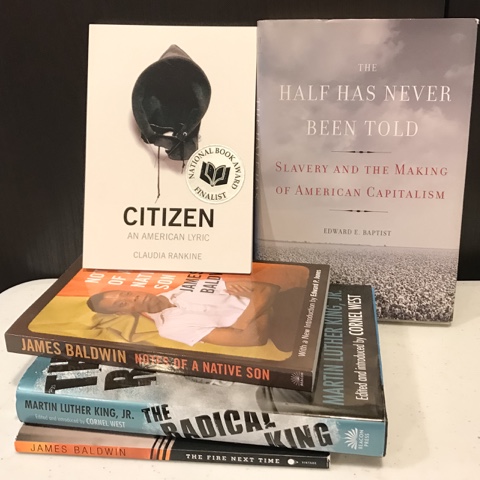
Claudia Rankine’s book Citizen uses these slights (does this word minimize the impact?) in an effort to show how the seemingly small, inconsequential moments are part of the larger web of privilege and racism. As The New York Times wrote when the book came out:

“Citizen” begins quietly, with descriptions of how encounters between people of different races can turn hurtful or puzzling or disconcerting in the space of a few words. The stories come from her own life and from people in her personal and professional circles.

One cannot forget the times a friend called her by the name of a black housekeeper. Another suffers a lunch companion who complains that because of affirmative action, her son cannot attend the same school that she, her father, her grandfather “and you” all attended. Yet another shows up for her appointment at the house of a specialist in trauma therapy. The therapist opens the door and yells: “Get away from my house! What are you doing in my yard?”

Ms. Rankine said that “part of documenting the micro-aggressions is to understand where the bigger, scandalous aggressions come from.” So much racism is unconscious and springs from imagined fears, she said. “It has to do with who gets pulled over, who gets locked up. You have to look not directly, but indirectly.”

There is a continuum connecting privilege and micro-aggressions to white supremacy and Dylan Roof-level violence. Roof, the white man who killed nine African American churchgoers in South Carolina two years ago, occupies a distinct position on this plane, along with Bull Connors and Jim Clark, but that does not absolve the rest of us of our guilt.

We are complicit, remain complicit, and cannot claim redemption until we first admit our sin and seek forgiveness by engaging in the debates and fighting to alter a system that was built on sin and maintains its power by playing on the worst instincts of the broader American public.

Send me an e-mail.

Weekly reminder: Buy my book

Reminder: As an Alien in a Land of Promise is available for purchase

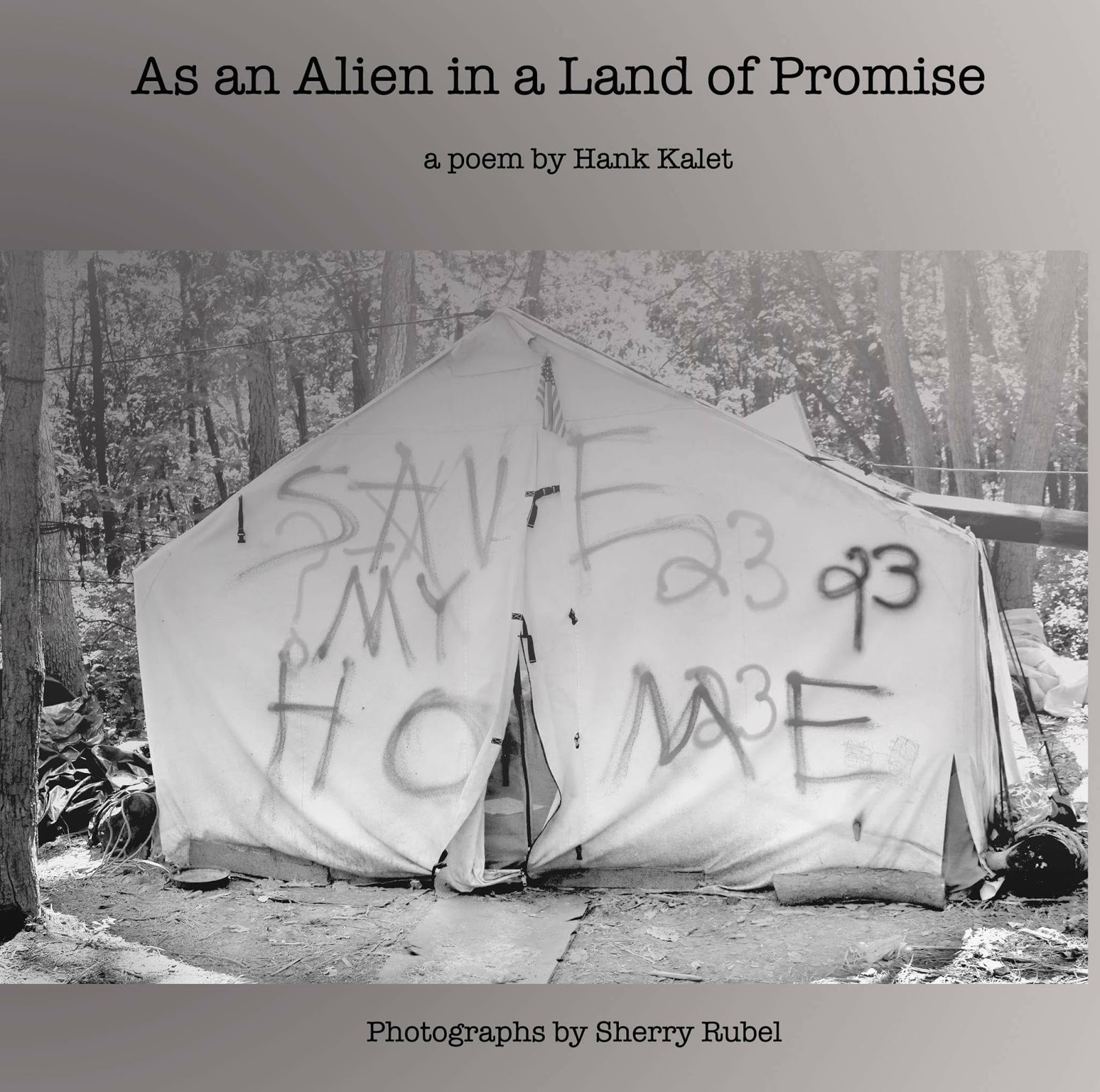
Hank Kalet’s As an Alien in a Land of Promise is a book-length mediation on homelessness and American capitalism. Interspersed with Sherry Rubel’s black-and-white photos, the hybrid work of poetry and journalism tells the stories of those living in a now-defunct homeless camp in central New Jersey, asking why our economic system turns people into refuse.

Based on a year of interviews and research in the former Tent City in Lakewood, Kalet tells the stories of people like Angelo, who lost his job in the crash of 2008, and the musician Michael. Interspersed with their voices – and those of “the pastor,” are writers like Jonathan Kozol and Michael Harrington, whose earlier research informs Kalet’s work.

The poet Eliot Katz, a former advocate for the homeless in New Brunswick, calls the book an “inventive mix of objectivist-influenced, journalistic poems and moving photographs” that “brings real, often-ignored human stories, statistics, and local geographies to life.”

B.J. Ward, author of Jackleg Opera, says Kalet “works in the poetic traditions of the inspired and observant narrator in Whitman’s ‘The Sleepers’ and, with his sense of lineation, Williams’ image-emphasis.”

Kalet is a journalist, essayist and poet, whose work appears regularly in NJ Spotlight and has been published by The Progressive, In These Times, The Progressive Populist, Main Street Rag, Lips, The Journal of New Jersey Poets and elsewhere. He is the auther of Stealing Copper, Certainties and Uncertainties, and Suburban Pastoral.

The book is published by the independent Piscataway House Press.

For more, see asanalieninalandofpromise.wordpress.com/ The book can be ordered at channel-surfing.blogspot.com/p/buy-books-by-hank-kalet.html, from Piscataway House, or Amazon. For press information, contact Hank Kalet at hankkalet@gmail.com. Press kit available upon request.

Send me an e-mail.

Sanctuary in New Jersey

I have a piece up today at NJ Spotlight on the Trump Sanctuary City order — municipalities like Newark and Jersey City are not backing down.

Executive orders by President Donald Trump late last week that mandated deporting undocumented immigrants, building a wall on the U.S.-Mexico border, and suspending entry to the country by refugees prompted protests around the United States, including in New Jersey — and spurred what is sure to be the first of many lawsuits.

Meanwhile, officials of New Jersey’s “sanctuary cities” say they will not capitulate to the president’s threat to use the power of the purse to punish them for providing safe havens to undocumented immigrants. One of Trump’s executive orders warned that federal grant money could be “stripped” from sanctuary states and cities that harbor illegal immigrants.

Municipal officials in such “sanctuary cities” as Newark, Jersey City, Princeton, and other towns limit their interaction with federal immigration officials and refuse to allow their police forces to be deputized by the U.S. Immigration and Customs Enforcement agency. They say they will continue to resist federal efforts to force their cooperation because it would make policing their communities more difficult and could endanger local health and the economy by making immigrants fearful of government.

Read more here.

Send me an e-mail.

Happy birthday, my love

It’s my wife’s birthday today. Here is a poem I wrote a while back (20130, though I don’t remember if I ever shared it.

I Wanted to Write a Sonnet

I wanted to write a sonnet to your eyes but the rhymes
fought me like a punch-drunk boxer
in his final bout. His wild swings
charged by desperation beat
upon my face until I cowered
in the corner, covered
by my gloved fists, my words
languid and dull under the onslaught
of your gaze. I wanted to write
a sonnet, a villanelle, an ode.
I wanted structure, unity, wholeness.
I needed to praise your thighs,
your breasts, compose an epic
to honor your touch. But foot work
failed and the right cross and the left
nailed me over and over, until I fell
senseless, a lost cause, silenced
by the power of your eyes,
your touch, your sweet and tender soul.

Send me an e-mail.