Nearly 10 million Americans have since applied for unemployment benefits, far more than for any corresponding period on record.
And these numbers may understate the full impact. Small business owners, independent contractors, and gig workers are not eligible for unemployed benefits, which means that, despite many losing their jobs, they are not part of the count.
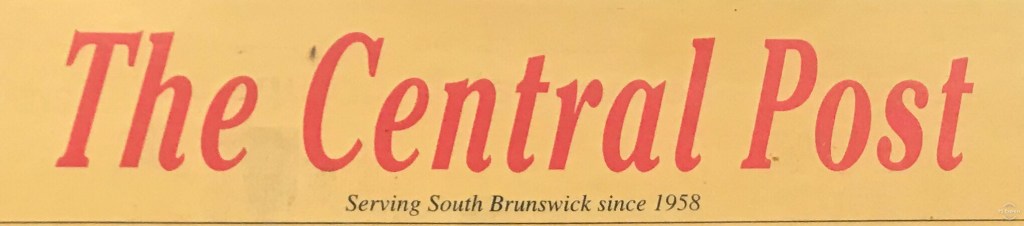
The flag from The Central Post, which became the South Brunswick Post in the late 1990s. I grew up reading this paper and then spent almost 20 years writing for and editing the local news it produced.
I began my journalism career in 1990 as a freelance sports reporter and then as a part-time news reporter, coving the South Brunswick school board.
My career has taken numerous turns over the years. While I stayed in the local news lane — mostly with the Princeton Packet news group — I took on a variety of roles: Reporter, print and web editor, editorial writer, poverty and immigration correspondent, and now teacher.
I’ve covered local meetings and girls basketball, broke major local stories, dug deep into budgets, interviewed major recording acts and writers, sat through gubernatorial press conferences, and taught students who now serve as anchors and reporters around the country.
All of these efforts took time and resources and, while I was paid, it has never been a lot, and certainly not what my efforts were worth. But I knew that when I entered the business.
What has been happening over the last decade, however, makes the low-paid past seem like salad days. The news industry has been hemorrhaging staff. Layoffs have been rampant and newsrooms have been shuttered. My old news homes either were closed (South Brunswick Post), merged into other papers (The Cranbury Press), or gutted (Patch).
This should concern us all. The disappearance of the local news media creates conditions in which malfeasance can flourish. Most local officials are good, hard-working people. But a small number see there local governments as fiefdoms and siphon off public funds or place their family members or political loyalists in positions of authority.
Local newspapers, television and radio, and news sites offer a bulwark against this, dragging local governments in to the light where residents can keep officials honest. That is our role, but we can’t do it without financial support from the communities we cover.
We are in an age when the president derides the larger news business as “fake,” and his supporters — and some on the left — mischaracterize the “media” as an agenda-ridden monolith that is at odds with these deriders’ beliefs. This is nonsense, but one can see from where the misperception grows.
Cable news, talk radio, propaganda sites like Breitbart have obscured the differences between news and opinion, between information and propaganda, and the upshot is that even the most reliable of news agencies — The New York Times, The Washington Post, Associated Press, and others — absurdly get tarred as tools of the left.
Cable also distorts the financial discussion. Cable continues to generate profit, which leaves the impression that the news business as a whole is doing well. But print outlets continue to struggle to generate profit — even the Times and the Post. It’s why, for instance, the Times charges more for a restricted digital-only subscription than it does for a Sunday-only print w/unlimited digital subscription. Print advertising remains their primary revenue, but more and more of us are moving online.
The newspaper business is responsible for its own mess, of course, because it had no idea what the Web might become. It dumped free content on its sites, training readers to assume news would always be free. This matched the historical advertiser-based model — nominal subscription fees designed less with revenue in mind than with creating a way of counting readers so the papers could show advertisers their reach. This worked well when papers were the only game in town, but it started to unravel once technology (well before the internet) intervened.
TV broke the local and national monopolies that print had on information, which freed advertisers to choose other options. This shift was hard to see because the first wave of newspapers failures had little impact on readers — going from seven or eight dailies in New York to three damaged the industry, but not the readership, which continued to grow with the population.
Advertisers continued to bleed off, however, and the news business, misreading the future, borrowed and borrowed, investing in physical plant and expanding beyond their coverage capacity as they chased white readers into the suburbs. This weakened their coverage of the cities, which have been underserved since, without creating a new base in the suburbs — the worst possible outcome.
Then comes the internet, which damaged the print bottom line not because it offered new ways of providing information. Rather, it was the creation of sites and services like Craig’s List that sucked away classified ad revenue, while businesses began to spend more on their own sites and their internal PR, which made sense given that there were new ways to go around the press to get the word out.
Then Amazon launches, which serves as both marketplace and advertising host and which didn’t need the print or TV outlets to thrive. The fact that Bezos used his Amazon fortune to buy the Washington Post as a toy seems symbolic to me.
In the end, what we all need to remember is that reporting the news costs money. If we want good reporting, we have to start paying for it.
This brings me to my plea. Subscribe to a local, state or national paper. I subscribe to the Times and the Post, along with four magazines. I regularly read others, but I can’t afford to subscribe to every outlet.
And, here’s the selfish part of my plea, consider becoming a patron at my Patreon page, which will give you access to all of the work that I am doing and specifically help fund my local coverage. All I ask is $1 a month. If you subscribe (and provide a mailing address), I’ll send you a copy of my latest book, As an Alien in a Land of Promise, a hybrid work of poetry and journalism that also features photos from Sherry Rubel.
The number of COVID-19 cases continues to climb, though South Brunswick’s infection rate continues to be lower than the rest of the state.
The township Office of Emergency Management reported last night that there had been 13 new positive cases since Friday, bringing the township total to 38. That means there is about 0.8 cases per 1,000 township residents. The statewide infection rate is at about 1.8 cases per 1,000 residents, with 16,638 people testing positive.
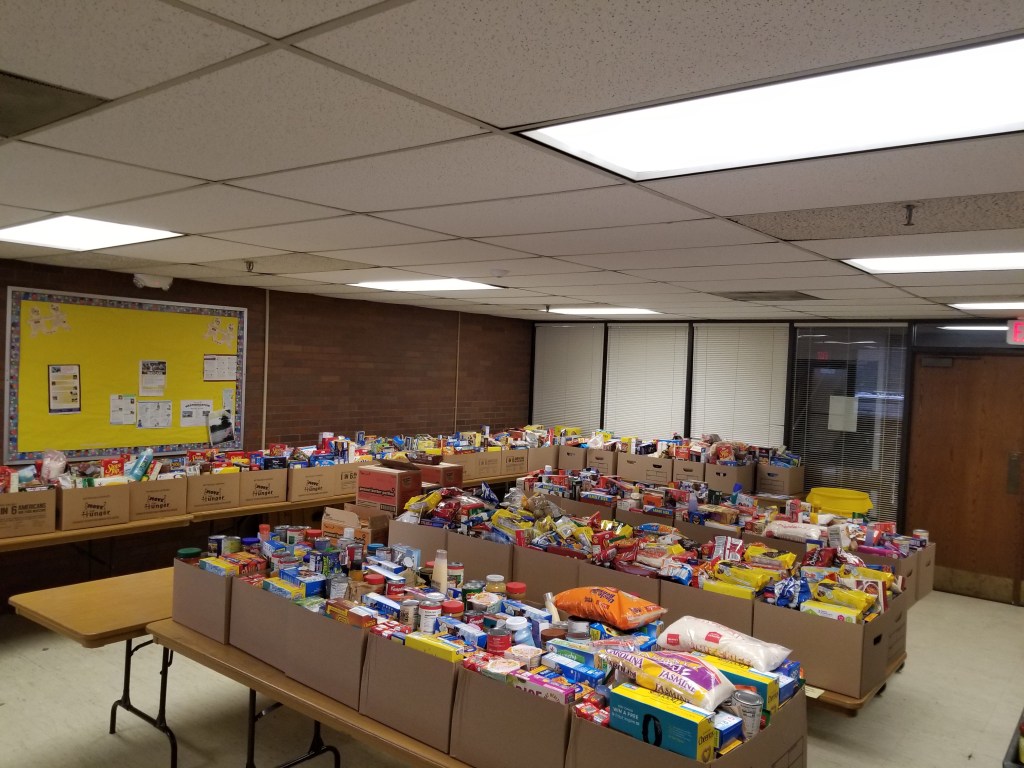
A successful food drive earlier this month will be followed up Friday as officials brace for growing need.
Remember, journalism is not free. If you find these local news updates useful, or are interested in the commentary and essays I post here, please consider becoming a patron.
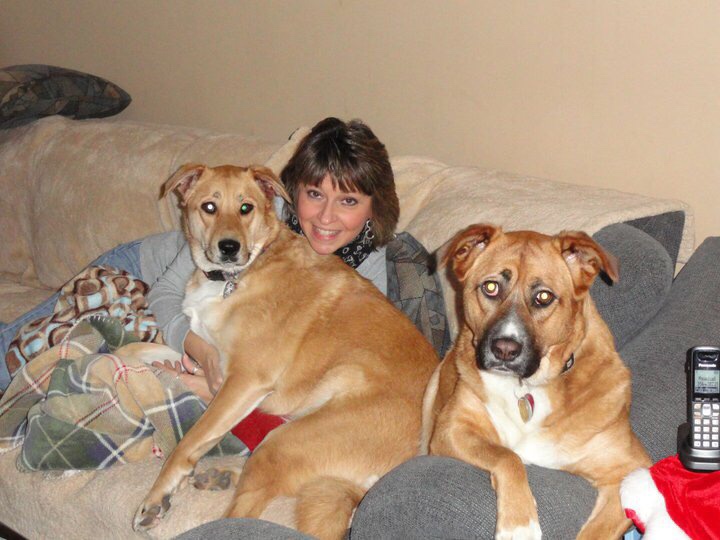
Annie with our rescues, Rosie and Sophie, in 2011.
I wrote a piece several years ago about the rescue dog operation overseen by our friend Carol in conjunction with a number of other rescues and national organizations. They bring dogs (like our two) north from the high-kill shelters down south, where spaying and neutering are far less common, which in turn leads to an explosion of the canine population.
I thought it would be useful to repost it today, because they held their monthly rescue transport in South Jersey and my good friend Bill Stanley, who fosters rescue dogs, told me the number of rescue groups involved and the number of dogs rescued was lower than normal. The rescues took significant precautions, he said, but the need for social distancing likely is having an effect on the number of volunteers and organizations that can participate. On the plus side, he said, more people are home, which makes it easier for them to adopt, acclimate and train their animals — but still, the virus is obviously taking its toll.
This is another under-reported way in which the coronavirus is affected us. I don’t mean to imply that this impact is on the same level as the human illness and economic damage we are experiencing. But the impact is real. Many of these animals have been abused. Many have been abandoned — pregnant females dropped off at shelters because the owners don’t want to deal with the responsibility, shelters that have a high kill rate, that view these animals as nothing more than possessions.
There is a danger that they will be forgotten in this crisis, that the volunteers and fosters will be unable to continue their work, that people will stop donating, that there will be no one to help these helpless animals. We can’t let that happen.

 Hank Kalet