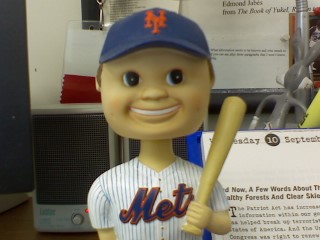
No reason smile Mr. Met

Why is this man smiling? Doesn't he know that the Phillis, and not the Mets, are playing for the NL championship?

This message was sent using the Picture and Video Messaging service from Verizon Wireless!

To learn how you can snap pictures and capture videos with your wireless phone visit www.verizonwireless.com/picture.

To play video messages sent to email, QuickTime� 6.5 or higher is required. Visit www.apple.com/quicktime/download to download the free player or upgrade your existing QuickTime� Player. Note: During the download process when asked to choose an installation type (Minimum, Recommended or Custom), select Minimum for faster download.

Feeding the hungry when we need to fight hunger

This is welcome news, given the dire straits faced by food banks in the state. The problem is that even with a program like this supplementing the food collected and distributed by private groups is that it does not address the underlying problems that lead to food insecurity, hunger and poverty in the first place.

1. A loss of jobs in New Jersey and nationally

New Jersey lost 700 private-sector jobs in August, bringing the total number of job losses in the state to 14,600 for the year so far, according to data released by the New Jersey Department of Labor and Workforce Development two weeks ago.

“New Jersey’s employment picture continues to weaken, and with the ongoing crisis in the financial sector, we can expect more job losses in the near future,” said Philip Kirschner, president of the New Jersey Business and Industry Association.

This past July, the state’s unemployment rate rose to 5.9 percent, yet still remains below the national unemployment rate of 6.1 percent. Employment has gone down in the major sectors of the state’s private-sector economy, according to the report.

In the first eight months of 2008, the manufacturing sector lost 7,800 jobs, construction lost 3,100 and the service sector lost 3,800, according to the report. The only sectors, which experienced significant employment increases, were in the education and health services sector and the information sector, according to the data.

2. Unequal income growth

Economic growth in New Jersey over the past 20 years has not been broadly shared by the state’s residents because the wealthiest have seen their incomes rise at a much greater pace than anyone else. In other words, the income inequality gap in New Jersey continues to widen and in some respects at a faster rate than in most of the nation.

3. A minimum wage that has not kept up with inflation

When New Jersey raised its minimum wage to $6.15 in 2005 and $7.15 in 2006, the state took an important step in the right direction for hundreds of thousands of working families. But, despite this increase, the minimum wage has simply not kept up with the rising cost of living—especially given skyrocketing prices for food and energy. New Jersey depends on its front-line workers to drive the state’s economy and perform important functions for residents, yet they cannot make ends meet on today’s minimum wage.

The New Jersey Minimum Wage Advisory Commission recognized this problem in its December 2007 report on the adequacy of the state minimum wage. Had the Legislature adopted the Commission’s recommendation to raise the minimum wage to $8.25 an hour and establish automatic annual cost-of-living increases, New Jersey’s workers would have received much-needed relief as they struggle to support their families and build a future.

4. A frayed social safety net at the state and federal levels

5. A cost of living that is higher than low-wage workers can afford

Many families do not earn Self-Sufficiency Wages, particularly if they have recently entered (or re-entered) the workforce or live in high cost or low-wage areas. Such families cannot afford their housing and food and child care, much less other expenses and are forced to choose between basic needs.

Runner’s diary, Thursday

I stayed inside today and did four miles on the treadmill. Yes, I know, it was a nice morning, with a little chill in the air and probably would have made for a great outdoor day. But I made the mistake this morning of not dressing for an outdoor run — when I got up to let the dog out, the patio was wet and it appeared to be raining, so I dressed to stay indoors.

When I got to the gym, however, I realized that it was a lot nicer than I expected. So I headed outside. The breeze, however, was just strong and cool enough to send me back in. Alas.

iPod: Rachel Maddow’s radio show

Sarah Palin, plugged

Now that the debate is behind her, Sarah Palin appears to have little reason to hold back. As Kathleen Parker of The Washington Post explains, the vice-presidential candidate
has trained her moose-hunting sights on bigger trophies — Barack Obama and the media.

And in doing so, Parker says, she is proving to be especially adept at using Republican code words on the stump.

Palin successfully conveyed to those she was targeting that she is a Ronald Reagan-ish outsider who puts God and country first. And The Other is just like that elitist, flip-flopping John Kerry.

That’s a plateful of imagery and a buffet of touchstones familiar to those who distrust “elitists” and who recognize in Palin a kindred regularness.

Her folksy, but fiery, attacks are not new, of course. What the Palin stump speech amounts to is a distillation of the Karl Rove technique, of the divide and conquer approach used by the Republicans since the early 1960s when the country-clubbers were relegated to second-class citizens in a party that would come to be dominated by the angry and resentful. That was the lesson that Richard Nixon took from Barry Goldwater’s ill-fated 1964 presidential race, one in which he carried six states — his home state of Arizona and five traditionally Democratic southern states. Nixon read the political tea leaves, sensing a seismic shift in demographics that was reinforced when Ronald Reagan fanned the flames of racial resentment and anger at the hippies to take the California state house. Nixon then rode his Southern Strategy — building an electoral campaign on the same kind of disaffection — all the way to the White House. The divide-and-conquer approach became a Republican staple for 30-plus years.

One might have expected that, with the collapse of the so-called Republican brand with George W. Bush’s failed presidency, this verbal violence would have been relegated to the dustbin of history where it belongs.

It hasn’t, of course, and we have John McCain and Palin to thank (as well as Hillary Clinton, but that is a story for another time) for, as Parker writes, “amp(ing) up their rhetoric of difference.”

Neither McCain nor Palin would dare mention Obama’s middle name, Hussein, but they can play up Obama’s past associations and let others connect the dots. Terrorist. Muslim. Dangerous. Other.

It is legitimate to question character and dubious associations — and William Ayers is certifiably dubious. The truth is, Obama should have avoided Ayers, and his denouncement of Wright was tardy. But this is a dangerous game.

The McCain campaign knows that Obama isn’t a Muslim or a terrorist, but they’re willing to help a certain kind of voter think he is. Just the way certain South Carolinians in 2000 were allowed to think that McCain’s adopted daughter from Bangladesh was his illegitimate black child.

The ugliness has a dangerous side, as demonstrated by reports on Politico and in The Washington Post (Parker cites these, as well). Dana Milbank describes a Palin rally that is chilling in its descent into something resembling fascism. Palin, he writes, continued attacking Obama for a loose connection to former Weather Underground member Bill Ayers.

“Now it turns out, one of his earliest supporters is a man named Bill Ayers,” Palin said.

“Boooo!” said the crowd.

“And, according to the New York Times, he was a domestic terrorist and part of a group that, quote, ‘launched a campaign of bombings that would target the Pentagon and our U.S. Capitol,'” she continued.

“Boooo!” the crowd repeated.

“Kill him!” proposed one man in the audience.

Chilling.