
Focus on Iranian bomb is misplaced

Iran is working toward the creation of a nuclear weapon. This is not good news and warrants our attention, but not in the way that the Washington concensus has it.

An Iranian bomb, in many ways, will be no more destabilizing and dangerous than the possession of a bomb by any other nation; our history with Iran and the assumption that their leadership is more irrational than other leaders guides our thinking in unhealthy ways and has left us wearing blinders when it comes to the threat of nuclear weapons.

The threat is not an Iranian bomb, but the proliferation of nuclear weapons more generally. We should be concerned about Iran’s bomb, but also North Korea’s and China’s and the bombs possessed by our allies, all of which create a destabilizing situation. Israel’s bomb, for instance, may seem important to the protection of the Jewish state, but it also creates fear in the rest of the Middle East, resulting in the various Arab and Muslim nations feeling the need to develop their own weapons in response. The Middle Eastern arms race did not start with Iran or even with Iraq, but with Egypt and Israel and the hostile environment across the region.

We should be working to prevent Iran from getting a bomb, but also to reduce the number of nukes in existence, overall. If we are going to be honest about the dangers of nuclear weapons, we can’t just focus on the so-called rogue states, but on Russia and China, England and France, Israel, Pakistan and India — and most of all, on the United States, which possesses more nuclear weaponry than anyone else. As long as the smaller nations of the world feel threatened by the larger ones, they will be looking for an equalizer — which is why the threat of war cannot work.

Our best approach to getting nations like Iran and North Korea to step down is to show a willingness on our part to step away from our own nuclear crutch and to lead the rest of the world away from nukes.
The Top Ten issues the candidates are not talking about

Paul Ryan mentioned poverty in a throwaway line about midway through the night but, like the other three men on the two major-party presidential tickets, poverty is not an issue that appears to be on his radar.

In fact, poverty is just one of a number of important issues about which the presidential candidates have little interest in speaking. Here are the 10 issues that should be on the table:

  1. Poverty: about 15 percent of Americans now live in poverty, many of whom work. While the number has grown over the last decade, we should not fool ourselves into thinking that it is purely a product of our current economic stagnation. As I point out in this column, we have come to view high poverty rates as the normal output of our corporate capitalism. There was a time when we had a president who started a war on poverty (a war derailed by his obsession with the war in Vietnam). Now? Silence.
  2. The financialization of the economy: The financial sector now accounts for about 8 percent of the nation’s economy — the highest level in our history — with nearly a third of corporate profits going to financial firms. This skews the incentives toward quick profits and financial gamesmanship and away from creating sustainable economic models — and is far more dangerous than the growth of government.
  3. The comprehensive discussion of health care: We insist on talking about the Affordable Care Act and Medicare as though they are completely unrelated. But rising healthcare costs — which will continue so long as much of the healthcare sector functions under the auspice of a for-profit insurance industry — have a massive impact on all aspects of the industry. We need to revisit the healthcare debate as a unified debate focused on universal coverage, the elimination of administrative overhead and an expansion of the risk pool (which will spread costs out over a larger group) — i.e., single-payer or Medicare-for-All.
  4. Women’s issues: Abortion came up, and there was a veiled reference to birth control, but women have been treated in this campaign either as voting uteruses (uteri?) or as stand-ins for families in the economic debate. No mention of equal pay, gender equality, access to daycare, after-school programs, the plight of single-mothers, etc.
  5. The erosion of civil liberties: Both parties support warrantless wiretaps, extra-judicial assassinations, the suspension of constitutional rights for terrorism suspects, etc.
  6. The militarization of society: I’m not just talking about the intrusion of the military on American soil as part of the war on terror, but of the shift in approach by local police departments, which now rely on a militarized urban assault mindset (typified by TV shows like  Flashpoint) to quell protests and tamp down even the most minor of disturbances.
  7. The war on drugs: This may seem like an outdated concern, but we are still waging war in our inner cities and attempting to address a public health issue with law enforcement and military means.
  8. Citizens United and campaign finance reform: This gets some lip service, mostly from Democrats who are worried about being outgunned in the murky superpac war by the GOP, but no one has attempted to get either of the major-party candidates to weigh in on whether they support a constitutional amendment that would strip corporations of their personhood rights. And no one is talking about public financing of elections, even though we have to get private money out of the electoral process if we are to have any chance at ending the legal corruption and corporate influence we now live with.
  9. The use of drones: We now fight wars with technology in a very impersonal way. This allows for us to fight more wars without thinking about the potential consequences.
  10. Immigration: There has been discussion of this, in regards to border security and the wisdom of the Obama administration’s executive order essentially instituting the Dream Act. But the notion of comprehensive reform that allows for an appropriate flow of immigrants in and out of the country and finds a way to allow the 11 million to 12 million undocumented people now here to stay here. Further militarization of the southern border — which is really what the anti-immigrant groups have been pushing — is both inhumane and doomed to failure.

What issues do you think the candidates need to talk about, but have ignored so far?

Debated to death

Let’s get this out of the way: Mitt Romney did a better job during last night’s presidential debate than President Barack Obama. He was more forceful — or as forceful as he is capable of being — and controlled the tone. But the points he made were built on easily disprovable lies and distortions.

Obama, for his part, was barely there. He let the lies stand, failed to take the initiative and helped move the debate to the right by accepting some well-worn, if untrue corporate talking points on Social Security and Medicare.

That said, the debate last night is unlikely to do much for or to the candidates. Yes, the Democratic base — and progressives more generally — is angry and the GOP may have regained some of its footing (though it is hard to see how, given that Romney made his first move to the center and tossed his right wing into the drink last night).

Last night’s spectacle was far from spectacular and more than a bit wonky and boring. It is hard to see how the small sliver of the electorate who remains undecided will be moved by what went down last night.

More likely, these viewers — if they watched — we’re pushed to boredom, may have changed the channel (reruns of old sitcoms on Antennae TV) or opted to do their ironing.

So, one down and three to go.

Trivia answers and more baseball trivia

Here are the answers to my earlier trivia question:

There have been 14 pitchers who have pitched in a Mets uniform who have won the Cy Young. Two did it with the Mets, 10 before they joined the Mets and two after they left. Can you name them all?

Hint: One is on the current Mets roster.

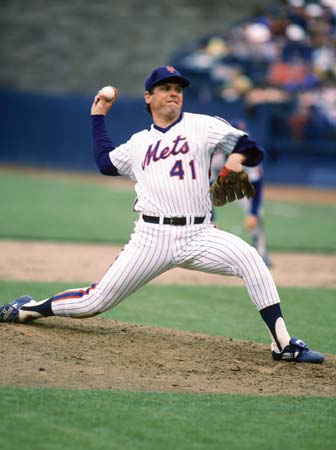
Part 1: Tom Seaver won it three times (’69, ’73, ’75) with the Mets and Dwight Gooden once (’85).

Tom Seaver, in a photo
from New York Mets Report

The players to win it before joining the team were:

  1. Warren Spahn won the award (only one ML award was given out) in 1957 with the Braves, played with the Mets in 1965.
  2. Dean Chance won it in 1964 (only one handed out) with the Angels and played with the Mets in 1970.
  3. Mike Marshall won it in 1975 with the Dodgers as a reliever and played with the Mets in 1981.
  4. Randy Jones won it in 1976 with the Padres, played with the Mets 1981-1982.
  5. Bret Saberhagen won in 1985 and 1989 with the Royals and played with the Mets from 1992-1995.
  6. Orel Hershiser in 1988 with the Dodgers and played with the Mets in 1999.
  7. Frank Viola in 1988 and played with the Mets from 1989-1991.
  8. Tom Glavine won in 1991 and 1998 and pitched with the Mets from 2003-2007.
  9. Pedro Martinez won in 1997, 1999 and 2000 and pitched with the Mets from 2005-2008.
  10. Johan Santana won in 2004 and 2006 and has pitched with the Mets since 2008.

The Players who won it after leaving:

  1. Mike Scott pitched with the Mets from 1979-1982 and won the award with the Astros in 1986.
  2. David Cone pitched with the Mets from 1987-1992 and again in 2003. He won the award with Royals. (Technically, Cone won the award both after leaving and before joining.)
***

Cone’s career, by the way, was marked by goings and comings. He started with the Royals, was traded to the Mets and then to the Blue Jays. He signed as a free agent back with the Royals after, was traded to the Blue Jays and eventually returned to the Mets.

Another note: Seaver finished second to Fernando Valenzuela in 1981 in one of the narrowest Cy Young votes in history. He went 14-2 in the strike-shortened season, Valenzuela led in strikeouts and won 13, along with the Rookie of the Year. They both ended up with eight first-place votes. Steve Carlton, who also won 13 and had the lowest of ERA of the three, had five first-place votes to finish third.

The answers and stats are from Baseball-Reference.

Cy Young trivia

With Mets pitcher R.A. Dickey making his final start in what cold be a Cy Young season, I want to offer a three-part Mets/Cy Young trivia question:

There have been 14 pitchers who have pitched in a Mets uniform who have won the Cy Young. Two did it with the Mets, 10 before they joined the Mets and two after they left. Can you name them all?

Hint: One is on the current Mets roster.