My latest arts column for Time Off, on Diane Lockward‘s book The Crafty Poet: A Portable Workshop.
Send me an e-mail.

My latest arts column for Time Off, on Diane Lockward‘s book The Crafty Poet: A Portable Workshop.
Send me an e-mail.
Read Thomas Frank’s long-view essay on the issue of ever-rising college tuition — an unexpected (and far better) follow to what I wrote yesterday.
“This bill doesn’t make college more affordable, reduce the amount of money students will have to borrow, or do anything about the lack of jobs grads face in the Obama economy,” Senate Minority Leader Mitch McConnell (R-Ky.) said in a statement.
He’s right, of course. But he’s also being disingenuous — or at least partisan. McConnell knows the Warren plan is likely to be popular because it is expected to save graduates real money on interest payments, which are a huge piece of the debt they are carrying and which are forcing many to alter their career paths, when they are lucky enough to find a job.
McConnell also knows that the GOP isn’t working on the issue of college costs beyond tuition freezes, a vague commitment to privatizing public colleges and funding options and railing against affirmative action programs.
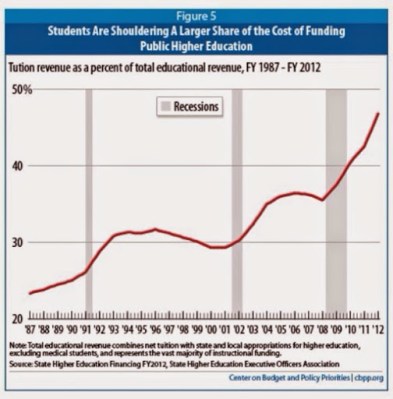
Tuition is higher than it’s ever been, while state and federal aid — both to schools and students — has been falling. According to the Center for Budget and Policy Priorities, the percentage of public college and university budgets funded by tuition is twice what it was in 1987. And there is evidence thatch of the money is going to administration — new positions, additional support and big top-level salaries — even as schools turn more and more to adjuncts (like me), who work on an as-needed basis. It is a corporate model — just-in-time, temp-driven service means no benefits costs, but it also means students are paying more and getting less time with professors (adjuncts do the best they can, but they often have to teach at multiple schools and can only offer limited office hours). The tuition freeze option will only force more of this on schools.
The cost issue is complicated, but it cannot be addressed until we start putting money back into the schools and expanding grant opportunities for students. You cannot remove billions in government financing over three decades and then pretend that it has not had an effect
Warren’s bill is not intended to fix all of this, but it should helped economically stressed graduates.
I came across this story today on Facebook:
Metal studs have been installed outside a block of flats in central London to deter rough sleepers.
The installation of the studs outside the flats on Southwark Bridge Road provoked widespread condemnation on Twitter with users claiming homeless people were being treated like vermin because similar metal spikes are used to deter pigeons.
Residents told the Telegraph that the studs were installed outside the flats in the last month to prevent homeless people from sleeping in the doorway.
The story comes on the heels of others in which cities are banning the feeding of the homeless and otherwise cracking down on the movements of homeless individuals.
I understand the desire to protect one’s neighborhood — it’s only natural. But these efforts will only chase the homeless from neighborhood to neighborhood.
And while many of these cities are also creating plans designed to move people from the streets and into housing, the aggressive anti-homeless measures may backfire by making it less likely that homeless men and women will seek help from officials in an environment that views them as nuisances.
We need more low-cost housing, better support services and better pay for so-called low-wage jobs. More broadly, we need to rethink the way our economy values people, especially those who seem to have little to contribute.
There is a bill in the New Jersey Legislature that would legalize marijuana use and subject it to taxation — legislation modeled on the Colorado and Washington state referenda that resulted in those states legalizing pot earlier this year.
It is unclear at this point whether the New Jersey legislation will get a hearing or, if it does, whether it will win approval of both houses of the Legislature. The governor has already said he would veto the effort, which could shut down debate — after all, some might say, why waste our time.
But we should have the debate. Polls show a slow shift toward support for decriminalization and away from outright prohibition, though there remains only modest support for legalization. (See Eagleton poll here and Monmouth poll here.)
And there are a lot of issues that need to be addressed: How would cannabis production, sale and use be regulated? How can dosages be normalized and users be made aware of variations? How do we keep pot out of the hands of kids? And should we “decarcerate” those now doing time on possession and low-level distribution charges?
The New York Times offers an interesting starting point today, with its Room for Debate feature. In five short essays, the Times covers several of these questions and sets the table for others to be addressed, such as how we ensure that legitimate research is done on pot’s physiological, economic and societal impacts, without the politics interfering.
I support legalization and “decarceration” in principle, but that’s not why I write this. My point is that, until recently, we have allowed cliches and stereotypes either to steer the debate or foreclose the possibility of talking altogether. We need to do the research, have the discussion and be open to what the evidence tells us.

