
Here’s a question:
If you post a sign in your yard declaring you stand against hate — which is admittedly a rather small gesture at best — does it say anything about your neighbors?
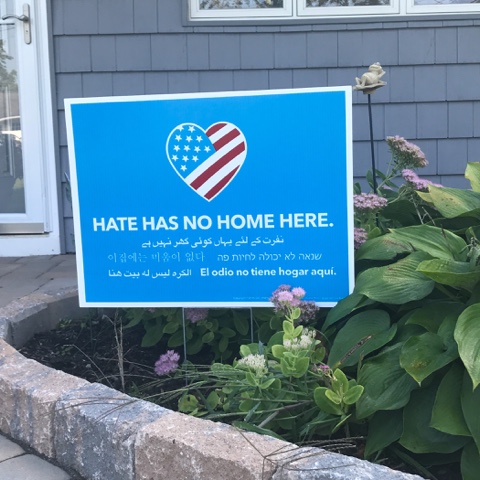
The answer, I had always assumed, was no. My declaration of belief, whether it is for peace, against hatred, or in support of something like universal health care, begins as a personal statement. I believe. As a writer, I know I need to go farther — as I teach students, the phrase “I believe often is used as a crutch. I believe something to be true, I, meaning it is my belief and only mine and I can believe what I want. Screw the evidence. Forget supporting my arguments. I believe it and that makes it as valid as anything anyone else might say.
This certainly is true of some things: taste, for instance, is deeply personal. I like The Beatles and Kendrick Lamar and don’t like Mariah Carey or Journey. I have a host of reasons, some rational, many not, but it doesn’t mean you have to agree.
There is, as with all deeply held beliefs, a sense of ownership and an implication that the holder of the belief is right and everyone else is wrong.
But does it imply anything more?
A month or so ago, the conservative blogger Matt Rooney commented on the signs this way on Twitter:
“Hate has no home here” yard signs are the new awareness ribbons. Condescension and tokenism at their worst.— Matt Rooney (@MattRooneyNJ) July 17, 2017
I was a bit surprised by his argument. Yes, the signs are merely a small gesture, but “Condescension and tokenism at their worst”? That was just absurd.
I commented in a retweet that it was a small public declaration, which elicited this response:
Why is it important to tell your neighbors that you think they’re bigots? Why not skip the yard sign (save a tree!), man up, and go tell’em? https://t.co/9obfXIInTO— Matt Rooney (@MattRooneyNJ) July 17, 2017
Again, this is absurd. Why would one assume hat my public declaration of what I believe is an implied critique of my neighbors? The answer, I think, is that Rooney and many on the right who are critical of the signs see them as a threat to their world view. My simple declaration, made public, raises questions about their beliefs that they may find uncomfortable — not that they hate, but that something in their belief system encourages hate? I don’t know. I’m loathe to engage in a pop psychoanalysis of politics and I want to make it clear that this is not about Rooney — he just provides a useful example, even if it is something that is a couple of months old.
Why bring it up now? Well, the sign discussion is an ongoing one. I drove around recently and found a dozen “Hate Has No Home Here” signs in my Kendall Park neighborhood, not including other variations. I also found a couple of pro-Trump signs — rare in Democratic South Brunswick — and a variety of others for football teams, colleges and contractors.
My posting of the sign is about me, about what I believe, about my belief hat I have to make that belief public. Do I hope others will follow suit? Of course. Do I hope it makes bigots uncomfortable? Yes. Does it mean I believe those who don’t post such signs — or the myriad others I’ve seen recently — are “bigots,” as Rooney said? Again, that’s absurd, presumptuous — and condescending, and it’s a variation of an argument that paints disagreement as something nefarious. My sign, which symbolizes something I believe in, which states my belief pretty clearly, is dismissed out of hand as an effort on my part to show my superiority and, because that is all it is, I can be ignored. My instinctive response is to say “Fuck off,” though I usually try to engage.
It’s like when someone says “you just want to be the smartest guy in the room” as a way of diffusing the points you make. (Which happened recently.) It no longer is about what you say, but about who you are. It is a personal attack — I don’t have to listen because you’re just an egomaniac who likes to hear himself speak. The instinctive response, again, is to say “fuck off,” and perhaps that is the best response. After all, why engage when someone seeks not to answer but to demean? Or, I could say, “I don’t need to try. I am the smartest guy” — a joke, though I suspect it is one hat, given the medium (Facebook and/or Twitter) and the sanctimoniousness of both sides of the argument (mine included), it is a joke destined to sink like the proverbial lead balloon.
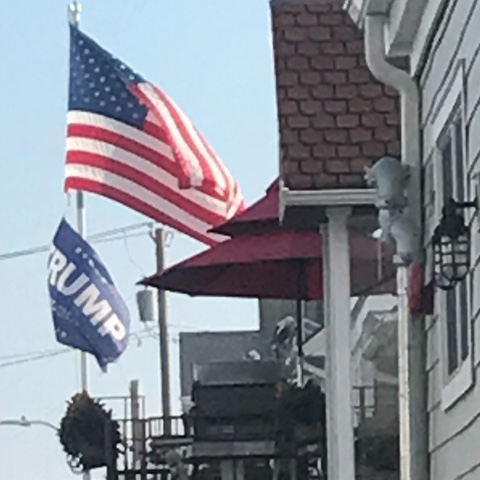 |
| A Trump flag in Long Beach, NY. |
“Hate has no home here” signs are really no different than the Trump signs that have popped up since his election — not the election signs, but signs that proclaim support of the 45th president and restate his slogan “Make America Great Again” — or the sign on my neighbor’s yard that proclaims “Proud to Be an American” (like the song). I don’t take either of these signs as questioning my Americanness or my patriotism (even if that might be — I can’t know without asking — the intent of the sign displayer). I know where I stand and I’m glad to know where you stand, as well, even if we disagree, even if it might mean we should keep some distance between us.
The reaction to the signs, like our efforts to dismiss he possibility of debate, is a symptom of a larger problem in American politics and society, one that is making it difficult, if not impossible to create the temporary alliances that need to be created to move the nation forward. I don’t mean we have to give in to racists and white supremacists, but we have to acknowledge those points where agreement can be reached and use those things we hold in common as a launch pad.
And we have to admit the humanity of our opponents, which has become difficult in our hyperpartisan era. Fox News, and more recently, cites like Breitbart, demonized their opponents, seek to take political or philosophical differences, paint their opponents as morally deficient because of these differences, and then bludgeon them with the differences.
I think this is partly why we view signs like “Hate has no home here” as provocations, rather than indicators of what the sign-owners believe.

 Hank Kalet
I've seen many of these signs in the Princeton, Kingston and South Brunswick Township area. It's obviously a reaction to having a con man demagogue in the White house who uses dog whistles and fog horns to stir up racism, bigotry, prejudice, xenophobia and chauvinism for his own short sighted twisted purposes.