
 |
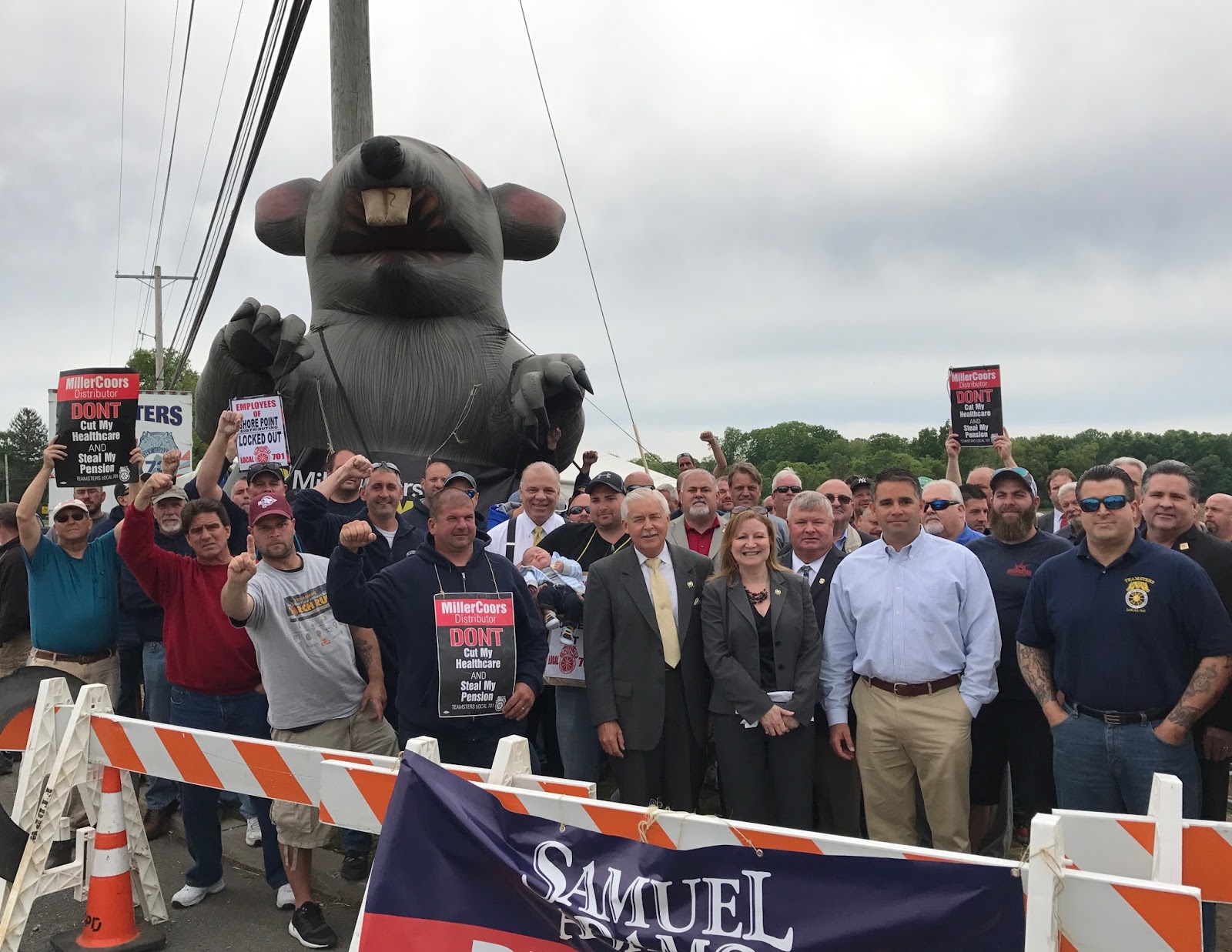
| Locked out workers protest in Freehold. (Photo from Democratic press release) |
Workers at a New Jersey Shore beer distributor have been locked out — a tactic growing more frequent as corporate managers around the country attempt to gut union protections, slow wage growth and slash health and retirement costs.
As The Nation reported last year, lockouts are growing in frequency. It is the management version of the strike — except that the strike is a tool designed to level the playing field between workers and management, who usually hold most of the cars. The lockout also stops work, but it makes use of management’s unequal power — as a rule, they hold all the cards — to force workers to grant concessions. As Michelle Chen writes,
The lockout is, essentially, a work stoppage initiated by the employer: the boss applies pressure to workers in a labor dispute by suspending operations. The power dynamics of blocking workers from their jobs, however, play out differently than a worker-led uprising. The Century Foundation (TCF) analyzed trends in labor lockouts and concluded that firms inherently wield dramatically more leverage over workers—that is, that lockouts are more damaging to workers than strikes are to employers—due to sheer volume of political and economic clout, beyond the bargaining table.
This may seem to fly in the face of current thinking. There are many who view unions as too strong, their workplace rules as an impediment to business. But unions are at their weakest point in decades, perhaps since they first popped up in the United States. The percentage of unionized workers in the private sector has dropped into the single digits, while public employee unions are battling just to maintain their limited power (see Wisconsin). Pro-management, pro-corporate politicians have drafted and passed so-called “right-to-work” laws, laws that allow workers to opt out of joining unions or paying dues for services unions provide.
The Shore Point lockout occurs within this climate. The North Brunswick-based company locked out 113 workers on April 30, “in an attempt to force them to give up their pension, agree to a three-year wage freeze, and agree to give the company permission to change their health insurance plan and healthcare costs at any time,” according to a press release from Teamsters Local 701.
Workers are fighting back by protesting at Shore-area festivals and by convincing local restaurants and bars to stop serving MillerCoors products until the lockout ends — at least according to the Teamsters. Three Democratic state legislators — Senate President Steve Sweeney and Assembly members Joann Downey and Eric Houghtaling — joined a protest in Freehold yesterday and announced legislation designed to help workers during lockouts. The bill, if approved, would “help workers cover the cost of health care during a lockout” by offering “funding assistance to pay for COBRA health benefits.” The chances of such a bill getting through the Legislature are unclear, but it is unlikely that, if it makes it to his desk, Gov. Chris Christie would sign it.
The bill would be an improvement on current law, which forces locked out workers to pay their own and their employers share of health coverage costs, but it does not go far enough. Current law tilts the playing field toward management, making it easier for companies to use the lockout as a negotiating threat. Employers lose potential revenue when they initiate a work stoppage, but they also avoid paying out salaries and benefit costs, limiting their exposure during a lockout, and they control the lockout’s duration. When workers strike, however, they control duration, but they give up everything — a sacrifice they make willingly. Employers should have to put more on the line when they lock out workers, including covering both their portion of benefit costs and those of their workers. They also should have to pay something into union strike funds, if not be forced to continue meeting their payroll.
I don’t expect changes of this magnitude to occur anytime soon — workers are too fragmented and the labor movement is too weak. The threats of outsourcing and company relocation remain strong, and labor has yet to develop a national and international mindset to address these issues. And rebuilding the labor movement during the age of Trump is likely to prove difficult, given his empty promises on jobs, and the Democrats’ lack of attention to union issues.
Send me an e-mail.

 Hank Kalet
There is a war on unions in this country and the plutocrats are winning. Too much of the media are anti-union and for that matter, too many Americans are anti-union. Where are those nifty swifty libertarians on unions with their free choice and faux individualism. Don't hold your breath for libertarians to support unions any time soon in the next 40,000 years. The libertarian toadies always support management over everything including unions. The billionaire libertarians are rabidly anti-union, think the Waltons or Koch brothers. The overall unionization rate is about 10%; compare that to the Scandinavian countries where the unionization rate is 51% and well above that as in Finland. Germany has works councils in which the workers have a seat at the board of directors' table. That is unthinkable in this anti-union country. Back in the 1950s the unionization rate was in the 30%-35% range and the top marginal tax rate was 91%. It's all up to the American people; if they are happy to become wage serfs without any benefits, then don't complain. We need unions more than ever, it will take a revolution to turn things around, hopefully it will be a bloodless struggle. Too much blood was shed in the labor union history of this country, we don't need any more violence. Perhaps the anti-unionism is related to the slave history of this country.