
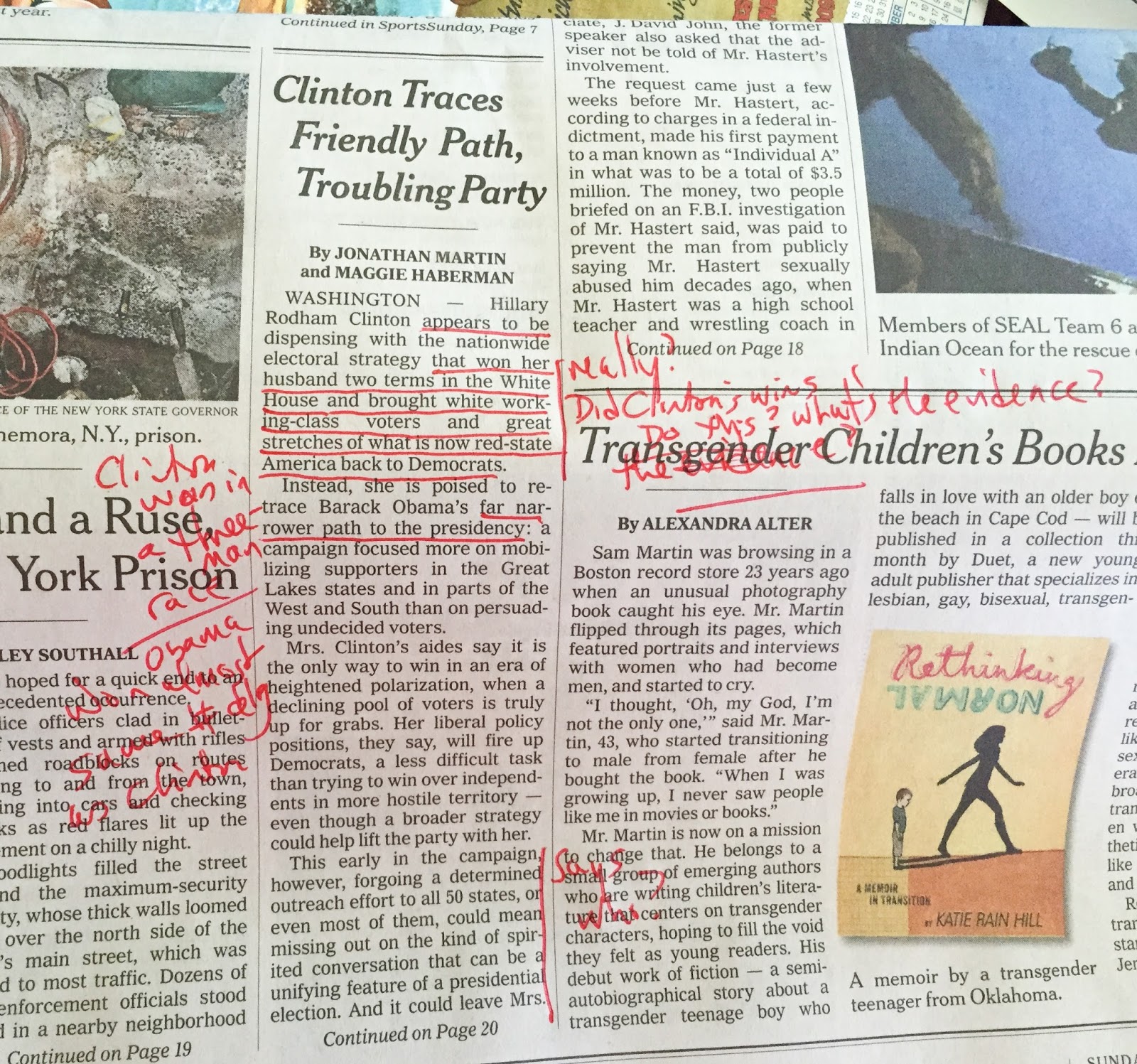
This kind of story makes me nuts. It is cast as unbiased reporting, but really is closer to opinion than a straight explanation of what is happening. As Jay Rosen, the press critic pointed out, it is so maddening that it deserves a response:
This story may finally get me to try press-criticism-as-annotation, a method I have been meaning to attempt. http://t.co/3lPD3EKmXu— Jay Rosen (@jayrosen_nyu) June 7, 2015
I thought annotation was worthwhile, too (see above), and it led me to the brief analysis that follows.
The key point I want to make is this: The unattributed statements in the first few paragraphs are meant to cast conventional wisdom as fact, which then recasts recent history in an alternative universe, painting the Clinton years as qualitatively different in terms of partisanship than what we have experienced during the Obama years. Of course, the story doesn’t overtly make that claim, but the implication is pretty clear from the way it chooses to describe Bill Clinton’s
Let’s look at the first four paragaphs (see the photo above of my red-penned mark-up). It starts with a conditional claim, that Clinton “appears to be dispensing with” with Bill Clinton’s approach — a phrase designed to distance the story from its main thesis, that Hillary Clinton has decided that she can’t win “white working-class voters and great stretches of what is now red-state America” and that, in doing so, she will be foregoing an opportunity to use her campaign to unite voters and politicians. This assumes, of course, that Bill Clinton was a unifying figure in American politics — a rather absurd claim given that the Democrats lost the House for the first time in 40 or so years while he was in office, and that the ’90s were marked by the same kind of partisan gamesmanship we have been witnessing during the Obama era.
The writers, however, double-down, claiming that her apparent decision to “retrace Barack Obama’s far narrower path to the presidency” may be “a less difficult task than trying to win over independents in more hostile territory.” according to Democrats, “even though a broader strategy could help lift the party with her” (unattributed comment — i.e., the writers’ opinion).
This early in the campaign, however, forgoing a determined outreach effort to all 50 states, or even most of them, could mean missing out on the kind of spirited conversation that can be a unifying feature of a presidential election. And it could leave Mrs. Clinton, if she wins, with the same difficulties Mr. Obama has faced in governing with a Republican-controlled Congress.
Bill Clinton, of course, did not have the “same difficulties” with the Republican Congress, or so the writers’ rather confused memory would have us believe. Clinton did manage to get some things through Congress — mostly the kind of dismantling of the safety net usually associated with Republicans — but the reality is that his eight years in office offered a permanent state of investigation of his administration, a government shut down and an impeachment.
Clinton’s broadbased election strategy, the story says, resulted in Democrats winning back the white working class. Again, this is at odds with reality. Exit polling showed that Bob Dole, the Republican candidate, won the white male and Protestant votes by significant margins — something that Republicans have continued to do in the intervening years.
In addition, it is important to remember that Clinton won both of his elections without crossing the 50 percent popular vote threshold, and it could be argued that his electoral college landslides occurred because Ross Perot siphoned off just enough conservative votes to keep several states out of the Republican column. (He won Kentucky and Nevada by about 1 percentage point each and Arizona and Tennessee by less than 3 percent each.)
This is pure speculation, of course — who knows what may have happened had Perot not run. This is why I turn to so-called “weasel words” like “could be argued.” I’m not saying he would have lost those states, but saying Bill Clinton was a unifying political force bears no relation to the decade of partisan warfare that I remember.
The story is, as Rosen pointed out on Twitter last night, a case bias without self awareness:
I wouldn’t mind these things if the reporters showed just a bit of awareness that THEY prefer centrism and “middle.” http://t.co/3lPD3EKmXu— Jay Rosen (@jayrosen_nyu) June 7, 2015
The conventional wisdom in Washington is that there is some reasonable middle and that anything that deviates from it, any politician who claims a political philosophy or boldly stands up for a constituency, contributes to paralysis.
Send me an e-mail.

 Hank Kalet
As Jay Rosen, the press critic pointed out, it is so maddening that it deserves a response:Cape Cod Surfing Lessons