
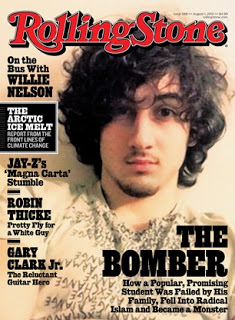
 The upcoming issue of Rolling Stone magazine has created quite a stir — and it hasn’t even hit newsstands yet.
That’s because it features a cover story — and cover — of suspected Boston Marathon bomber Dzhohkar Tsarnaev. Officials in the Boston area and many, many others in the social media universe reacted harshly. I posted a link yesterday to Twitter and Facebook saying I agreed with Jon Wolfson, the editor of Boston Magazine. Wolfson told Jim Romenesko, who runs the influential Romenesko journalism blog, that
“There are people here in the city, and even on my staff, who are really angry about the cover, but I’m having a hard time getting as upset as everyone else. I completely understand how the cover could be interpreted as glamorizing Tsarnaev and, in a way that further wounds the victims, painting him in a sympathetic light. But I think that interpretation misses the point of what Rolling Stone was trying to do, which was to spotlight just how unlikely it would have seemed on April 14 that his kid could have done something like this.
“Could the execution have been better? I think so. The cover language describes Tsarnaev himself as a victim, and from my perspective at least, that was insensitive to the people who were killed and wounded in the bombings. But overall, it’s my opinion that the outrage has been to some degree out of proportion to the magazine’s offenses.”
This seems eminently reasonable. It is important to note, for instance, that — as The Huffington Post reports — Tsarnaev’s picture (a self-portrait)
has in fact been used by other publications since the April 15 Boston Marathon bombing, which Tsarnaev stands accused of carrying out with his brother, Tamerlan. The photo even appeared on the front page of The New York Times in May. However, its presence on the cover of Rolling Stone, a space typically occupied by rock stars and actors, sparked outrage on Twitter and Facebook, where many observers objected to what they saw as the glamorization of Tsarnaev.
Both assertions are correct. The photo has been used in the past and a story like this, which purports to explain how a seemingly integrated kid ended up turning extremist and conducting an act of terror on American soil, certainly deserves cover treatment. But the cover, as designed by Rolling Stone, does treat Tsarnaev like the pop-culture stars that usually take up this coveted real estate.
In judging the cover, I attempt to follow a set of journalist principles, some of which are in conflict and require a delicate balancing: Is the story and cover newsworthy? Does it warrant lead placement — i.e., is it the most interesting or important piece in the magazine? What are the expectations of the readership (this is different than the expectations of the larger community)? There are other questions that I would ask and there are questions that might come from someone higher on the food chain — like the publisher — but I think you can understand the general outlines of the decision-making process.
I’ve already answered the first two questions — yes, it is newsworthy and, yes, it does warrant lead treatment, though executed a bit differently. The expectation question is harder to answer, but I suspect that the magazine’s audience will have far less of an issue with this cover than those who are criticizing it, meaning that the community that Rolling Stone serves is likely to be OK with what has been presented here.
This brings me to one of the more interesting parts of this story — the call for boycotts. First, I am generally critical of boycotts that target media organizations and their sponsors, whether they be Rolling Stone or Rush Limbaugh. They amount to an economic attack on editorial independence and are really just the converse of a publisher coming to an editor and saying “write this story to please our advertiser.” Rolling Stone attempts to make this argument, but does so badly — no, Rolling Stone, this is not a constitutional issue because government is not involved in censoring the press and because newsstands, stores and advertisers have a right to determine what they will sell and where to place their advertising.
I also find it unlikely that the boycott will have their desired effect, partly because the goal seems kind of murky — is it to get Rolling Stone to change its cover? to punish the magazine for offending the community? or is the goal something else? — and partly because the people who are engaged in this conversation are not the people reading the magazine in the first place. Rolling Stone’s demographic skews young and somewhat liberal. It is not a group likely to take umbrage at the cover, as I said, and in the end the advertisers are going to acknowledge that and stick with the magazine.
The uproar over the cover is overblown and likely to blow over quickly, though it does have the potential to spark a conversation about what good journalism is, what responsibilities journalists have to the community and — something rarely ever mentioned — what the community at large owes to the journalists.
In the end, I’ll be boycotting the boycott.
Send me an e-mail.

 Hank Kalet
In my opinion, it was insensitive to the victims and their families to feature this monster's picture on the cover of a magazine that usually features pop icons on the cover. Why even have a picture of him on the cover at all? Having an article about the little psychopath was fine but the giant photo of him, dominating the cover, was bound to upset people who lost legs, hearing, vision and loved ones. The wounds are still too fresh. If I were in their place, I guess I would want to boycott the magazine.
As any regular, or even occasional reader of Rolling Stone is aware, the editorial staff rarely makes decisions on what, or what not, to publish based on what's the popular sentiment. Even though the vast majority of the magazines reporting centers around music, there is always a political subcurrent that plays to the beliefs of its readership. Left of center, yes, but also politically more active than the average bear. Most recently, this manifested itself in the piece that got General Stanley McChrystal prematurely retired from the US Army.This was a story that needed to be told, if only to expose how someone in this guy's position – growing up in the United States after his family escapes Chechnya, goes to a prestigious high school, and enrolls at UMass – becomes the fundamentalist wingnut he did. There is a cautionary tale here, and the usual tendency is to ignore it, at our peril.If RS had decided not to publish this story, they could rightly be accused of self-censorship, which in some ways is even worse than government censorship.
Write whatever articles you want but putting the face of the loser on cover meant for superstars exhibited extremely poor taste. One can only assume the folks at RS didn't think this through fully. His victims and their families have suffered enough. NOT thoughtful journalism. NOT the appropriate forum for rockstar treatment. Thus the outrage and boycott. RS has lost touch with how American psyche works and that is why it is no longer relevant.