
Situational ethics

I’m not sure what to make of this response to Gov. Jon Corzine’s ethics reform package from a group calling itself GOP STRONG — a Passaic County conservative group. The organization issued a press release Monday that called for legislators and officials in the state’s counties to “reject Gov. Corzine’s new ethics proposals because they will further tilt the balance of power in New Jersey toward public unions and that will ultimately lead to higher taxes.”

“The reforms we need are more immediate reporting of contributions, an open and fair contract process and severe limits on donations by public employee unions – the unions that Corzine has been protecting since he got elected,” said Ramaglia. “Jon Corzine isn’t a governor; he’s union leader.”

Corzine’ plan proposes to limit donations and end wheeling the practice of a political organization in one county from donating to a political organization in another county. But Corzine proposes no limits on donations from public employee unions.

“Corzine’s plan will take money out of the political system from the private sector leaving public employee unions with a bigger say in the outcome of elections. That will be a disaster for the taxpayers,” says Robert Fass, a GOP Strong co chair and a business owner.

“The last thing New Jersey taxpayers need is for public employees to control politicians even more than they do now. The reason taxes are so high in this state isn’t because of pay to play from the private sector, it’s because of salaries benefits and ridiculous pensions given to the public employees that taxpayer are forced to pay for,” added Fass.

The group is oposed to the governor’s proposed ban on wheeling — a practice that allows money to be contributed to one candidate but moved to other candidates running for other offices — because it would make “it nearly impossible for party building because it would outlaw donations across party lines.”

The key to understanding the group, I think, is its harsh and constant rebuke of the state’s public employee unions — an obsession that seems to be its entire reason for existing. Consider this comment from the press release:

“Gov. Corzine’s plan is another sham designed to protect the public unions that are driving up the costs of property taxes in New Jersey,” says GOP Strong co-chair Mike Ramaglia.

Or this:

“The reforms we need are more immediate reporting of contributions, an open and
fair contract process and severe limits on donations by public employee unions –
the unions that Corzine has been protecting since he got elected,” said
Ramaglia. “Jon Corzine isn’t a governor; he’s union leader.”

Or this:

“Corzine’s plan will take money out of the political system from the private sector leaving public employee unions with a bigger say in the outcome of elections. That will be a disaster for the taxpayers,” says Robert Fass, a GOP Strong co chair and a business owner.

“The last thing New Jersey taxpayers need is for public employees to control politicians even more than they do now. The reason taxes are so high in this state isn’t because of pay to play from the private sector, it’s because of salaries benefits and ridiculous pensions given to the public employees that taxpayer are forced to pay for,” added Fass.

Apparently, the unions are more powerful than the business community, according to GOP STRONG — a thought so absurd it boggles the mind.
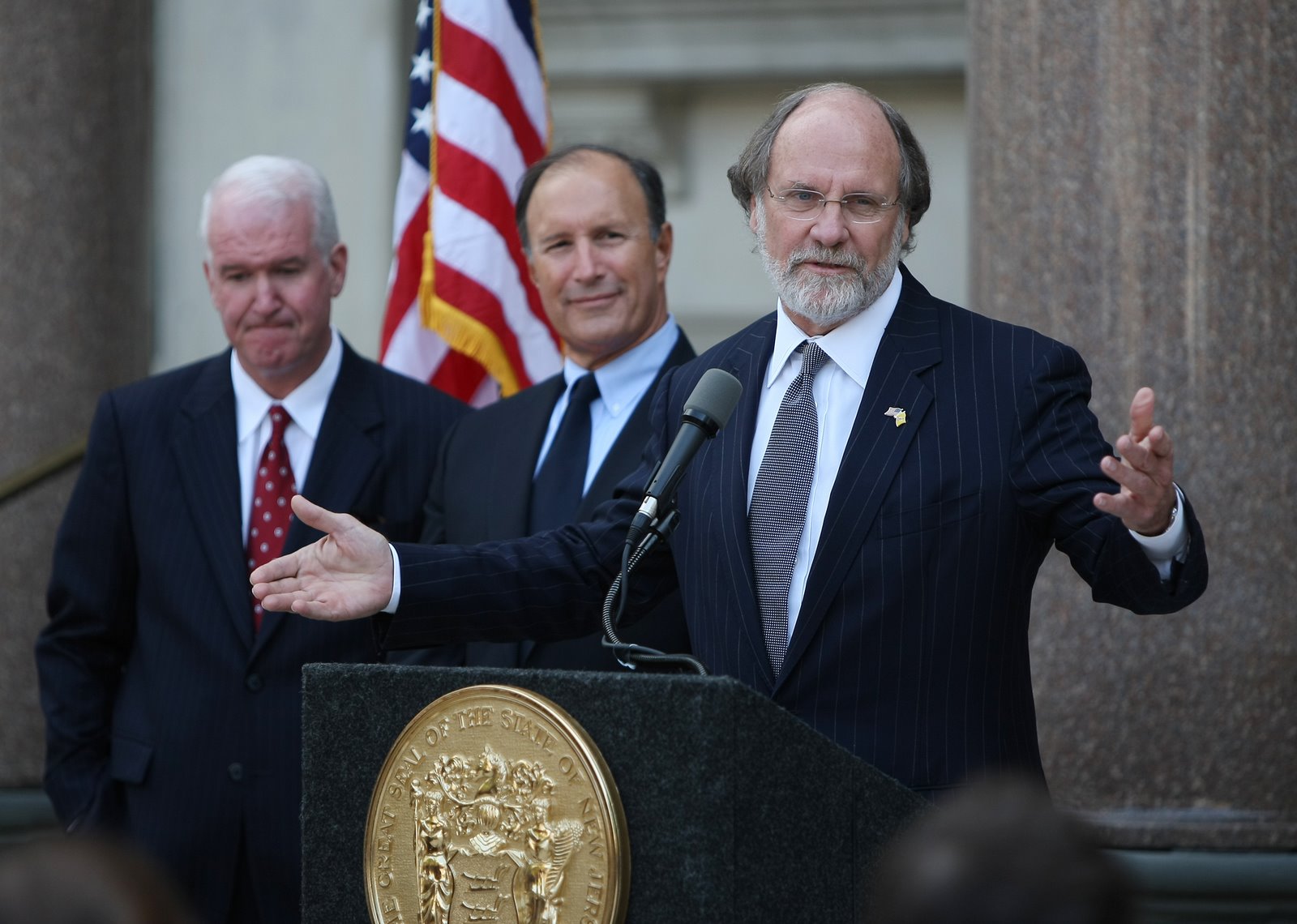
Corzine’s cleanup plan


I wrote the other day about Gov. Corzine’s new ethics reform package, which includes rather strict bans on pay-to-play and wheeling (the practice of passing campaign contributions from committee to committee). I just finished a telephone press conference with the governor during which he outlined his plans and offered a sense of how important he views these reforms:

There is a need for greater transparency and public accountability in government, he said, and it is important that new rules be put in place to give the state’s residents confidence that elected and appointed officials are working in the public’s interest.

“We’re trying to, through ethics reform, deal with financial responsibility to make sure we are not spending money we don’t have to be spending,” he said. “And we are taking actions that would give people greater sense that the mix of money in politics is not determining the direction of public policy.”

The governor is using a two-pronged attack — enacting some reforms by executive order and pushing a number through the legislative process. In the end, he is hoping for comprehensive controls on pay-to-play that will be in force at all levels of New Jersey government.

Prior to the governor’s Sept. 24 executive order, only state contracts were covered under state rules (towns like Monroe and South Brunswick have their own pay-to-play restrictions in place). Businesses or their principles — those owning at least 10 percent of the business — were ineligible for public contracts worth at least $17,500 if they made reportable campaign contributions (more than $300) to a candidate committee and/or election fund of any gubernatorial candidate, or to any state or county political party committee within the previous 18 months.

In addition to the earlier rules, enacted by executive order under Gov. Jim McGreevey, Corzine has placed restrictions on contributions to local candidates and local party committees for firms seeking state contracts. He also removed the 10 percent requirement, meaning that all partners, no matter how small a stake they may have in a company, are now on the restricted list.

The governor said he would like to see a more comprehensive ban on pay-to-play at the local level, and he is encouraging the Legislature as part of his reform package to cover local contracting, as well.

He said “there are a number of municipalities that have been proactive in moving forward on (pay-to-play bans), but it is very uneven across the state.”

“I think there are only 60 of the 566 municipalities in New Jersey that have taken up these rules,” he said. “We’re asking for uniformnity on that so that the public can have the confidence that money in political contributions does not determine where contracts go.”

At the same time, he does not want state law to pre-empt stronger local laws, but “set a floor for every municipality.”

The wheeling ban may be more significant, because it should limit the ability of individual legislators or county freeholders to act as power brokers outside of their geographical regions.

“We want money raised in Bergen to stay in Bergen and money raised at the local level to stay at the local level — within limits,” he said.

On a related note, I asked him about the recent decision regarding Arizona’s clean elections law, in which its rescue money provision was deemed unconstitutional, a decision that has tabled the New Jersey clean elections experiment for the time being. The Arizona decision was based on a New York ruling over the summer that found unconstitutional a provision of federal rules altering contribution limits when candidates face self-funded opponents.

He says he remains committed to clean elections. He would “like to continue to expand its operation in the state” and was “disappointed in (the courts) its most recent negative interpretation” of the law.

“I am hearing legal advice that there has been an overreading of how much (the earlier New York decision) it affects clean elections,” he said.

“The more we can move in that direction, the better we can be served by reducing the role of political contributions as the basis on which candidates are chosen and elections are decided,” he said.

Corzine targets ethics

Gov. Jon Corzine finally maybe living up to the expectations I had for him when he ran for office in 2005.

A progressive-leaning U.S. senator, Corzine figured to be a breath of fresh air after the McGreevey administration and eight years of Whitman/DiFrancesco. But in his nearly three years in office, the governor has stumbled badly, giving in to too many of the political power brokers that have run this state for too long.

While his budgets have begun the difficult process of righting the fiscal ship, he punted on full-scale reform and opted to bet his political capital on a plan to privatize state assets — a move that has helped drive his approval ratings to the basement.

But maybe I’ve been too harsh. The governor unveiled an ethics package earlier this week that would do help clean up state and local governments.

The proposal includes, according to a press release from the governor’s office:
Reforms Through Executive Order
Pay to Play

  • Ban contributions by State redevelopers and their consultants
  • Tighten coverage of current ban on State-contractor contributions to include contributions by partners of professional service firms regardless of percentage of ownership
  • Address issue of evasion of current restrictions by extending current ban to include State-contractor contributions to legislative leadership committees and municipal committees

The above provisions would be codified in subsequent legislation

Ethics Enforcement

  • Appoint a task force to make recommendations on whether the Local Government Ethics Law should be amended to match the State Conflicts of Interest Law and whether enforcement responsibility should be shifted from the Local Finance Board to another entity focused solely on government ethics. Task force also would consider how to implement a training and compliance program for local ethics.

Financial Disclosure

  • Update financial disclosure executive order to address newly created boards and positions that should be subject to disclosure requirement

Reforms Requiring Legislation
Pay-to-Play
State government and authorities

  • Codify Executive Orders that strengthen State contractor ban and that create new ban on State redevelopers

County and municipal governments and authorities

  • Amend current law to remove “fair and open process” exception
  • Tighten coverage to include contributions by partners of professional service firms regardless of percentage of ownership
  • Ban contributions by county government or county authority contractors to municipal candidates and municipal committees in that county and ban contributions by municipal government or municipal authority contractors to county candidates and county committees in that county
  • Enhance compliance and enforcement by making State law apply uniformly across all local governments since with strengthened State law there is no need for the current mosaic of local ordinances
  • Ban contributions by county and local redevelopers and their consultants (modeled on State-level ban to be established by Executive Order)
  • Ban contributions by developers seeking development approvals

School Districts

  • Codify current Department of Education Accountability Regulations regarding pay-to-play (which cover contributions to school board candidates) and extend the ban to cover contributions by school district contractors to county candidates, county committees, municipal candidates, and municipal committees where the school district is located

Regional Utility Authorities

  • Extend contribution restrictions that apply to State contractors to contractors for legislatively created regional utility authorities

Auditors

  • Ban contributions by audit firms and partners to audit clients (as recommend in August 2008 Report of State Comptroller)

Wheeling

  • These reforms will help prevent party committees from being used to evade pay-to-play and regular campaign finance law limits on contributions. Except for certain restrictions on county committees, current law allows party committees to make unlimited contributions to candidates, other party committees, and PACs. Under these reforms, county-to-county contributions would be banned, as would contributions by county or municipal committees to municipal committees in other counties. Party committees would only be permitted to make unlimited contributions to candidates or constituent party committees within the intended sphere of influence of the party committee. In essence, unlimited contributions would be permitted to flow only downhill, not uphill or laterally. As to all other contributions, a party committee would be subject to the same contribution limits as PACs.

State Committees

  • Impose new annual limit of $25K on contributions by State committees to a legislative leadership committee
  • Impose new annual limit of $7,200 on contributions by State committees to a PAC

Legislative Leadership Committees (LLCs)

  • Impose new annual limits on contributions by LLCs to a State committee ($25K), another LLC ($25K), a county committee ($25K), a municipal committee ($7,200), a county or municipal candidate ($8,200), and a PAC ($7,200)

County Committees

  • Impose new annual limit of $25K on contributions by a county committee to a State committee or a LLC
  • Extend current ban on contributions by a county committee to another county committee, which runs from Jan. 1 to June 30, to cover the entire year, and ban contributions to municipal committees in other counties.
  • Impose new annual limit of $7,200 on contributions by a county committee to a PAC

Municipal Committees

  • Impose new annual limit of $8,200 on contributions by a municipal committee to a candidate in another municipality
  • Ban contributions from a municipal committee to another municipal committee in another county and impose new annual limit of $7,200 on contributions by a municipal committee to another municipal committee in the same county
  • Ban contributions by a municipal committee to a county committee in another county and impose new annual limit of $25K on contributions by a municipal committee to its own county committee, the State committee, or an LLC and $7,200 on contributions to a PAC

Campaign Finance
Lower Contribution Limits

  • Lower current annual limit on contributions to a county committee from $37K to $25K.

527s and Similar Groups

  • Require greater disclosure for ads broadcast within certain period prior to election

Contracting Reform

  • Codify Executive Order No. 37 (2006) (independent State authority procurement and governance reforms) and provide for Governor’s veto power over minutes of the few authorities where the power does not now exist (North Jersey District Water Supply Commission and Passaic Valley Sewerage Commission)
  • Amend Local Public Contracts Law, Local Public School Contracts Law, and County College Contracts Law to require “fair and open process” as a minimum process for all awards of professional service contracts
  • Amend Local Public Contracts Law, Local Public School Contracts Law, and County College Contracts Law to require “competitive contracting” for insurance contracts
  • Reform local auditing rotation and selection practices to enhance independence of auditors (to include recommendations from August 2008 Report of State Comptroller)
    • prohibit audit firms from providing other services to public entity audit clients during term of audit engagement
    • require rotation of auditors at least every 10 years, replace single-year auditing engagement with five-year engagement subject to termination for violation of professional standards or similar malfeasance, and require competitive selection process

Ethics Enforcement, Compliance, and Training

  • Amend current law to make State Ethics Commission an all-public-member body, as the Legislative Ethics Committee now is

Financial Disclosure

  • Strengthen legislative disclosure regarding sources of income

Other Reforms

  • Prohibit use of State grant funds for hiring lobbyists to lobby State government
  • Amend criminal statutes to add corruption offenses to the list of “predicate offenses” under the State’s RICO statute
  • Modernize enforcement of campaign finance reporting requirements by giving ELEC authority to establish a schedule of penalties for late filing of campaign finance reports and for other administrative violations of election laws (modeled on federal law)
  • Amend law regarding penalties for failure to file financial disclosures so that the per-diem fine would apply to employees but failure to file by unpaid board and commission members after appropriate reminder would trigger automatic removal from position rather than fine

    Al Doblin, of The Record, sums the effort up this way:

    Corzine deserves credit for moving forward on ethics reform. But his timing is a little off. Right now, New Jerseyans are concerned about the meltdown on Wall Street, not ethics reform in Trenton. Corzine’s critics will make the most of that.

    The good and bad of Corzine is he isn’t a natural politician. In the U.S. Senate, he advocated for important social issues, notably against the genocide in Darfur. Jersey politics, and many of its elected officials, are not focused on the big picture. It’s very local.

    The state’s political bosses may have little interest in fixing the national economy, getting our National Guard members home or universal health care. But they have strong views about construction contracts, filling jobs on utilities boards and making sure that political pork is delivered to their home turf.

    In Jersey, wheeling is not a round of Swiss; it is the Big Cheese making the rounds.

    It’s hard to predict how much of Corzine’s reform package will be codified into law, but reformers should celebrate. Fondue would be appropriate.

    Veto this: Deadline looms on Permit Extension Act

    The clock is ticking on legislation that grants builders broad exceptions to state planning rules — a bill that could have dire consequences for the environment, while creating the illusion of generating jobs and boosting the economy.

    Consider this comment from the state builder’s association in The Star-Ledger:

    Legislators from both political parties supported the measure because it would provide sorely needed jobs in a struggling economy, noted Amy Whilldin, director of communications for the New Jersey Builders Association.

    “These projects were largely stalled because of the economic downturn. Allowing the time period to be extended, for a reasonable period of time, will stimulate growth,” she said.

    Stimulate growth? By extending the permits of projects approved in the past, projects that may have stalled for reasons other than the economy, all the bill will do is give builders a way around environmental restrictions they opposed when they were passed.

    Gov. Jon Corzine has until Sept. 15 to make a decision on the legislation, called “Permit Extension Act,” which the Ledger describes as “giv(ing) developers a two-year extension to complete any stalled building projects.”

    There are aspects of the bill that make sense — provisions tied to transit hubs and redevelopment projects — though it is important that development projects be held to the highest environmental standards, and that includes requiring those that expired to meet recently enacted environmental laws.

    But the governor has a conditional veto he can use to force a rewrite of the legislation to make it more consistent with environmental goals, as Jeff Tittel of the New Jersey Sierra Club and Dave Pringle of the New Jersey Environmental Federation told the Ledger. The two organizations

    want the governor to “conditionally veto” various parts of the bill, including what they call the “Dracula” provision. That provision would allow projects with permits that expired after Jan. 1, 2007, to be “brought back to life” and enjoy the two-year extension, they said.

    “In the midst of presidential politics, Governor Corzine has to govern New Jersey, including deciding the fate of the Permit Extension Act,” said Pringle, the federation’s campaign director. “Within two weeks, he will decide whether or not to underline core environmental and public health protections, good planning, and the constitution.”

    Tittel, the state Sierra Club’s director, said the governor also could amend the act to protect local planning decisions made in communities like Bernardsville, Newark and Jersey City to promote growth near transportation hubs, protect environmentally-sensitive areas and halt sprawl.

    So, what’s the decision Gov. Corzine?

    New Jersey: The debtor state

    How bad are the state’s finances? Consider this report from The Star-Ledger:

    New Jersey’s state debt swelled by almost $2.2 billion last year even as Gov. Jon Corzine campaigned to rein in borrowing, state officials have confirmed.

    The additional borrowing pushes the state’s debt load to $32.9 billion. Including $3.6 billion in bonds being repaid with payments from a national settlement against cigarette manufacturers — which the state Treasury does not count in its debt calculations — the state’s total debt load is $36.5 billion, nearly triple the level of a decade ago.

    State bond documents show that the bulk of the new debt run up last year was attributable to the state’s $8.6 billion school construction program and transportation projects.

    The problem with debt, of course, is not debt itself. Some debt is inevitable — it simply makes no sense to upgrade or build new roads using general operating funds (most people don’t do that with their homes), or to build new schools or purchase parkland. These are longterm expenditures that will be of benefit not only to us but to future generations.

    The problem is that the state’s debt also includes an array of borrowing designed to do little more than balance the budget.

    The upshot of all of this, of course, is that debt repayment pinches other areas of spending.

    Repaying the state’s debt is scheduled to cost about $2.8 billion this year, a jump of about $115 million over last year’s debt costs. But Corzine said his debt retirement plan will cut that tab by at least $130 million.

    That’s $115 million that had to go to debt repayment in a flat budget that could have gone to other programs — or to tax relief.

    That makes debt our No. 1 fiscal issue, one that has to be tackled to allow the state to do the other things that need to be done.