
Religion in the public eye

The intersection of faith and public morality too often is derided or, at the very least, cast on the shoals of the church-state debate.

Let me say, first off, that the wall Jefferson wrote separating religion from government is one of the most important constructions devised by the founders. It protects religious minorities amd the irreligious from the majority and the state and, avoid unnecessary and dangerous entanglements, while creating space for religion to grow and prosper.

That is why the religious culture of the United States is healthier and more diverse than in most European nations. There is no war on religion, despite what Bill O’Reilly and his neandethal brethren say, (I would argue, in fact, that if anyone is doing harm to religion in the United States, it is folks like O’Reilly and the American Taliban).

The Constitution prohibits government involvement or endorsement — which I read to include religious holiday displays on government properties — but not public involvlement. Churches and synagogues and mosques and all other religious groups are free to display their symbols publicly — as the Chabad does in South Brunswick, with its massive menorah on its Route 130 property.

More importantly, religious congregations, clergy and parishioners are free to engage in the political debates of the day (though specific churches and denominations cannot endorse because of their status as nonprofit entities).

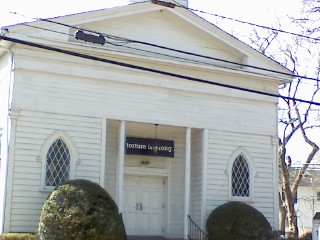
Religion, as the banner hanging from the Witherspoon Street Presbyterian Church in Princeton makes clear, has a lot to say about the issues of the day. In this case, the “Torture is wrong” is proclaimed.

There is the clergy component of the battle against poverty in the state, the clergy letter condemning the death penalty, the Catholic Church’s “Just War” theory, the civil rights movement and so on. We don’t need to agree with every decree — the Catholic Church is wrong on homosexuality and abortion is a private matter best left to individual women to wrestle with — but we should acknowledge the role religion can play in the debate.

I write this not in response to any specific news event, but because I saw the banner on the church as I walked from by office to a downtown deli. It hit me that, while there are people like Christopher Hitchens who see the religious as superstitious nits, the reality is that the mass of believers out there is a rather complex and diverse lot that reflects who we are in all of our imperfections.

What makes our democracy work is the cacophony of voices, secular and religious, liberal and conservative, and the miraculous music it can make when each voice is willing to make room for the other.

Winter wonder

I have a love-hate relationship with winter, as I suspect most people do. I hate the bone-chilling cold, the black ice that makes driving hazardous, hate shoveling snow from the driveway and sidewalk and brushing it from the car.

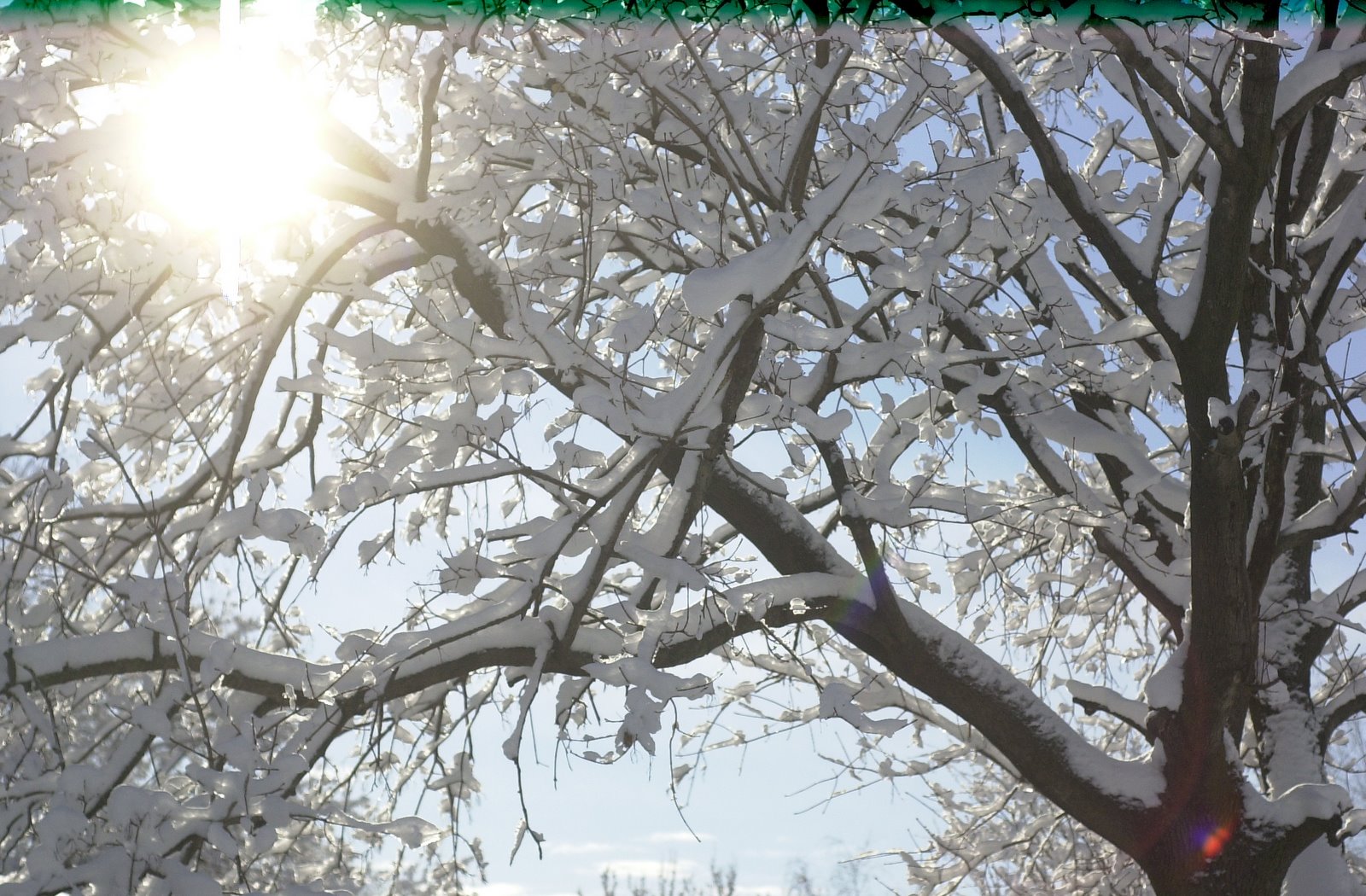
And yet, there are things about winter that are rather spectacular and spiritual, those small moments when we catch the light filtering through the snow-covered trees reminding us that beauty lurks in the most mundane of places, that our focus on just finding a way to get by day to day can obscure the wonders of what surround us.

These wonders, for me, are an indication that there is something much greater than us in the world — god, perhaps, something that ties all of this together beyond biology and chemistry and physics.
Don’t misunderstand me, though. I do not subscribe to the so-called “intelligent design” theory, which posits an overarching plan for the world as if god (I am being deliberate in my use of the lower-case) were an architect with a pencil and T-square, taking pains to map out each little movement forward toward perfection.
I believe, as readers of many of my poems might have noticed, in randomness and imperfection, in the notion that things are as they are at any given moment and that change occurs either by accident or because we actively seek it. There is no utopia toward which the human race and the planet move, only the now, which is the only time we have.
So what of god, then? It is in he acceptance of this imperfection and impermanence, the pushing ahead, loving, living, creating, working to improve the lot of man and beast, despite the chaos, maybe because of the chaos, it is in this that the connection, the awareness of a greater entity outside of the self, what Buber calls “Thou” and others call god, can be found.
(Photos: Hank Kalet)

On religious chauvinism

Joe Conason offers a succinct and on-target take on the dust-up over Mitt Romney’s Mormonism and the GOP evangelical base’s antipathy toward him.

The issue is not whether a Mormon should be elected or could be elected, but why we should allow those who wish to impose their sense of faith on the American public. Romney, after all, offered this comment as part of his speech:

“Freedom requires religion just as religion requires freedom … Freedom and religion endure together, or perish alone.”

As Conason writes, however,

This statement is so patently false that it scarcely deserves refutation. If Romney has studied the bloody history of his own church, then he knows that the religious fervor of its adversaries drove them to deprive the Mormons not only of their freedom but their lives, and that the Mormons reacted in kind. If he has studied the bloody history of the world’s older religions, then he knows that the most devout Christians of all sects have not hesitated to suppress, torture and murder “heretics” throughout history. Only the strictest separation of church and state has permitted the establishment of societies where freedom of conscience prevails — and those freedoms are firmly rooted in societies where organized religion has long been in decline.

That’s what makes the discussion about Romney important; it’s not the electoral math, but the constitutional implications of connecting religion and government.

And it is the implied religious chauvinism of Romney and former Arkansas Go. Mike Huckabee that should worry us all.

Phonies like Huckabee and Romney complain constantly about the supposed religious intolerance of secular liberals. But the truth is that liberals — including agnostics and atheists — have long been far more tolerant of religious believers in office than the other way around. They helped elect a Southern Baptist named Jimmy Carter to the presidency in 1976, and today they support a Mormon named Harry Reid who is the Senate majority leader — which makes him the highest-ranking Mormon officeholder in American history. Nobody in the Democratic Party has displayed the slightest prejudice about Reid’s religion.

Liberals and progressives have no apologies to make, or at least no more than libertarians and conservatives do. Cherishing the freedoms protected by a secular society need not imply any disrespect for religion. But when candidates like Romney and Huckabee press the boundaries of the Constitution to promote themselves as candidates of faith, it is time to push back.

I couldn’t agree more.

South Brunswick Post, The Cranbury Press
The Blog of South Brunswick

E-mail me by clicking here.

The Romney speech

Mitt Romney’s speech today, in which he attempted to “address concerns” that apparently come from a significant portion of Republican voters about his Mormon beliefs, is going to be dissected, bissected and generally revisited ad nauseum by those vapid pundits who populate cable news.

While I won’t comment directly on it (I’ll let John Nichols do so), the speech is worth noting:

The former Massachusetts governor — the first major Mormon candidate for president — has seen his support slip recently in the early battleground state of Iowa amid misgivings by some Christians, particularly evangelicals, about his religion.

So in a 20-minute address billed as his definitive response to the issue, Romney said he was seeking to be a leader for Americans of all faiths, not just his own.

“If I am fortunate to become your president, I will serve no religion, no one group, no one cause,” Romney said, eliciting applause from the audience at the George Bush Presidential Library here on the campus of Texas A&M University.

“There are some for whom those commitments are not enough,” he added. “They would prefer it if I would simply distance myself from my religion, say it is more of a tradition than my personal conviction, or disavow one or another of its precepts. That I will not do. I believe in my Mormon faith and I endeavor to live by it. My faith is the faith of my fathers.”

Romney even struck a note of defiance, suggesting at one point that he understood his Mormon faith could cost him some votes. But he predicted that Americans would ultimately respect him for sticking to his beliefs, noting that the United States had a proud tradition of religious tolerance that began with the founding fathers.

“Some believe that such a confession will sink my candidacy. If they are right, so be it,” he said. “But I think they underestimate the American people. Americans do not respect believers of convenience. Americans tire of those who would jettison their beliefs, even to gain the world.”

What strikes me about this, however, is not the potential political implications. What strikes me is that, in the year 2007, we still view some religions as suspect. The speech, in many ways, should not have been necessary.

That Romney and the political establishment seemed to think it was says a lot more about that segment of Republican voting base — and the pundit class — than it does about Romney. His religion just shouldn’t matter.

South Brunswick Post, The Cranbury Press
The Blog of South Brunswick

E-mail me by clicking here.