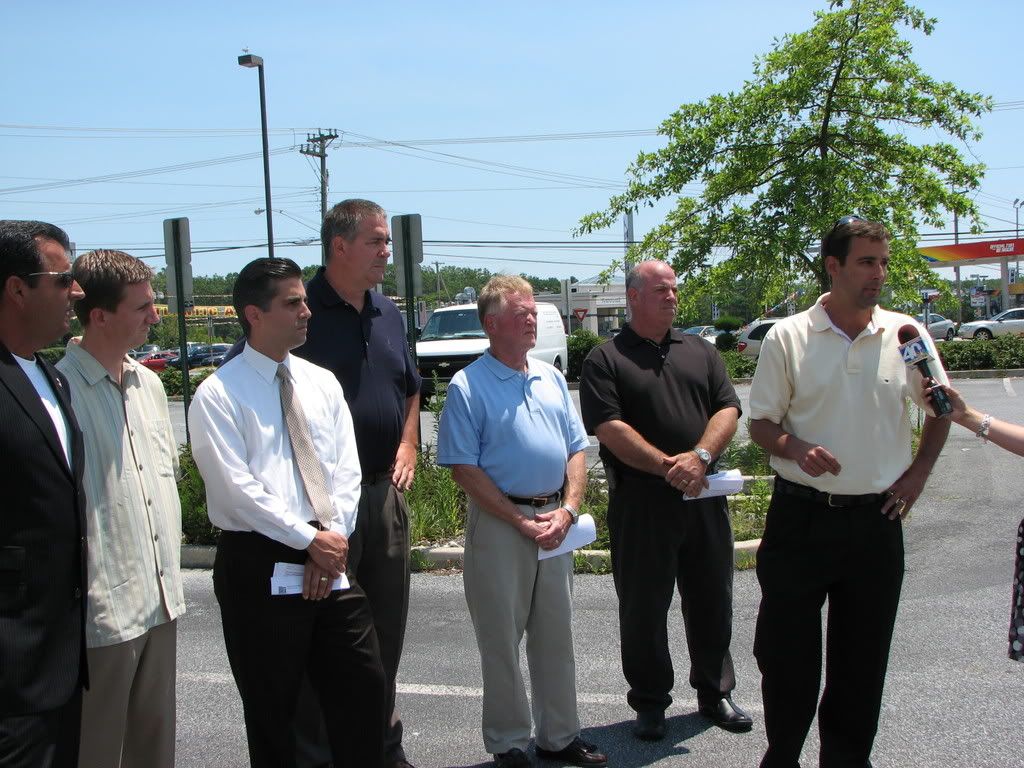
A picture is worth a thousand words

This picture of a Republican press conference in Atlantic County — which ran on PoliticerNJ — offers a pretty good explanation for much of the opposition to affordable housing programs in the state. There is legitimate concern — about open space and overbuilding — but much of it comes down to this picture and this question: What do these seven men have in common? And, perhaps more importantly, what do the vast majority of those living in the state’s cities — including Atlantic City, Trenton and New Brunswick — have in common? And what do these two groups, for the most part, not have in common?
Then again, I guess these things just arent’ black and white….

Race and the race

Do not let anyone fool you. While Barack Obama is doing well in the polls, there is a significant portion of the electorate who sees him as nothing more than a black man — not as a Harvard graduate, former community organizer, lawyer, state legislator or U.S. Senator, but as a black man.

That, in their eyes, makes him different than the rest of us, than white America. That’s the subtext of much of what the Clinton campaign’s late strategy was and why we are witnessing a full-out focus on Obama’s middle name, the flag pin, the Muslim rumors.

And we shouldn’t expect it to die off anytime soon.

I was at a barbecue today when the conversation turned to politics. I opted to remain in the background today, mostly because the tenor of the conversation lacked any real substance, building on innuendo and ad hominem attacks to take the discussion nowhere.

On one side were a couple of 18-year-old Obama supporters, who hit all the candidate’s buzzwords — change, McCain’s 100-year war — while on the other side were the generally older McCain supporters touting his experience and Obama’s lack thereof.

It was an amusing display, including a side-argument over abortion and Catholics (I may have been the only non-Catholic there) that featured the canard about falling African-American birth rates due to abortion.

The 18-year-old –I’ve decided not to name anyone because it was just a graduation party and not a political caucus — said that he thought there was a racial element involved, that some McCain supporters were backing the Republican because of his race. He said that many of his family members — erstwhile Democrats — were planning to vote for a Republican.

His uncle chimed in that he would never support Obama because “next thing you know, you’d have Sharpton in the White House,” proving the kid’s point.

The conversation, while amusing, was also disheartening, revealing the undercurrent of racism that remains out there. I’ve not had any illusions about this, but it really hits home when you confront it straight on like this.

What I’m hoping, at this point, is that the racism is out in the open — or at least accounted for in the polling and that we don’t have what is called the Bradley Effect (polls showing a black candidate leading because many respondents were afraid to say they wouldn’t support him; Los Angeles Mayor Tom Bradley, Virginia Gov. Douglas Wilder and New York Mayor David Dinkins all experienced a variation of this). I don’t mean to imply that this is the only way McCain can win but, if it did play out this way, it would be particular divisive and call into question all the progress we’ve made on race relations over the years.

My hope is that the candidate who is most in tune with voters’ beliefs, who best understands their concerns and offers the most forward-looking plan will win and that race won’t be the determining factor.

The race card

In the euphoria surrounding the Obama nomination — the first black presidential candidate to represent a major party — and the discussion of what Hillary Clinton and her supporters might do, we have allowed an issue that played out as subtext to much of the primary campaign to fall from sight: Race.

Andrew Greeley, writing in The Chicago Sun-Times, cuts to the chase, reminding us that what we saw during the primary — the veiled playing of the race card by former President Bill Clinton in South Carolina, the pandering to “hard-working whites” (implication being, of course, that non-whites might not be hard-working), etc. — will not go away.

(R)acism permeates American society and hides itself under many different disguises. The nomination of an African-American candidate was a near-miracle. Only the innocent and the naive think that the November election will not be about race.

The odds against the replication of the primary miracle in November, even against a disgraced and discredited Republic administration, are very high.

Race will silently trump the war, the economy, the cost of gasoline, the disgust with President Bush. One may wish that it will not be so, that if Obama loses it will not be because of the color of his skin but because the country genuinely wants another Republican administration.

Greeley is not wishing for a McCain win — on the contrary, he is just reminding us that the issue of race is the 800-pound gorilla in the room and that progressives interested in seeing Barack Obama, and the candidate and his campaign, will have to work that much more diligently to overcome the historical blight of racism.

Two Americas, black and white

It seems like a different moment in history, but the eloquent speech offered by Barack Obama on racism in the United States and the insidious ways in which it spreads its poison was just a little over a month ago.

But here we are again, discussing the political impact of his association with the Rev. Jeremiah Wright, pastor of the church he attended for nearly two decades, discussing the harsher aspects of Wright’s public comments and ignoring the truth that lies buried at the bottom of Wright’s apparent narcissism.

Consider the differing ways in which blacks and whites are viewing the Wright controversy, from MSNBC:

Black voters, in particular, urge Obama to rise above campaign attacks and dustups, saying he is not responsible for what Wright says. Many white voters say they were deeply troubled and baffled by Obama’s association with Wright, even before the preacher reiterated some of his most incendiary comments on Monday.

MSNBC — a mainstream news outlet that tends to follow the conventional wisdom — seemed to be at odds with itself in explaining the disparity. On the one hand, it calls it a “fundamental disagreement about Obama’s strengths and weaknesses in his battle against Hillary Rodham Clinton.” On the other, it offers this:

In interview after interview, black and white Democrats seemed to talk past each other on the issue of religion and campaigns, even though all said they deeply dislike President Bush and want a change in Washington.

“Obama is not responsible for what his preacher says,” said Copeland Richard, of Knightdale, who attended the Chapel Hill rally. “As far as I’m concerned, he doesn’t have to answer that,” said Richard, 66, who is black. “He’s above that, he’s dignified.”

The differences dismay many North Carolina Democratic officials, who saw the excitement over the Obama-Clinton contest as virtually unprecedented, possibly leading to huge gains for the party in November.

“I see a permanent fissure developing now” between black and white Democrats, said state Rep. Dan Blue, of Raleigh, who was North Carolina’s first black House speaker.

With the Wright controversy hot again, and former President Clinton recently saying Obama’s campaign “played the race card” against him, Blue said a great opportunity may turn to tragedy.

“I don’t know how you repair it,” he said in an interview Tuesday.

The Associated Press mined some of the same ground:

The issue threatens the multiracial coalition that is crucial to Obama’s hopes of becoming the first black president, and it has highlighted a gulf between white and black Americans on matters of church and religion. But interviews with more than two dozen Indiana and North Carolina voters Wednesday suggested Obama may have made the best of a bad situation, even if belatedly.

While many white voters were shocked to hear a minister curse America and promote conspiracy theories from the pulpit, some accepted Obama’s argument that he should not be blamed for his former pastor’s words. Many black voters, meanwhile, were far more familiar with Wright’s style of preaching — whether or not they agree with it — and believe the issue will not cripple Obama’s campaign.

Many white voters said the Wright controversy was not important, but “some white voters take a sterner view of the controversy.”

Betsy Lipsky of Raleigh, N.C., said she was deeply troubled by Wright’s remarks and could not understand why Obama stayed in the Chicago church from which the minister recently retired. Lipsky strongly supports Clinton but said she would reluctantly vote for Obama in November if he is the nominee. GOP candidate John McCain “frightens me,” she said, because he would continue Bush administration policies she abhors.

That, most likely is the silver lining for Democrats, but the different languages being spoken on this issue mirror other controversies in the public eye — such as the Sean Bell verdict in New York, in which police officers were acquitted of a fatal shooting of an unarmed man outside a nightclub.

This column by Lawrence Aaron in today’s Record of Hackensack offers an interesting take. Aaron outlines the ways in which police officers have an advantage over mostly minority victims when excessive force complaints are filed or litigated.

AN OFFICER from Clifton, Michael Oliver, had the most emotional reaction of the three New York City detectives acquitted Friday in the death of Sean Bell, a 23-year-old Queens man shot in the wee hours before his wedding. Oliver, who had been charged with the gravest offenses, broke down and cried.

Oliver had been through a tense 17 months since Bell died in a hail of police bullets. The case against him looked the worst. He was singled out as the source of nearly two-thirds of the 50 rounds police detectives fired at Bell and his friends as they left his bachelor party. Oliver fired a total of 31 rounds, 15 of them after he had reloaded his weapon.

No one should be surprised by the final verdict. The sad truth of American justice is that police officers rarely are convicted when they kill civilians. In a police shooting trial, the odds-on favorites are the cops.

The word justice has a hollow ring in this case — and in dozens of others that follow the same pattern. Police are infrequently charged. If they are charged, acquittal is the likely outcome.

Police tend to have some built-in advantages:

Rutgers Law School Professor Louis Raveson cites some factors that have ensured the process is weighted in favor of the police in almost every case. Police are like professional witnesses familiar with the courts, while less experienced civilians are learning as they go, Raveson said.

Also, police have time to “harmonize” their views so that there are no clashing accounts. They don’t have to make any official statements immediately after their involvement in an incident. Cooperman found in his ruling that key witnesses for the prosecution had told slightly different versions of the story to the grand jury.

Raveson said law enforcement tends to have more credibility with a judge not only because of frequent interaction, but also because police are perceived to be doing a heroic job that puts them in death’s path. That image is hard to challenge.

Race is not the controlling factor in these cases. But it is a factor and it does color the reaction of those watching from the outside. The black community was angered by the Bell verdict and critical of the police, while the white community — well, there has been little written in the New York papers about the white community’s reaction. Perhaps that is a commentary in and of itself.

The world is changing, though, as the general reaction to the Bell shooting shows — most people saw the shooting as excessive, even if there was disagreement over motivation. And while former Newark Mayor Sharpe James had supporters who pointed to racism as the reason for his fall from power, there were far more in predominately black Newark who were tired of James’ abuse of the system. Whatever good he had done for his community, in the end he was nothing more than a corrupt pol, no different than John Lynch or any of the other corrupt pols that make New Jersey politics the cesspool that it is.

I’m hopeful that these changes are happening more quickly than my gut tells me they are, that we won’t witness a Doug Wilder effect (or Tom Bradley or David Dinkins), a phenomenon in which a black politician does well in pre-election polling but falls short. The theory is that white poll respondents are unwilling to look racist to pollsters, so they say they are willing to vote for the black candidate. When they walk into the voting booth, however, they are free to let their racism guide their selection.

South Brunswick Post, The Cranbury Press
The Blog of South Brunswick

E-mail me by clicking here.

Wrights and wrongs

The Rev. Jeremiah Wright should leave the public stage.

I wasn’t prepared to write this — his basic critique of American imperialism and capitalism are not too far off base — but having absorbed his ego-driven performance on Monday morning, what else can I say.

Actually, Joan Walsh on Salon put it best in a Monday post:

He may be wounded, but this is a man of enormous self-regard, and he’s clearly trying to hurt Barack Obama. His national rehabilitation tour started fairly sympathetically with the Moyers conversation, but it’s devolved into self-pity and self-glorification ever since. His Sunday night talk to the NAACP was mostly silly, from the questionable science behind his insistence that black children are right-brained (creative) while white children are left-brained (logical and analytical) to his mocking the way white people talk, dance, clap, worship and sing. I understand and agree with Wright’s notion that “different is not deficient,” but mocking white people, including JFK and LBJ, doesn’t seem like the best way to get his point across (yes, he was talking to the NAACP, but he knew — and relished — that he had a national audience). At his Monday speech he insisted attacks on him were really an attack on the black church, a typically Wright-centric view of the world, while his security was reportedly provided by the Nation of Islam.

Wright, as Walsh points out, is a full-blown narcissist concerned only with his own reputation and apparently unconcerned with the issues he says he believes are important.

Both Bob Herbert and Eugene Robinson — two of the best columnists in the newspaper business, both of whom happen to be black, turned their rhetorical guns on the Rev. Wright and his outsized ego, criticizing him for raising himself up as a stand-in for the black church in America.

Here’s Herbert:

Smiling, cracking corny jokes, mugging it up for the big-time news media — this reverend is never going away. He’s found himself a national platform, and he’s loving it.

It’s a twofer. Feeling dissed by Senator Obama, Mr. Wright gets revenge on his former follower while bathed in a spotlight brighter than any he could ever have imagined. He’s living a narcissist’s dream. At long last, his 15 minutes have arrived.

So there he was lecturing an audience at the National Press Club about everything from the black slave experience to the differences in sentencing for possession of crack and powdered cocaine.

All but swooning over the wonderfulness of himself, the reverend acts like he is the first person to come up with the idea that blacks too often get the short end of the stick in America, that the malignant influences of slavery and the long dark night of racial discrimination are still being felt today, that in many ways this is a profoundly inequitable society.

This is hardly new ground. The question that cries out for an answer from Mr. Wright is why — if he is so passionately committed to liberating and empowering blacks — does he seem so insistent on wrecking the campaign of the only African-American ever to have had a legitimate shot at the presidency.

The answer, as Herbert points out, is that Wright wants this to be about Wright.

My guess is that Mr. Wright felt he’d been thrown under a bus by an ungrateful congregant who had benefited mightily from his association with the church and who should have rallied to his former pastor’s defense. What we’re witnessing now is Rev. Wright’s “I’ll show you!” tour.

And show he has. Wright has decided that not only is the Obama campaign a slap in his face, but he has conflated himself with the black church, as Robinson says.

I would never try to diminish the service he performed as pastor of his Chicago megachurch, and it’s obvious that he’s a man of great charisma and faith. But this media tour he’s conducting is doing a disservice that goes beyond any impact it might have on Obama’s presidential campaign.

The problem is that Wright insists on being seen as something he’s not: an archetypal representative of the African American church. In fact, he represents one twig of one branch of a very large tree.

It’s understandable, given how Wright has been treated, that he would want to attempt to set the record straight. No one would enjoy seeing his 36-year career reduced to a couple of radioactive sound bites. No preacher would want his entire philosophy to be assessed on the basis of a few rhetorical excesses committed in the heat of a passionate sermon. No former Marine would stomach having his love of country questioned by armchair patriots who have done far less to protect the United States from its enemies.

Given Wright’s long silence, I thought he had taken to heart Jesus’s admonition to turn the other cheek. Obviously, I was wrong.

I’m through with Wright not because he responded — in similar circumstances, I certainly couldn’t have kept silent — but because his response was so egocentric. We get it, Rev. Wright: You’re ready for your close-up.

What all this means for Barack Obama is difficult to say, but it has allowed Hillary Clinton to reframe the election on racial terms and set the stage for what is likely to be a gruesome general election campaign in which the ugly racial politics that have been an undercurrent of national Republican politics since the 1960s will once again be a major theme.

I wish it wasn’t so, but the cynic in me knows better.

South Brunswick Post, The Cranbury Press
The Blog of South Brunswick

E-mail me by clicking here.