
Dispatches No. 2 — this one running in The Cranbury Press — is up. It’s about the increasingly nasty tone of the presidential campaign.
Tag: presidential election
Guilt by association
Gail Collins’ column in The New York Times today — “Clearing the Ayers” — needs no comment on my part. Suffice it to say that, having once met James McGreevey at a christening, I should acknowledge my responsibility for his failed governorship, or maybe his ties to Golan Cipel, the Israeli government, the settler movement …
We could keep going.
Sarah Palin, plugged
Now that the debate is behind her, Sarah Palin appears to have little reason to hold back. As Kathleen Parker of The Washington Post explains, the vice-presidential candidate
has trained her moose-hunting sights on bigger trophies — Barack Obama and the media.
And in doing so, Parker says, she is proving to be especially adept at using Republican code words on the stump.
Palin successfully conveyed to those she was targeting that she is a Ronald Reagan-ish outsider who puts God and country first. And The Other is just like that elitist, flip-flopping John Kerry.
That’s a plateful of imagery and a buffet of touchstones familiar to those who distrust “elitists” and who recognize in Palin a kindred regularness.
Her folksy, but fiery, attacks are not new, of course. What the Palin stump speech amounts to is a distillation of the Karl Rove technique, of the divide and conquer approach used by the Republicans since the early 1960s when the country-clubbers were relegated to second-class citizens in a party that would come to be dominated by the angry and resentful. That was the lesson that Richard Nixon took from Barry Goldwater’s ill-fated 1964 presidential race, one in which he carried six states — his home state of Arizona and five traditionally Democratic southern states. Nixon read the political tea leaves, sensing a seismic shift in demographics that was reinforced when Ronald Reagan fanned the flames of racial resentment and anger at the hippies to take the California state house. Nixon then rode his Southern Strategy — building an electoral campaign on the same kind of disaffection — all the way to the White House. The divide-and-conquer approach became a Republican staple for 30-plus years.
One might have expected that, with the collapse of the so-called Republican brand with George W. Bush’s failed presidency, this verbal violence would have been relegated to the dustbin of history where it belongs.
It hasn’t, of course, and we have John McCain and Palin to thank (as well as Hillary Clinton, but that is a story for another time) for, as Parker writes, “amp(ing) up their rhetoric of difference.”
Neither McCain nor Palin would dare mention Obama’s middle name, Hussein, but they can play up Obama’s past associations and let others connect the dots. Terrorist. Muslim. Dangerous. Other.
It is legitimate to question character and dubious associations — and William Ayers is certifiably dubious. The truth is, Obama should have avoided Ayers, and his denouncement of Wright was tardy. But this is a dangerous game.
The McCain campaign knows that Obama isn’t a Muslim or a terrorist, but they’re willing to help a certain kind of voter think he is. Just the way certain South Carolinians in 2000 were allowed to think that McCain’s adopted daughter from Bangladesh was his illegitimate black child.
The ugliness has a dangerous side, as demonstrated by reports on Politico and in The Washington Post (Parker cites these, as well). Dana Milbank describes a Palin rally that is chilling in its descent into something resembling fascism. Palin, he writes, continued attacking Obama for a loose connection to former Weather Underground member Bill Ayers.
“Now it turns out, one of his earliest supporters is a man named Bill Ayers,” Palin said.
“Boooo!” said the crowd.
“And, according to the New York Times, he was a domestic terrorist and part of a group that, quote, ‘launched a campaign of bombings that would target the Pentagon and our U.S. Capitol,'” she continued.
“Boooo!” the crowd repeated.
“Kill him!” proposed one man in the audience.
Chilling.
A new slogan for Obama?
It should surprise anyone how quick this graphic has arrived on the scene:
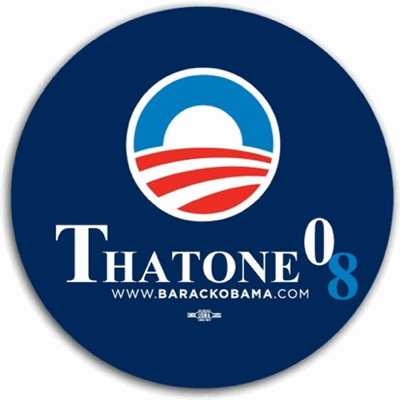 Isn’t it nice that John McCain has decided to add some levity to the campaign?
(Thanks to Bob at the Rix Mix for putting this on his site.)
Thoughts on race and the race
There was a good piece by Nicholas D. Kristof in Sunday’s Week in Review section of The New York Times on the impact that race may be having on this campaign.
Kristof writes that Barack Obama’s race has probably cost the candidate about 6 percentage points in the polls, though not because of outright racists.
Such racists account for perhaps 10 percent of the electorate and, polling suggests, are mostly conservatives who would not vote for any Democratic presidential candidate.
Rather, most of the votes that Mr. Obama actually loses belong to well-meaning whites who believe in racial equality and have no objection to electing a black person as president — yet who discriminate unconsciously.
“When we fixate on the racist individual, we’re focused on the least interesting way that race works,” said Phillip Goff, a social psychologist at U.C.L.A. who focuses his research on “racism without racists.” “Most of the way race functions is without the need for racial animus.”
It’s not hate, necessarily, but a lingering distrust born of a long and terrible history of racism and discrimination. It is racism, but a racism based not on individual prejudice but on cultural attitudes.
I mention this because of a conversation my wife had tonight with a friend who said she distrusts Obama. Annie asked her why, which elicited one of those vague answers — “something about him,” “I just don’t know him,” etc. — that lacks substance, that comes from someplace other than a well-reasoned exploration of the candidates’ backgrounds or stances on the issues.
Our friend is not a racist, but I think that race is playing a part in her reaction to Obama. I fully believe that a white candidate with Obama’s resume, a white candidate named Smith or Johnson or Petty, would be getting quite a different reaction.
 Hank Kalet