Bloomberg, check your cops

The video from today’s protest, via Huffington Post and You Tube. Huffington Post has not been able to verify when exactly this is from — it is supposed to be tonight — but it really doesn’t matter. New York Mayor Michael Bloomberg needs to order an investigation.

  • Send me an e-mail.
  • Read poetry at The Subterranean.
  • Certainties and Uncertainties a chapbook by Hank Kalet, will be published in November by Finishing Line Press. It can be ordered here.
  • Suburban Pastoral, a chapbook by Hank Kalet, available here.

Grand jury only option as tensions rise in New Brunswick

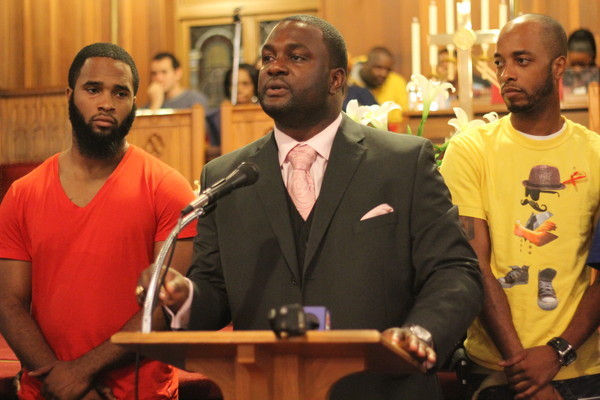
Walter Hudson, of the National Action Network.
Photo Credit, Maxwell Barma, New Brunswick Patch.

I wasn’t on Throop Avenue the night that Barry Deloatch was shot by New Brunswick police. Few people were, which has left huge questions to answer in the wake of the death of the 46-year-old New Brunswick resident.

In the nearly two weeks since the shooting, city residents have protested and a number of community meetings — including one tonight — have been held in an effort to bridge what is becoming a growing divide between the police and city government on one side and its mostly minority citizens on the other.

A tort claim — essentially a civil suit — is in the offing and a Latino group has asked that a grand jury be convened to get answers, both about the shooting and the conduct of New Brunswick police more generally. The Latino Leadership Alliance of New Jersey

issued a five-page release naming New Brunswick Police Officer Brad Berdel as the shooter, as well as naming Officer Dan Mazan as his partner involved in the foot chase toward the alley at 105 Throop Ave., where Deloatch was shot.

The press release also detailed findings of “use of force” reports the group said it reviewed on Berdel and Mazan for 2010, noting: “the two primary officers in Barry Deloatch’s death were involved in 10 separate reported force incidents, and that 80 percent of these incidents “involved using force against Black and Latino men.”

Berdel and Mazan, however, were not among what the report called the “Top 10” city police officers, representing less than 7 percent of the entire department, who “were responsible for 34 percent of the force incidents during 2010.”

Police officers and their supporters may not like the request. They may view it as an attack. But the relationship between the police and the prosecutor’s office is too close, while the city’s residents have apparently lost faith in law enforcement.

The only way to repair the relationship — one that must be fixed if the city is to become safer — is for police to open their books and open their doors to the public in the form of an independent grand jury, to do so voluntarily and to make every effort to show that the department is cooperating.

Fighting the request for an investigation and keeping the public at arm’s length will only guarantee that the situation will get worse.
 

  • Send me an e-mail.
  • Read poetry at The Subterranean.
  • Certainties and Uncertainties a chapbook by Hank Kalet, will be published in November by Finishing Line Press. It can be ordered here.
  • Suburban Pastoral, a chapbook by Hank Kalet, available here.

Maybe traffic jams aren’t that bad, after all

Rarely will you hear anyone say anything good about traffic in the region, especially on Route 18 through East Brunswick where I sometimes think there are more cars than there are brain cells.

But maybe we need to reconsider our distaste for the traffic jam in light of this story:

Minutes after a Metuchen bank opened yesterday, a bandit struck, fleeing with cash and driving away. But everything after that went wrong for the man and right for police, who captured the suspected robber about 30 minutes later.

Jermaine Dawkins, 37, of Staten Island was arrested after an Edison police officer saw him on Route 1 driving a silver SUV that matched the description of the get-away vehicle, authorities said. The officer started a pursuit that ended when Dawkins got stuck in traffic on frequently congested Route 18 in East Brunswick.

Like that old James Taylor song, “Traffic Jam”:

Well I left my job about 5 o’clock
It took fifteen minutes to go three blocks
Just in time to stand in line
With a freeway looking like a parking lot

Or, perhaps, a police holding cell.

Catching a cab or caught in a cab

This police item from Morristown was just too odd to pass up, even if it isn’t in our immediate coverage area:

Cops: Man robs store, waits for cab, gets caught

MORRISTOWN — A man who allegedly robbed an Elm Street phone store at knifepoint on Monday afternoon and fled the scene was found about a block away waiting for a cab, police said.

According to police, “Eric Scottland, 19, of Morris Township” stole about $300 from Phones Are Us in Morristown and fled. Police discovered someone matching Scottland’s description, according to the story, “in the rear of a Morris Street business, about a block away from the store.”

Why hang around, you ask? The answer is what makes this worth reading:

The man, who was later identified as Scottland, had called a local cab service and was waiting for the car when he was found, police said.

I guess there wasn’t a bus that ran in the area.

Profiles in semantics

The Lawrence Police Department has a problem. It has been accused by Hispanic activists of profiling Hispanic drivers in the area around the Brunswick Circle near the Trenton border and, while it denies the charge, it is clear that much will need to be done to build trust between the police and the Hispanic community.

Ms. Juega said it appeared that a disproportionate number of Hispanic drivers were stopped by police in the area around the Brunswick Circle, which borders Trenton. The reasons for being stopped were “pretextual” — a rosary hanging on the rearview mirror or tinted windows or driving a car with out-of-state license plates, she said.

A review of Lawrence police videotapes and written records “confirmed our fears” that Hispanic and black motorists were stopped more often than other groups, Ms. Juega said. They also receive more tickets when they are stopped than other groups, she said.

Richard Rivera, a retired West New York police officer and who is now the director of the Latino Leadership Alliance of New Jersey’s Civil Rights Protection Project, said he had helped investigate racial profiling allegations made against the New Jersey State Police.

”When you look at the whole police department, you try to assess particular patterns of behavior,” said Mr. Rivera. “There were a lot of stops of people of color that happened on the border (between Lawrence and Trenton). The officer sits on the street and watches (incoming) traffic from Trenton.”

Some of the traffic stops that were videotaped showed some “questionable behavior” that related to the officer’s own safety, such as shutting off the microphone during a stop or giving the incorrect location of the stop, he said.

”After you look at this, it starts to form a pattern,” Mr. Rivera said. “You also form an opinion. You kind of get the feeling of the overall culture and oversight of the Police Department. There is a lack of oversight.”

Township officials take a different view, attributing the higher rate of stops to other factors — the higher percentage of Hispanic residents living near the Brunswick Circle, which means “you would expect more stops,” and the higher incidence of accidents around the circle.

Based on “where the facts took us,” Mr. Bostock said, township officials concluded the Police Department does not practice racial profiling and steps are being taken to ensure “fair and equal treatment.”

“I will say personally, I have real confidence in the Police Department,” he said, adding that township officials will continue to work with LALDEF and to ensure that Hispanic drivers will receive “the fair and equal treatment they deserve as a matter of basic human rights.”

The issues raised are troubling. I am too far removed to have an opinion on their accuracy, but I think it is clear that there is a belief among at least some Hispanics that they are being targeted. Whether or not it is true, it is incumbent upon the Lawrence police to address the concerns, as they say they will.

The police have an opportunity here to show they value input from a segment of the community that too often feels left out of the loop; more than lip service is needed.