
The arch-conservative Jesse Helms died this morning. I have no comment.
Tag: obituary
RIP George Carlin
 I grew up listening to George Carlin’s FM & AM album and, in the process, I learned a lot about language.
Carlin — who along with Lenny Bruce, Richard Pryor, Mort Sahl and a few others — stands above the stand-up business the way the 1927 Yankees stand above other baseball teams. He was inventive, pointed and versatile — and he was one of the most incisive social critics of his generation.
The series of bits he did on profanity — “Shoot,” “The Seven Dirty Words” — took the harsh language of the street and the bland euphemisms we’ve concocted to replace them and twisted them in such a way as to expose our own hypocritical self-censorship.
I won’t repeat the language — this blog is tied to a family newspaper, after all — but how is it any less crass to substitute “shoot,” “horse hockey” (remember Col. Potter on “M*A*S*H) or “frig” and “Fug” (this one is Norman Mailer’s early contribution) than to use the expletives in their full and unvarnished glory?
He broke open the oxymorons that we live by (from the first Saturday Night Live):
The term Jumbo Shrimp has always amazed me. What is a Jumbo Shrimp? I mean, it’s like Military Intelligence – the words don’t go together, man.
RIP, Mr. Carlin.
RIP, Danny Federici
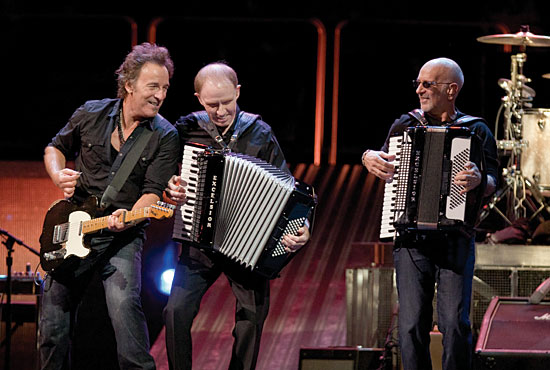
Longtime Springsteen organist, the great Danny Federici (center, between Springsteen and Roy Bittan in a photo by A.M. Saddler from the Backstreets Web site), has died. Federici, with his swirling organ that intertwined with Roy Bittan’s piano, was as responsible for the E Street Band’s sound as anyone.
He’d been sick, with melanoma, and missed most of the current tour. He died today in New York.
From The Boss’ Web site:
Danny Federici, for 40 years the E Street Band’s organist and keyboard player, died this afternoon, April 17, 2008 at Memorial Sloan-Kettering Cancer Center in New York City after a three year battle with melanoma.
The Federici family and the E Street family request that, in lieu of flowers, donations be made to the Danny Federici Melanoma Fund. A web site for the Fund is being established and we’ll post its link when it is on line.
Bruce Springsteen’s concerts scheduled for Friday in Ft. Lauderdale and Saturday in Orlando performance are being postponed. Replacement dates will be announced shortly.
E-mail me by clicking here.
In memory, of Ed
We attended a funeral today for a longtime family friend, Ed Mack. Ed was like a brother to my dad, who is an only child, and my folks were unable to travel in for the funeral.
Ed was a truly nice guy, a family man who would do anything for the people close to him.
The rabbi who spoke — I didn’t get his name — offered some comments that I think bear repeating, at least in paraphrase, based on the 15th Psalm:
- 15:1 A Psalm of David. the Lord, who shall sojourn in Thy tabernacle? Who shall dwell upon Thy holy mountain?
- 15:2 He that walketh uprightly, and worketh righteousness, and speaketh truth in his heart;
- 15:3 That hath no slander upon his tongue, nor doeth evil to his fellow, nor taketh up a reproach against his neighbour;
- 15:4 In whose eyes a vile person is despised, but he honoureth them that fear the Lord; he that sweareth to his own hurt, and changeth not;
- 15:5 He that putteth not out his money on interest, nor taketh a bribe against the innocent. He that doeth these things shall never be moved.
The psalm is especially apt at a time of mourning, offering a catalogue of attributes that the virtuous embody, the rabbi said. And it reminds us, the mourners that, at a time of grieving, we can do more than shed tears.
Tears have their place, he said, but we can more effectively remember the dead by acting as the deceased would have us act, by being the best that we can be, by living the ethical life. In that way, the rabbi said, we allow the deceased to live on in us.
In Ed’s case, his love of family and friends stand out as his example and we can best remember him by emulating this love with our own families and friends and extending it outward to our fellow man.
I won’t turn this into a political screed — readers of this blog know where I stand on issues like poverty or the war — but there are too many people around the globe living in desperate circumstances, too many living in poverty, dealing with the ravages of war. We have a responsibility to at least speak up for them.
South Brunswick Post, The Cranbury Press
The Blog of South Brunswick
E-mail me by clicking here.
Considering Norman Mailer

I haven’t written about the death of Norman Mailer (pictured above from New York Times obit) yet, because I am still trying to come to grips with my opinions of him as a writer. I’ve read several of his books, mostly his nonfiction novels, and have had great difficulty getting through much of his fiction. He was, as “Advertisements for Myself” shows, a remarkable egomaniac and intellectual, one who would fight both physically and rhetorically for the things he believed (even if some of them, especially his disdain for feminism and feminists, completely contradicted his professed humanism).
Much of the writing about Mailer over the last few days has been fawning — some of it deserved, like this one from John Nichols (in which he mentions Mailer’s pointed attack on President Bush’s “Mission Accomplished” Moment — an earlier, prewar piece by Mailer also is worth reading).
Some of it, however, seems to gloss over the nasty edges of his character — for a deconstruction of this trend, read Steven Hart’s takes on Stevenhartsite and The Opinion Mill).
Mailer, as Hart writes, was a generational writer, meaning that his commitment to the novel and storytelling was formed during an earlier time when the novel was still deemed an important pursuit and postmodernism had not fractured storytelling (I say this not to criticize current writing, but only as an observation and description of the changing face of fiction writing). Mailer was committed to the big book, the Great American Novel, a noble pursuit that has fallen out of favor and probably was more a mythical enterprise anyway, sort of like the pursuit of the Holy Grail.
That Mailer’s big fiction books were mostly awful ultimately is not the point. His writing about 1967 Pentagon protest (“Armies of the Night”), the presidential conventions of 1968 and 1972 (“Miami and the Siege of Chicago” and “St. George and the Godfather”) and the Gary Gilmore execution (“The Executioner’s Song”) are brilliant forays into what was then a new genre of literature and among the best works the so-called New Journalism produced.
These nonfiction novels should secure his place in literary history — a place of ambivalence similar to the awkward perch he will occupy within the intellectual history of the American left.
South Brunswick Post, The Cranbury Press
The Blog of South Brunswick
E-mail me by clicking here.
 Hank Kalet