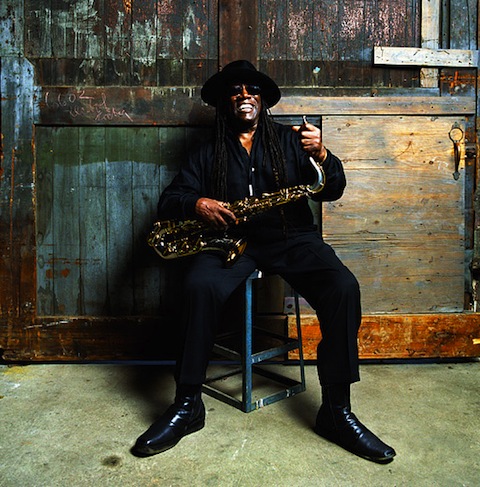
Only The Band could get away with a name like The Band

The Band. THE Band. that’s it. That’s all there was to it. Earlier, they may have been the Hawks and there was a moment when people viewed them as Bob Dylan’s backing group. But they were The Band, the only band that could get away with a name like that.

With the sad news being announced today that Levon Helm, one of the voices of this seminal five-man ensemble, in the final stages of throat cancer, that another member of this great group is leaving us, we must celebrate the majesty of the short but remarkable career. On albums like Music from Big Pink, The Band and Stage Fright and in the live concert film The Last Waltz, Helm, Robbie Robertson, Rick Danko, Richard Manuel and Garth Hudson created some of the most memorable music in the rock canon and forced a shift in thinking in Eric Clapton and others back to a tighter, more focused roots-rock that has never gone out of style.

Robertson was the songwriter and one of rock’s greatest guitarists, but it was Helm’s voice on songs such as “Up on Cripple Creek,” “The Weight,” “Chest Fever,” “Rag Mama Rag,” “Jemima Surrender” and “The Night They Drove Old Dixie Down” that helped define the Americana feel of a band made up of mostly Canadians.

Helm has been sick for a while, but he battled and released a powerful pair of what now appear to be his final albums, Dirt Farmer and Electric Dirt.

As with The Band, there were no frills. And that is the highest of compliments. For Helm, with or without his Band-mates, it always was about the music.

As my friend Rich said on Facebook, “Thank you, Levon. Prayers and wishes for you and your family. Sing us a song when you get there and make the angels jealous of your voice.”

  • Send me an e-mail.
  • Read poetry at The Subterranean.
  • Certainties and Uncertainties a chapbook by Hank Kalet, will be published in November by Finishing Line Press. It can be ordered here.
  • Suburban Pastoral, a chapbook by Hank Kalet, available here.

The year in music: A to Z

It was a surprisingly good year for music lovers, with the ladies leading the way with some major rock ‘n’ roll. For my money, Wild Flag’s debut was the year’s best, with discs by Lydia Loveless, Le Butcherettes, Imelda May, the Dum Dum Girls and Lucinda Williams also ranking high on my list.

Here are my choices for best and worst, following the alphabet:

A) With Ashes & Fire, Ryan Adams issues one of his most satisfying solo efforts.

B) Black Keys rock out on a great follow to BrothersEl Camino.

C) Consistency, the hallmark of Wilco, the Feelies and Cake, each of which released another top-notch disc in careers that feature no clinkers.

D) Disappointing at best, R.E.M. releases a yeomen-like, but unfullfilling disc; Lady Gaga issues a weak effort that contains a few good songs; the Amy Winehouse vault is opened with some good covers and unnecessary originals; while The Strokes and P.J. Harvey release their worst efforts. Other disappointments included Steve Earle (good but not great, not up to earlier standards), the Jayhawks and The Cars (some good singles, but mostly a disc that begs the question, “Why come back?”).

E) Emptying the vaults has become a great way for rockers like the Rolling Stones, Bob Dylan, Bruce Springsteen and Elvis Costello (not to mention the jazz greats) to remind the world what made them great — and make them and their record companies some cold, hard cash.

F) “Forget You,” or something like that, an unforgettable single by the unforgettable Cee Lo Green.

G) Good-bye to R.E.M. When the Athens band called it quits earlier this year it marked the end of a long and illustrious career. (Unfortunately, it ended with the mediocre Collapse into Now, a disappointing follow to the brilliant Accelerate.)

H) Happy as hell that the Feelies came back.

I) If imitation is, indeed, the sincerest form of flattery, then R.E.M. should find the Decemberists’ The King is Dead.

J) Garland Jeffreys returned with a great, though under-the-radar gem, The King of In Between.

K) Killer debut by The Civil Wars with Barton Hollow.

L) Lulu, as in a lulu of a terrible album by Lou Reed and Metallica. Even with The Raven, the pretentious attempt to set Edgar Allen Poe, in the discussion, Lulu stands as the worst album of Lou’s career and one of the worst ever recorded.

M) Crazy music from Mariachi El Bronx.

N) New finds: Several established bands made it onto my playlist for the first time, making me wonder why I hadn’t heard them before — Dawes, the aforementioned Mariachi El Bronx,

O) Old guys make good music. Both Paul Simon and Tom Waits release great albums. As always.

P) Protest:  Iraqi-American folk-rapper protest singer Stephan Said’s disc, Difrent, was a great find to be sure.

Q) Quiet folkies The Fleet Foxes step it up on their sophomore set.

R) “Rolling in the Deep” helps make Adele’s 21 a powerful follow, if not quite as good as her debut disc 19.

S) Super group Superheavy offers a super heavy set.

T) Take a moment to remember Charlie Louvin, John Barry, Don Kirschner, Nick Ashford, Jerry Leiber, Amy Winehouse, Phoebe Snow, Gerry Rafferty, Poly Styrene, Gil Scott-Heron and the Big Man, Clarence Clemons.

U) Undun is another great hip-hop record by The Roots.

V) Variety and eclectic virtuosity — hallmarks of the latest Van Hunt disc.

W) Women of rock, I salute you. As I said, it was the year of the rock ‘n’ roll woman with the top discs — Wild Flag’s self-titled debute, Le Butcherettes’ Sin Sin Sin and records by the Dum Dum Girls, Lydia Loveless, Lucinda Williams, Imelda May and Ida Maria — dominating the year’s releases.

X) X frontman John Doe releases a Keeper of an album.

Y) “You are a Tourist” was a great lead-off single from Death Cab for Cutie’s great album Codes & Keys.

Z) Z, as in the letter that represents sleep in the comics, is as good a way to end this and to offer a sum-up of the generic pop that still rules the airwaves. With so much good music out there, it is sad to see so much with so little value dominating radio and the video screen.


  • Send me an e-mail.
  • Read poetry at The Subterranean.
  • Certainties and Uncertainties a chapbook by Hank Kalet, will be published in November by Finishing Line Press. It can be ordered here.
  • Suburban Pastoral, a chapbook by Hank Kalet, available here.

Thoughts on R.E.M. as the band calls it quits

Photo from R.E.M. Website: http://remhq.com/photo_gallery_detail.php?id=1586&gallery_id=118

I guess I was 19 or so when I first heard R.E.M. on college radio — most likely WRSU at Rutgers or WPRB in Princeton, though it could have been on the Penn. State station, where I was still in school.

“Radio Free Europe” came out on an independent label in 1981, received more widespread attention in the year that followed and then became the centerpiece (in a more polished version) of the band’s first full-length album, Murmur, in 1983.

The jangly guitar and muffled vocals that created an odd sense of mystery, and a title referring to the U.S. funded radio station piped into communist countries — it was a revelatory sound that, along with the remnants of punk, helped set me on a musical path that I have hued closely to ever since.

Now, 30 years after the song came out on Hib-Tone, the band is calling it quits. I can’t really blame them. The band’s first 15 years were a blur of perfection, a collection of remarkable releases that saw its stylistic pallet grow. Murmur was pure low-fi indie, as were the next few albums to follow. The band’s sound grew to fill stadiums with Document — which I think is their finest, a cross between their low-fi past and stadium present/future.And then it softened with the exquisite Automatic for the People and grew outsized and harsh with Monster. What followed was less consistently good, though had some other unknown or less-well-regarded band had produced them, albums like New Adventures in Hi-Fi, Up and Around the Sun might have been seen as the solid recordings that they were.

Accelerate was somewhat of a return to form for the band, and included songs that looked back at R.E.M.’s heyeday, but Collapse into Now, a solid effort, fell flat and it was clear that R.E.M. had probably run out of gas — a sense that was reinforced by Mike Mill’s comments on the band’s Web site:

During our last tour, and while making Collapse Into Now and putting together this greatest hits retrospective, we started asking ourselves, ‘what next’? Working through our music and memories from over three decades was a hell of a journey. We realized that these songs seemed to draw a natural line under the last 31 years of our working together.

 I feel lucky to have been a fan of the band throughout the career, to watch it grow and change and adapt. And I feel even luckier to have gotten to see them live three times at different points in their career. I wish the members well and hope their new projects are fulfilling for them and produce music that strikes a cord with the listener.

  • Send me an e-mail.
  • Read poetry at The Subterranean.
  • Certainties and Uncertainties a chapbook by Hank Kalet, will be published in November by Finishing Line Press. It can be ordered here.
  • Suburban Pastoral, a chapbook by Hank Kalet, available here.

Clarence, rest in peace, big man

Clarence Clemons has joined Danny Federici on the other side.

From brucespringsteen.net.

The Big Man, who suffered a stroke recently, died today at 69, about two years after his fellow E-Streeter succumbed to cancer.

I’ve seen Springsteen 10 times in concert and it is hard to imagine him introducing the band without the man whose presence on the Born to Run album cover helped turn that into an iconic image

Rest in peace, Big Man.

And rest in peace, Kevin Kavanaugh, keyboardist for the Asbury Jukes — another keystone of the Jersey Shore sound. I hope both of you are jamming with Danny and the others.

  • Send me an e-mail.
  • Read poetry at The Subterranean.
  • Certainties and Uncertainties a chapbook by Hank Kalet, will be published in November by Finishing Line Press. It can be ordered here.
  • Suburban Pastoral, a chapbook by Hank Kalet, available here.

Thoughts on Poly Styrene

I don’t exactly remember my first reaction when I hear Poly Styrene scream out, “O! Bondage, Up Yours” as the intro to the X-Ray Spex single of the same name, but I’m sure it wasn’t contentment.

The song growls out of Styrene’s introductory yawp, an electric charge that shocks the musical soul back to life.

The initial response, however, seems unimportant now, the song’s aggressive mauling of rock ‘n’ roll conventions altered my music-listening DNA longterm, implanting within me a punk gene that has remained alive.

Styrne died Monday at age 53 of cancer, on the eve of the release of a new solo album, her first since 2004.

Pop Matters’ Mixed Media blog called her an “always…incisive cultural chronicler and commentator” whose “music was always smart and fun in equal doses, making listeners think about gender politics, while shaking their booty and enjoying her marvelous wit.”

Discussions of the punk era always begin with the British movement (don’t get me started on how this underplays the role of the artier New York and American punk sound) and tend to founder in a debate over whether the Clash or the Sex Pistols provided the most lasting model for future musical transgressors. But the English sound owed as much to other bands — Elvis Costello was a punk rocker, remember, hte Gang of Four helped pioneer what might be described as punk-disco or punk-funk — and other impulses.

Enter Poly Styrene and X-Ray Spex. The 1977 single, “O! Bondage, Up Yours!”, and the 1978 album Germ-Free Adolescents were precursors to 1990s bands like L7 and Breeder and a feminist prototype within the largely male punk culture.

Poly may be dead, but her influence will live on.

  • Send me an e-mail.
  • Read poetry at The Subterranean.
  • Certainties and Uncertainties a chapbook by Hank Kalet, will be published in November by Finishing Line Press. It can be ordered here.
  • Suburban Pastoral, a chapbook by Hank Kalet, available here.