
On food drives and poverty

Matthew Yglesias at Slate makes a compelling argument against the traditional food drive — but it’s one that, in the end, I can’t support. The argument — that donated money makes more sense — has some validity in larger communities, but in areas with smaller food banks, money can create a strain.

Organizations like Rise in Hightstown and the Crisis Ministry of Princeton and Trenton rely on both food and money, with money going a lot farther toward meeting the needs of local communities because they can buy in bulk. But smaller organizations like the South Brunswick Food Pantry (which also has a trust fund that collects monetary donations for other services) and Skeet’s Pantry in Cranbury do not have the manpower or economies of scale to be able to take advantage of bulk buying power.

The greater issue is our societal reliance on food banks and soup kitchens to plug holes in the safety net. Poverty is a social issue and is created by larger cultural trends with impacts that reach out beyond the immediate families into local neighborhoods and beyond into the larger community.

Relying on private organizations to address larger societal problems is destined to leave us chasing our tales on the poverty issue, always a step behind, the solution just a step out of reach.

  • Send me an e-mail.
  • Read poetry at The Subterranean.
  • Certainties and Uncertainties a chapbook by Hank Kalet, will be published in November by Finishing Line Press. It can be ordered here.
  • Suburban Pastoral, a chapbook by Hank Kalet, available here.
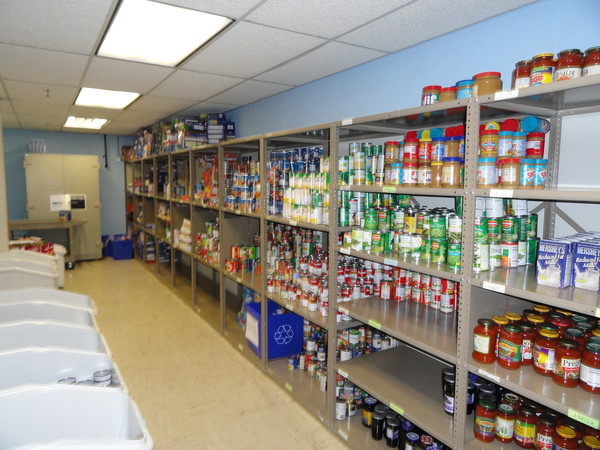
Once again, community comes to Food Pantry’s aid

Patch photo by Davy James

No one can say that the South Brunswick community does not care about its own. With a heavy push in the final week, the township Food Pantry exceeded its goal and collected nearly $50,000 in cash and $15,000 in food over a 10-week period.

That means the pantry should receive additional cash from the Feinstein Foundation, which challenges anti-hunger agencies across the country to raise funds and collect as many food donations as possible. The township is now eligible for a cut of the $230 million pie.

Kudos to the community, especially in such difficult economic times.

  • Send me an e-mail.
  • Read poetry at The Subterranean.
  • Certainties and Uncertainties a chapbook by Hank Kalet, will be published in November by Finishing Line Press. It can be ordered here.
  • Suburban Pastoral, a chapbook by Hank Kalet, available here.

Penny wise, pound foolish

We have too long been in an emergency situation, as far as the state’s budget, but the flare up over providing money to the state’s food banks so they can fill their nearly empty shelves, seems — as the cliche goes — penny wise and pound foolish.

Gov. Jon Corzine wants to provide the money, Gov.-elect Chris Christie doesn’t. The dispute illustrates the kinds of problems that crop up when a state — or the federal government — fails to manage the public’s money wisely during good times: When bad times hit, it is left without money to do what absolutely must be done.

In this case, the state has what I think is a moral obligation to help the food banks out — given the skyrocketing increase in the number of people who have been forced by the economy to make use of food banks and soup kitchens.

Let them eat … somewhere else

Stories like this leave me shaking my head:

A judge has ruled that a church in Phoenix, where homelessness is on the rise, cannot feed the homeless. Crossroads United Methodist Church lost a court battle that began after neighbors complained about its weekly pancake breakfast and the hungry riff-raff turning up for it. Zoning, says the court.

The pastor, on the church’s blog, sums up the contradictions and biases implicit in the ruling, ones that only increase the dangerous economic divide in our society, a chasm that threatens to rip us apart.

However, there’s still a lot of questions to be answered. Questions like, How hungry? What about our potlucks? What about our Christmas dinner or Easter Sunrise breakfast? When I eat that, I am pretty hungry…is that allowed? What about the coffee and donuts we serve on Sunday mornings? Can we eat that if we are hungry? And then there is the other question, “How poor?” How poor do we have to be to be considered a “charity?” Federal-poverty-guidelines-poor? Not-able-to-make-the-house-payment-poor? Or, how about not-able-to-pay-off-the-credit-card-poor?

Or, are we just discriminating against people who are poor and who don’t have homes, because we don’t like what we feel when we see them? The real issue, is not that there are hungry people out there, or that we serve food in church, the real issue is that we are afraid. Afraid to reach out a helping hand; afraid to see what the economy could do to us; afraid to face our worst fears…

We can minister to the poor…that’s a given. We can hold a worship service for them out on the front lawn. We just can’t feed them. We can’t fill their bellies with warm food. …We might as well just go to the street corners and start handing out money, in hopes they will make their way to some food, because you are not allowed to do it at church!

And since, when we give food to the hungry and poor, that somehow redefines us as a “charity dining hall”…who among us can eat at church? Can we put a donut or a sip of coffee in our mouths when we can’t do the same for the poor? In good conscience, can we eat anything on church property if we can only give food to the well-off and wealthy?

The decision was rendered in Arizona, but it seems consistent with the kinds of battles we see over zoning everyday — battles of affordable housing rules, for instance. As the pastor says, our opposition to many of these things stems from our discomfort with what they say about our society and our fear of the other, especially of those who are poor or darker skinned.