
Overreacting and the First Amendment

Protesters from the Westboro Baptist Church are not my favorite people in the world, but they have the same First Amendment rights as the rest of us regardless of the nonsense they spew or where they spew it.

But are there limits to their rights to protest — including how close they can get to their targets?

A Maryland congressman believes the answer is yes. Dutch Ruppersberger, a Maryland Democrat, “introduced legislation that would prohibit protests five hours before and five hours after military funerals, and force protestors to gather at least 2,500 feet away from the event.”

The rules, he says, “would preserve the protestors’ right to free speech without harassing the military families.”

“I didn’t like the Supreme Court decision, but I understood it,” Ruppersberger said. “But the court has recognized the right to regulate the time and place of those protests — if it’s reasonable. And I think it’s reasonable to have these families come and go to the funeral without being impacted by the protests.”

The rules, however, would render any protest moot by pushing protesters about a half mile away from their targets and using time restrictions to delink the protests from their targets. So while restrictions might be permissible, these would seem to be extreme and designed to strip the protests of their effectiveness.

Federal law already imposes restrictions on protests at military cemeteries — one hour and 500 feet — that are far less onerous and do a better job of balancing free-speech and assembly rights against the right to privacy, which is the conflict at the heart of this debate.

Any infringement on the First Amendment must be limited and must not violate its spirit. The Ruppersberger bill goes too far.
 

  • Send me an e-mail.
  • Read poetry at The Subterranean.
  • Certainties and Uncertainties a chapbook by Hank Kalet, will be published in November by Finishing Line Press. It can be ordered here.
  • Suburban Pastoral, a chapbook by Hank Kalet, available here.
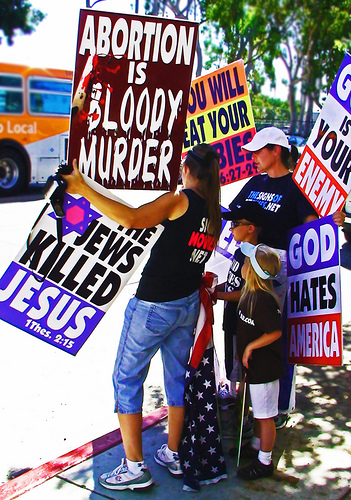
The right to be racist

The First Amendment’s free speech and assembly protections mean nothing unless we are willing to afford them to the most reprehensible and disturbing speech.

So, while I despise everything that the Westboro Baptist Church stands for and find their use of soldiers’ funerals deplorable, I have to applaud the Supreme Court’s ruling today:

In an 8-1 vote, Supreme Court Justices voted in favor of the Westboro Church, ruling that the protesters are protected by the First Amendment, no matter how offensive their anti-gay, anti-military message might be to some.

The church and Fred Phelps were being sued by Maryland resident Albert Snyder, the father of the late Matthew Snyder, a soldier who died in Iraq in 2006. Albert Snyder cited “emotional distress” as the reason for his lawsuit. Phelps and his family protested at Matthew Snyder’s funeral with signs that read “God Hates America” and “Semper Fi Fags”.

Nothing that the church has done or does can be defended or should be defended. Its members and views are offensive and hateful. But nothing the church does should be the subject of government interference.

Do we really want to follow the French example on this and prosecute the speaker of hateful speech? Does an anti-Semitic or racist rant warrant a jail sentence of as long “as six months in prison and up to €22,500, or $31,000, in fines”? Should Mel Gibson or Michael Richards have gone to jail, as they likely would have under French law, which “makes it a crime to incite racial hatred”? And who gets to decide what inciting hatred means?

American law, thankfully, protects our rights to be idiots. I prefer it that way.

  • Send me an e-mail.
  • Read poetry at The Subterranean.
  • Certainties and Uncertainties a chapbook by Hank Kalet, will be published in November by Finishing Line Press. It can be ordered here.
  • Suburban Pastoral, a chapbook by Hank Kalet, available here.

Quote of the day: Robert Braun cuts to the chase

There are a lot of serious flaws — unfixable flaws — with the “scholarship” bill that has been making its way through the state Legislature in recent days.

First, we should be working to improve public education by making public schools better, by finding more money for schools in urban districts and changing the funding mechanism to make it fairer. Creating a system in which the state gives tax credits to rich folks to create scholarships designed to siphon kids from the public schools into private — including religious — schools does not improve educational opportunity. It only exacerbates the gap between urban and suburban schools (the top kids get to escape failing schools) and endorses the privatization of public schooling.

Just as important, the bill would take public money — tax money — and hand it off to religious schools, an endorsement of religion that is a direct violation of the First Amendment prohibition against the state wading into religion.

This brings me to the quotation referenced in this post’s title, from one of the few top-notch political columnists in the state, Robert Braun of The Star-Ledger:

It is just plain wrong to use taxes to promote a religious message.

Simple. To the point. Too bad the people in Trenton do not seem to be listening.

  • Send me an e-mail.
  • Read poetry at The Subterranean.
  • Certainties and Uncertainties a chapbook by Hank Kalet, will be published in November by Finishing Line Press. It can be ordered here.
  • Suburban Pastoral, a chapbook by Hank Kalet, available here.

Hey Point Pleasant: Meet the U.S. Constitution

It’s shocking that it’s taken this long for the courts to intervene in this silliness, and perhaps more shocking that people in government don’t seen anything wrong with prayers at a public meeting. My suggestion: Read the First Amendment.

  • Send me an e-mail.
  • Read poetry at The Subterranean.
  • Certainties and Uncertainties a chapbook by Hank Kalet, will be published in November by Finishing Line Press. It can be ordered here.
  • Suburban Pastoral, a chapbook by Hank Kalet, available here.