
Clean coal ain’t clean

Maybe you’ve seen the ads: A man playing a blue-collar worker at an energy plant talking about the wonders of clean coal, leading the viewer through the plant to the place where the magic happens. Then he opens the door onto an open field, a desolate plain, saying this is where it all happens. “Amazing,” he says, shouting over the nonexistent machinery.

The ad was produced by a new coalition — the Reality Coalition — which is advocating against the false promise of clean coal technology.

Author Jeff Biggers in The Washington Post earlier this year offered a damning assessment of the clean-coal scam:

Orwellian language has led to Orwellian politics. With the imaginary vocabulary of “clean coal,” too many Democrats and Republicans, as well as a surprising number of environmentalists, have forgotten the dirty realities of extracting coal from the earth. Pummeled by warnings that global warming is triggering the apocalypse, Americans have fallen for the ruse of futuristic science that is clean coal. And in the meantime, swaths of the country are being destroyed before our eyes.

Biggers is focusing on the tangential costs — the destruction of coal-producing areas and the people who work the mines. Extracting coal will remain a deadly pursuit, no matter what kind of technology is devised for cutting down on polluting emissions.

And that assumes that coal emissions can be cleansed. While there are some benefits to clean coal — replacing coal with something else will be difficult — the fact is “Coal is the dirtiest of all fossil fuels, and not easy to clean,” or cheap, according to Charles Q. Choi on Live Science.

“You’re taking an inherently very polluting fuel, with each pollutant
posing myriad problems, and solving each with different technologies, and that
keeps adding up in terms of cost,” Freese said.

Opponents claim — with some legitimacy — that costs could skyrocket.

It could easily increase the cost of energy from a pulverized coal plant by two-thirds to three-quarters, “way more than any of the other technologies needed to control the other pollutants,” Freese said.

In the end, the cost to the environment may just be higher than any benefit that so-called clean coal technology generates, because

“you’re depending on a nonrenewable resource for energy, and one that’s notoriously destructive on the environment when it comes to mining it out,” she added.

If carbon capture and storage do not work properly, “obviously there’s the problem of carbon dioxide leaking into the atmosphere, and that undermines the whole point of capturing it in the first place,” Freese said. “There’s also the risk that leaks from pipelines or storage facilities carrying the concentrated gas can be fatal. Dissolved carbon dioxide is also acidic, and if it migrates into groundwater supplies it can carry toxins with it, poisoning the water.”
The false promise of falling gas prices

The Valero station at the Cranbury circle on Route 130 is selling unleaded regular for $1.71 a gallon cash — a figure that is shockingly low compared to the sometimes $3-plus a gallon we were paying in central New Jersey over the summer. And the other stations on Route 130 appear to be in the same $1.70-$1.75 range.

That is creating a false sense of security, an assumption that fuel efficiency is not an important consideration when looking for a new car.

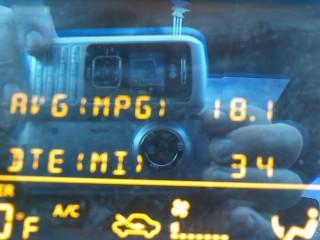
I learned this on Friday, talking to my brother-in-law about my leased Nissan Murano. The lease runs out in February and Annie and I already are thinking about what we need to do. Both of us have come to the realization — something we should have understood three years ago — that fuel efficiency has to be a part of our discussion. We can’t afford a hybrid, nor are we prepared to go with a car small enough to get us 30-plus mpg, but we have to improve on the ridiculous 18 mpg we get now.

I told my brother-in-law this, saying we weren’t sure what we wanted to replace the Murano with.

“Why,” he said. “Gas prices are down.”

True enough. But for how long? The reality is that anything below $2 is artificially low (even $2.50 is optimistic) and when the economy stabilizes gas prices will start climbing again.

So, the best course of action is to understand this and rethink our response. It is no longer good enough to say gas prices are too high. We have to find ways to lessen our use, and the only way to do this is to cut down on our driving and to boost fuel-efficiency standards.

As a driver, I have to consider this when I buy (or lease) my next car. It is irresponsible — both economically and environmentally — not to.

Dirty skies

Every week, there is new evidence that we need to make changes in the way we live to prevent us from further polluting the skies and water.

Consider this United Nations report, which found that a “noxious cocktail of soot, smog and toxic chemicals is blotting out the sun, fouling the lungs of millions of people and altering weather patterns in large parts of Asia,” The New York Times reports.

The byproduct of automobiles, slash-and-burn agriculture, cooking on dung or wood fires and coal-fired power plants, these plumes rise over southern Africa, the Amazon basin and North America. But they are most pronounced in Asia, where so-called atmospheric brown clouds are dramatically reducing sunlight in many Chinese cities and leading to decreased crop yields in swaths of rural India, say a team of more than a dozen scientists who have been studying the problem since 2002.

“The imperative to act has never been clearer,” said Achim Steiner, executive director of the United Nations Environment Program, in Beijing, which the report identified as one of the world’s most polluted cities, and where the report was released.

While the smog may be tempering the effects of global warming, it has some deleterious effects on humans and the environment.

Rain can cleanse the skies, but some of the black grime that falls to earth ends up on the surface of the Himalayan glaciers that are the source of water for billions of people in China, India and Pakistan. As a result, the glaciers that feed into the Yangtze, Ganges, Indus and Yellow Rivers are absorbing more sunlight and melting more rapidly, researchers say.

According to the Chinese Academy of Sciences, these glaciers have shrunk by 5 percent since the 1950s and, at the current rate of retreat, could shrink by an additional 75 percent by 2050.

“We used to think of this brown cloud as a regional problem, but now we realize its impact is much greater,” said Veerabhadran Ramanathan, who led the United Nations scientific panel. “When we see the smog one day and not the next, it just means it’s blown somewhere else.”

Although the clouds’ overall impact is not entirely understood, Mr. Ramanathan, a professor of climate and ocean sciences at the University of California, San Diego, said they might be affecting precipitation in parts of India and Southeast Asia, where monsoon rainfall has been decreasing in recent decades, and central China, where devastating floods have become more frequent.

He said that some studies suggested that the plumes of soot that blot out the sun have led to a 5 percent decline in the growth rate of rice harvests across Asia since the 1960s.

For those who breathe the toxic mix, the impact can be deadly. Henning Rodhe, a professor of chemical meteorology at Stockholm University, estimates that 340,000 people in China and India die each year from cardiovascular and respiratory diseases that can be traced to the emissions from coal-burning factories, diesel trucks and wood-burning stoves. “The impacts on health alone is a reason to reduce these brown clouds,” he said.

Presidential candidatesget an incomplete on environment

The two candidates for president didn’t exactly make green issues a priority this year, though they like to talk up their credentials on the stump, based on the League of Conservation Voters National Environmental Scorecard issued today.

The 2008 Scorecard includes 11 Senate and 13 House votes dominated by energy but also encompassing other environmental issues. This year, 67 House members and 27 senators earned a perfect 100 percent score, which is significantly higher than the 33 House members and 3 senators who earned a 100 percent in 2007. This year, 70 House members and 2 senators earned an appalling score of zero percent, compared with 48 house members and 9 senators in 2007.

The average House score in 2008 was 56 percent, and the average Senate score was 57 percent, which is slightly higher than the 53 percent House and 52 percent Senate averages in 2007. California, Connecticut, Michigan, Montana, Rhode Island, Vermont, and Wisconsin all had perfect Senate averages of 100 percent, while Alaska, Arizona, Georgia, Mississippi, Oklahoma, and South Carolina’s senators averaged just 9 percent. In the House, New Hampshire, Massachusetts, Maine, Vermont, and Maryland all averaged above 90 percent, while Montana and Wyoming were both below 10 percent.

According to the scorecard, Sen. Barack Obama missed nine of the 11 “key” environmental votes in this year’s Senate, though his two votes were considered “pro-environment.” His overall grade for the 110th Congress was 46 percent pro-environment (he received a 67 percent rating for the first session in 2007) and 96 percent for the 109th Congress.

As bad as Obama’s rating was for this year, his opponent, Sen. John McCain of Arizona missed all 11 votes this year and received a 0 score for 2007. His scores have been 41 percent for the 109th Congress, 56 percent for the 108th Congress, 36 percent for the 107th Congress, 6 percent for the 106th Congress. Anyone sense a pattern? In the two years leading up to his two runs for the White House — this year and in 2000 — McCain’s score has tanked.

In the end, the League endorsed Obama:

“Senator Obama’s proven record and his commitment to a clean, renewable energy future make him the best choice for President,” LCV President Gene Karpinski said. “At a time when this country must reinvent itself for a new energy future, we can imagine no better steward than Barack Obama. Under his leadership, America will finally achieve the economic growth, environmental protection, and national security that are possible with a new, clean energy economy.”

“We have a real choice here,” said Carol Browner, LCV board member and the longest-serving EPA Administrator in the agency’s history. “Barack Obama has been a committed leader and has offered bold and comprehensive proposals when it comes to global warming, energy and the environment. John McCain, whose plan will be a continuation of Bush-era political gimmicks, will carry on Bush’s legacy of failure when it comes to energy policy.”

Vice-Presidential candidate Joe Biden, the Democratic senator from Delaware, scored a 64 percent this year — he missed four votes and cast seven considered pro-environment. His earlier scores: a 67 percent for the first session of the 110th Congress, 93 percent for the 109th Congress, 92 percent for the 108th Congress, 96 percent for the 107th Congress and 88 percent for the 106th Congress.

Other key votes: Frank Lautenberg and Robert Menendez, the Democratic senators from New Jersey, both scored 91 percent. Lautenberg, who is running for re-election against former U.S. Rep. Dick Zimmer, was endorsed by the LCV:

“Senator Lautenberg has the second highest LCV lifetime score in the Senate” said LCV President Gene Karpinski. “His record on the environment with a LCV lifetime score of 96% in our annual National Environmental Scorecard proves his dedication to protecting New Jersey and the health and safety of all Americans. Senator Lautenberg is not just someone who votes consistently pro-environment. He is also a real leader and a champion, and that’s the kind of person we need in the Senate.”

Lautenberg continues to be a strong proponent of the program that ensures polluters pay for cleanup of their own sites and has fought to ban offshore drilling by oil and gas interests.

Last year, Sen. Lautenberg continued his pro-environment voting on key pieces of energy legislation, including his support for the renewable electricity standard that was ultimately unsuccessful in Senate and stripped from the final bill. Lautenberg is a long-time supporter of incentives for renewable energy sources.

And Rush Holt, the Democrat who represents the 12th District in the House, scored 100 percent — one of three New Jersey Congressmen to do so and 67 nationally.