
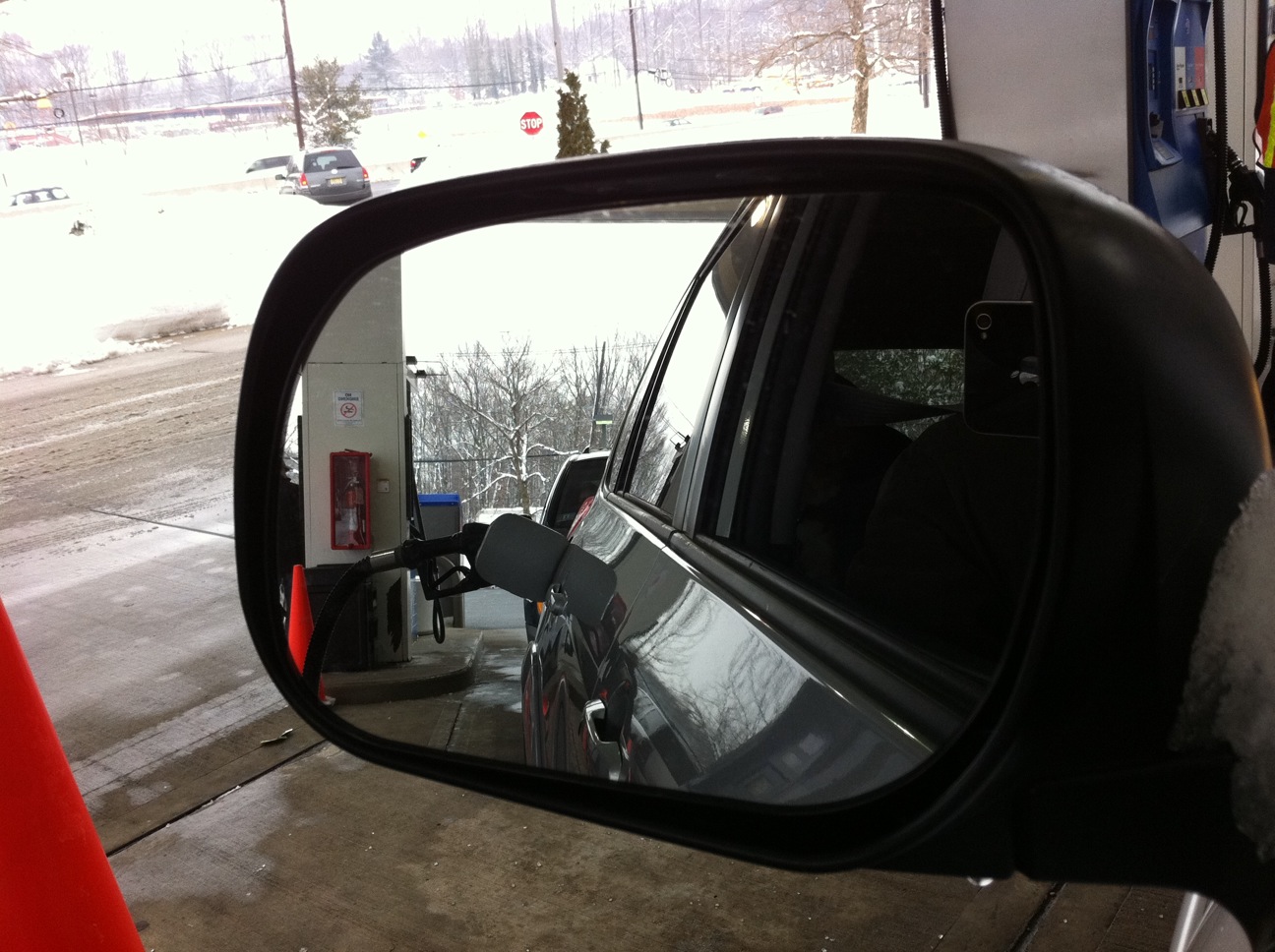
Fill ‘er up

I stopped to fill the gas tank on my RAV4 this morning and, cough, it cost me $39.14, or $2.999 a gallon. That’s a lot of pocket change to keep the rubber on the road, as they say. But is it too much?

I don’t think so.

Like everyone else, I hate to pay high gas prices — and high prices for anything — but the question is whether higher gas and energy prices are bad for society as a whole.

I’m going to go out on a limb and say no. Free-marketers should agree (though, I suspect they won’t), because higher energy prices in theory should alter behavior, lead people to drive less, conserve, invest in alternative energy or high-mpg cars, etc.

There are problems — higher energy costs will hit the middle class and the poor to a greater degree — that need to be addressed by government, including subsidies to energy users to encourage the move to efficiencies and use of alternative power, an end to oil company subsidies (as the president has proposed), planning and zoning rule changes, etc

The point is, we cannot expect not to see gas prices rise. It is inevitable, especially given how scarce gasoline is and how damaging its use is to the environment. We are going to pay for this scarceness and damage, either in money or in something more vital (resource wars will be bloody).

  • Send me an e-mail.
  • Read poetry at The Subterranean.
  • Certainties and Uncertainties a chapbook by Hank Kalet, will be published in November by Finishing Line Press. It can be ordered here.
  • Suburban Pastoral, a chapbook by Hank Kalet, available here.

Sunny approach to power

Slowly, we’re starting to see property owners with large acreage add solar generators, as the Lawrenceville School and Dow Jones are doing. It is a positive trend, though one that has moved far too slowly to address the real dangers of climate change. This is where a real government incentive could work, and create new jobs to boot.

  • Send me an e-mail.
  • Read poetry at The Subterranean.
  • Certainties and Uncertainties a chapbook by Hank Kalet, will be published in November by Finishing Line Press. It can be ordered here.
  • Suburban Pastoral, a chapbook by Hank Kalet, available here.

Carrots and sticks and the high cost of going green

The nation’s energy debate is a nonstarter.

While most people, according to the polls, believe we need to do something to slow global warming, there is no agreement on how. And, just as importantly, our reliance on the market is making it impossible to address the problem. As The New York Times makes clear, the high upfront costs of renewables places them at a disadvantage in the marketplace.

Even as many politicians, environmentalists and consumers want renewable energy and reduced dependence on fossil fuels, a growing number of projects are being canceled or delayed because governments are unwilling to add even small amounts to consumers’ electricity bills.

Deals to buy renewable power have been scuttled or slowed in states including Florida, Idaho and Kentucky as well as Virginia. By the end of the third quarter, year-to-date installations of new wind power dropped 72 percent from 2009 levels, according to the American Wind Energy Association, a trade group.

The Times explains that

Electricity generated from wind or sun still generally costs more — and sometimes a lot more — than the power squeezed from coal or natural gas. Prices for fossil fuels have dropped in part because the recession has reduced demand. In the case of natural gas, newer drilling techniques have opened the possibility of vast new supplies for years to come. 

Left undiscussed is the infrastructure of incentives that supports the oil and natural gas businesses, with government subsidies for exploration and drilling dwarfing the small change provided to the green energy sector.

Government policy can address this — first, by ending the tax breaks given to gas and oil companies, plugging loopholes and then by shifting the money to green programs in the form of consumer credits and development subsidies for green companies.
 The cost to society of burning one gallon of fossil fuel needs to be reflected in the price we pay at the pump, which is not happening now. An increase in the national gas tax, with the proceeds going to green investment (along with state level taxes that would pay for roads and mass transit) is good public policy that will save us money in the long run by preventing the costly impacts of climate change and other pollution-related problems.

Basically, we must use energy tax policy as a carrot and stick to alter the competitive field in the energy business.

More on the BP boycott

As I wrote in my column yesterday, a direct boycott of BP as a resposne to the gulf oil spill is badly flawed because it ignores the larger impact that oil has on society and that the oil industry has on the environment and the economy.

My friend Rob Stolzer, who lives in Wisconsin, commented to me on my Facebook page that the boycott also would have the unintended consequence of harming small businesses, the mom-and-pop owners of the service stations that sell BP gas.

But environmental columnist Jeff McMahon offers what seem like rational and potentially effective alternatives to a direct boycott, one that attacks BP but also the other oil companies while moving us toward a new paradigm of energy use.

McMahon (who quotes my blog in his piece) provides “Five ways to boycott without helping Exxon“:

  1. “Boycott bottled water,” which is responsible for the use of about 50 million barrels of oil  a year “just manufacturing the plastic bottles for bottled water” plus an additional amout for transportation.
  2. “Avoid plastics and other petrochemical products, including chemical pesticides and fertilizers,” which are manufactured by BP and other oil companies.
  3. “Buy bulk foods and put them in reusable bags” — we could save 120 million barrels of oil worldwide annually by switching to reusable bags and loose produce, bulk items and nonprocessed foods use less oil.
  4. “Be a locavore,” which cuts down on energy used for transportation and the need for heavy fertilizer and pesticide use.
  5. “Boycott aluminum cans,” about a third of which are made by BP subsidiary Arco Aluminum.

And — this is his sixth suggestion:

Don’t buy something new just to boycott BP. Some in the green-lifestyle press have advised people to buy aluminum water bottles instead of plastic, unaware BP may have supplied the aluminum. Others urge glass food containers instead of plastic, or petroleum-free cosmetics, etc. The green-lifestyle press often falls prey to the consumerist impulse to buy, buy, buy. But unless it grew in your back yard, every new product arrives with oily footprints. If you use plastic containers now, replacing them with glass will only burn more fossil fuels.

These are sensible suggestions; follow them and stick it to BP.

It’s not about independence; it’s about the health of the planet

When Barack Obama proposed drilling for oil and natural gas off the East Coast, he not only played co-dependent to our national oil addiction, he endorsed a dangerous rhetorical trope.

His speech at Andrews Air Force Base focused on “energy security” and “independence,” laudible-sounding goals that obscure the real dangers of our oil economy. It’s not just that we are reliant on unstable regimes for oil, which leaves us vulnerable economically to unrest. The issue goes much deeper.

It’s not “energy independence” we should be striving for, but independence from oil itself. Oil, as Peter Maass’ fine book Crude World shows, is a corrupting influence on the world, encouraging kleptocracies in most nations with significant reserves and distorting the vision of those that need it, like us. It incites violence, whether full-scale wars or internecine strife.

And it is killing the planet. Drilling, even with new technologies, is horribly intrusive and will become more so as the oil we seek becomes more difficult to draw from the ground. And burning oil as fuel fouls the air, rots the ozone layer, poisons us and the rest of the planet, with the residue of car exhausts ending up in our acquifers.

Were we suddenly to find enough oil in Wyoming, the issue of importing from Saudi Arabia and Nigeria and other unsavory regimes would go away. We would have “energy independence” and “energy security” but we still would need to reduce our reliance on fossil fuels.

The issue is one of public health and planetary health and we should be framing the debate this way.

Send me an e-mail.