
The final day

We have finally hit the end of this dismal election cycle, with the Democrats — deservedly — facing dim prospects and a wave of lunatics on the precipice of gaining entry to the nation’s statehouses and national legislature.

It is a sad state of affairs, but one that serves the corporate world well, because it keeps the rightwing strong and sends liberals chasing their tales until they collapse from exhaustion.

That said, I will hit the voting booth tomorrow to cast my ballot. Look, I have no illusions that either party has much in common with my belief system — I am, as I have taken to describing myself, an Anarchist radical populist progressive socialist, meaning I hate large concetrations of power, in particular corporate power, but view the existence of democratic government (when it functions as an extension of the people) as a bulkwark against corporate power. But I can see some candidates — U.S. Rep. Rush Holt, for instance — as having a lot to recommend themselves.

But this is not the post I intended to write. My focus was to be on the anti-politician meme that has controlled this year’s election. Consider Scott Sipprelle, who is running against Rush Holt. His campaign is predicated on painting Holt as a career politician, while painting himself as outside of politics.

A businessman, not a politician — but then, the act of running for office makes one a politican. That’s just the way the language works.
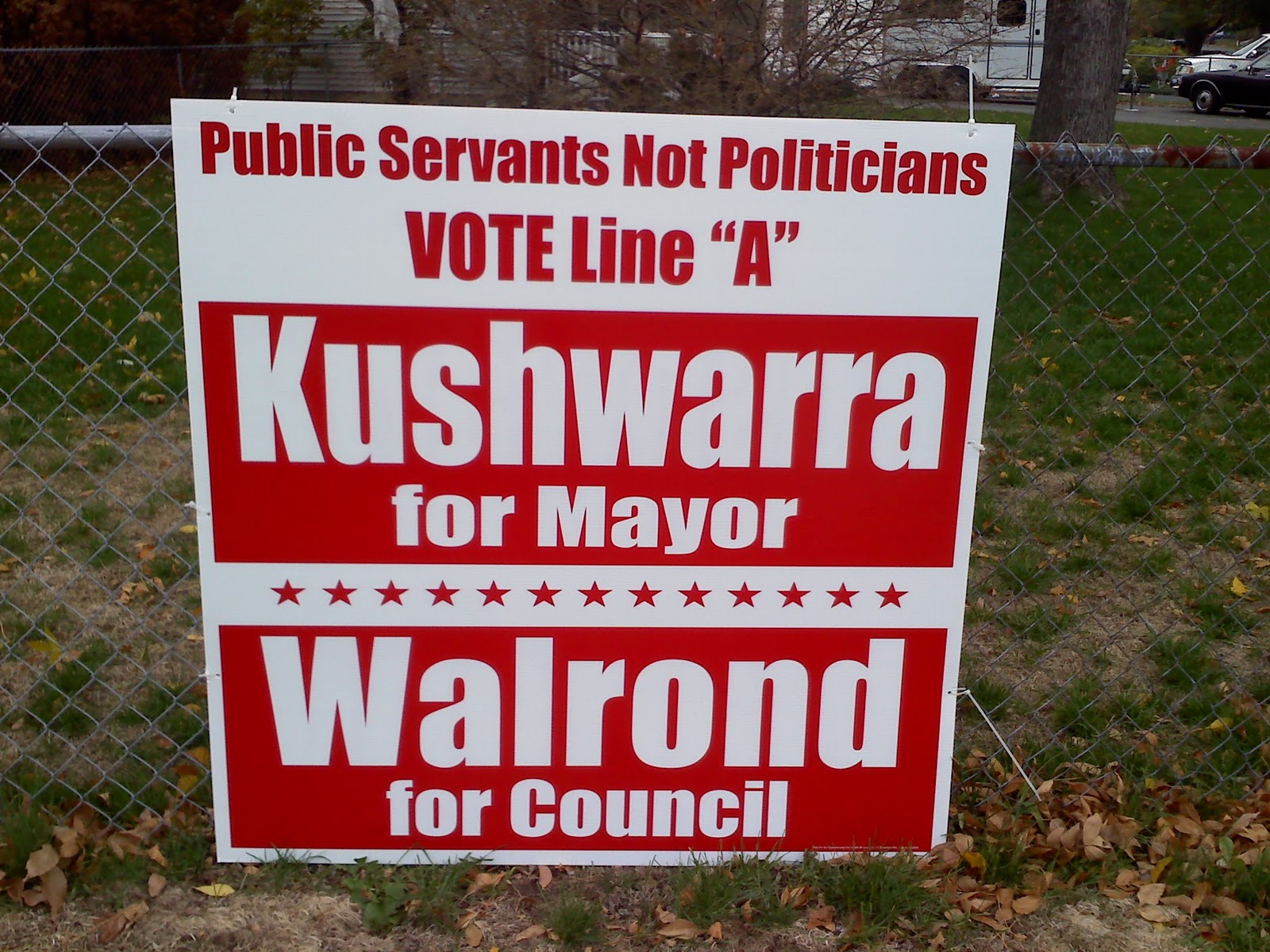
A sign on Kendall Park in Kendall Park.

And it happens at the local level, as well. Mike Kushwarra and Steven Walrond, the Republicans running for mayor and Township Council in South Brunswick, are calling themselves “public servants not politicans,” a claim that automatically paints the opposition as politicians. Both were township police officers and still live in town — the public service part of the claim — but aren’t they, by virtue of the campaign, politicians, as well? Walrond, of course, ran for council two years ago — which makes it pretty clear that he is a politician just like everyone else. And Kushwarra has run for school board, so I leave it to readers to make up their minds.

None of this should surprise anyone, given the anti-incumbency tenor of the election season. Politicians are running against themselves, which cannot be good for anyone, especially voters.

  • Send me an e-mail.
  • Read poetry at The Subterranean.
  • Certainties and Uncertainties a chapbook by Hank Kalet, will be published in November by Finishing Line Press. it can be ordered here.
  • Suburban Pastoral, a chapbook by Hank Kalet, available here.

Muddy waters

Upset victories in Republican primaries in Delaware and New Hampshire have further muddied the waters in this year’s election, taking two states listed by Real Clear Politics as “Lean Republican” and likely moving them into the “Toss-up” column.

In Delaware, Democrat Chris Coons has an 11-point lead in the most recent poll over Tea Party favorite Chritine O’Donnell, who knocked off Republican Mike Castle, who was expected to win by a large vote total come November.

In New Hampshire, early returns have Ovide Lamontagne beating Kelly Avotte — which, if it holds, gives the Democrats a shot at stealing a Republican-held seat, based on polling from earlier this summer.

This is just speculation, of course. But it does present us with an interesting election season to follow.

  • Send me an e-mail.
  • Read poetry at The Subterranean.
  • Certainties and Uncertainties a chapbook by Hank Kalet, will be published in November by Finishing Line Press. it can be ordered here.
  • Suburban Pastoral, a chapbook by Hank Kalet, available here.

Don’t count GOP — or Democratic — seats just yet

The electorate is a lot more unpredictable than the national story line is letting on. The common narrative is that the Democrats get smacked and possibly lose both houses of Congress. I have my doubts, mostly because the narrative is based on 1994 and some questionable polling. Democrats will lose seats — most likely a lot, but we have to acknowledge that the wild cards are having their impact in states that six or eight months ago were considered GOP locks: Sharron Angle winning the GOP primary may have saved Harry Reid’s job, for instance, and the Tea Party win in Alaska could flip a long-held GOP set.

And then there is Delaware, which was expected to go to popular Republican Congressman Mike Castle, but which now is a crapshoot because of a hard rightwing challenge that could sink the GOP and keep the seat in the Democratic column.

Here is the latest polling.

This isn’t meant to say that the Democats will win any of these seats; rather, the point I am making is that this is a volatile election season and anything could happen.

  • Send me an e-mail.
  • Read poetry at The Subterranean.
  • Certainties and Uncertainties a chapbook by Hank Kalet, will be published in November by Finishing Line Press. it can be ordered here.
  • Suburban Pastoral, a chapbook by Hank Kalet, available here.

Nationalizing politics

All politics is local (isn’t that what Tip O’Neill used to say?), but all coverage appears be national — and it is skewing the storyline.

Blanche Lincoln’s escape Tuesday, a narrow win for a conservative, probusiness Democrat in a conservative state, is being spun as a huge loss for organized labor (it wasn’t) and a major rebuff of the Democrats’ flaccid left wing. Democrats, the lesson appears to be (or so the conventional wisdom folks are telling us) that Democrats must move to the right or lose.

Except that two weeks ago, when Joe Sestak knocked off Republican-turned-Democrat Arlen Specter on the same day that Bill Halter forced Lincoln into yesterday’s runoff, the storyline was about muscle-flexing on the left.

I wish they would get their stories straight.

The problem with national coverage of U.S. Sente and House races is that most of the races do not hinge on national issues. These are local races that often turn on local and state-level issues.

When Bill Bradley nearly lost his re-election bid to the U.S. Senate from New Jersey in 1990, it was because the former Knick was seen as out of touch with the Garden State. He refused to take a position on the biggest issue in New Jersey that year — the Florio tax increases — and he allowed a then-relatively unknown Christie Whitman to capitalize and make the race close. (She then parlayed that campaign into two terms in the governor’s mansion)

Chris Christie won the NJ governor’s race in 2009 not because of some kind of national backlash against President Obama, but very simply because he was not Jon Corzine, a governor with approval ratings in the 30s.

Candidates who nationalize these elections often fail to make headway with voters, which is what appears to have happened in Arkansas, where Halter got tremendous help from “outside groups” and Lincoln made it an issue.

But this doesn’t work on national television, so the narratives get rolled out: It is about Obama’s coattails, the Tea Party, an anti-incumbent mood. True, generic polls show voters ready to throw the bums out, but voters do not vote generically and most tend to believe that the bums represent other districts.

We may as yet see a shift in numbers in both houses of Congress toward the Republicans, with a possible shift in majority; that’s normal during off-year races, especially ones during economically volatile times.

But the winners will have won not because of Obama or the Tea Party. Rather, the peculiarities of the local landscape are likely to have the final say.

Grassroots Democrats fight back

There has been some interesting analysis of Tuesay’s results and a lot of wasted language, as well.

What strikes me most about Tuesday is not the lack of impact that the Obama endorsements had, or that Rand Paul’s win confirms the Tea Party takeover of the Republican Party. What is most interesting — and least remarked upon (at least in the MSM) — is that Tuesday’s results may just signal a resurgence of the progressive wing of the Democratic Party.

Joe Sestak, a moderately liberal Democrat, absolutely creams the former Republican Arlen Specter — Sestak, a candidate who was unabashedly for health care reform and has been leading the push to repeal “Don’t Ask Don’t Tell,” who favors card-check and a strong bank regulations; Specter was none of this, plus he carries a long history of what I view as unprincipled toadying to the GOP leadership. Remember, Specter — who had his good moments, to be sure — was always viewed as a pro-choice Republican, but when it came to voting on pro-life judges, his pro-choice stance rarely mattered. He was rhetorically moderate, but party-line on the votes and Demcorats would have been foolish to allow him to keep his seat.

Blanche Lincoln is in a runoff, thanks to her obstructionism on health care — a final straw position that cut her off from the party’s grassroots and left her hanging. She may still pull this out — the runoff is next month, I believe — but the message has been sent.

And then there is Rand Paul. The son of Texas Congressman and libertarian hero Ron Paul, young Dr. Paul won the GOP nomination for Senate in Kentucky over a candidate handpicked by Senate Minority Leader Mitch McConnell. Paul, who is bat-sh*t crazy on so many issues, is also the kind of ally that progressives could use on issues like civil liberties, the wars in Iraq and Afghanistan, and Federal Reserve reform. He opposes both wars (maybe not for the right reasons, but he offers an opening), which could be key as we move forward with a Democratic admininistration that has bought into the conventional wisdom about why we fight.

Let’s be clear: None of these candidates are hard-core progressives, and there are no guarantees that any of them will survive their November races.

I mentioned the strong analysis — David Sirota on his radio show yesterday (via podcast) was spot-on, as was Cenk Uygur on the Young Turks. And then there was the nonsense — much of what the cable newsies were saying about the results was little more than fluff or conventional noodling focused on November.

That just misses the point completely.