Another bad idea for rating teachers

John Burzichelli is right that parent involvement makes for better students, but judging teachers based on whether parents engage with the school is pure nonsense.

A-2732, Burzichelli’s bill, calls on the state education commissioner to create standards for parentla involvement on which teachers would be judged, which can include “the parent’s responsiveness to communications initiated by the teacher; the parent’s participation in parent-teacher conferences; the student’s completion rate for homework; and the parent’s responsiveness in returning documents requiring the parent’s signature.”

Got that? A teacher potentially is going to be held accountable for the speed with which a parent fills out paperwork and gets it back to the school or whether a parent actually shows up for a conference.

There seems to be some support for Burzichelli’s bill — based on this story in MyCentralJersey.com, though, the structure of the story and some of the quotations raise questions about just how committed any of the educators quoted are to the bill. The focus of the story is on the importance of parental involvement — nearly everyone quoted talks about it and I don’t think you would find anyone who would disagree that it is better to engage parents than to not do so. But little attention is paid in the story to the elephant in the room — exactly how will teachers hold parent’s feet to the fire” — at least not until the final paragraph.

MyCentralJersey.com quotes Bruce Titen, who is the supervisor of mathematics and a school leader at Plainfield’s Frank J. Hubbard Middle School. Titen “called parental involvement a “very taboo” subject,” though it is “the No. 1 indicator for academic achievement in 95 percent of students, especially at the elementary and middle school levels.” Does he support this kind of legislation? Hard to say, but he does offer this comment:

“The quote given to me from numerous administrators from the time I was teaching,” Titen said, “was we can’t talk about what the parents do or don’t do at home because it’s not something in our control as a school system.”

The story never says whether Titen agrees with these previous administrators or not, though it implies that he does. More telling is that this is the only mention of what is likely to be a massive logistical problem. Teachers cannot control whether parents get involved. They can reach out. They can make the effort. But if a parent doesn’t care or, more likely, doesn’t have the time because he or she has to work, what is the teacher supposed to do?

I just don’t see how you can hold a teacher accountable for the things that go on outside of the classroom. We know, for instance, that students who get a good night’s sleep perform better in school, as do students who have healthy diets. Should these things be included in teachers’ evaluations, as well? What about making sure that students live in safe neighborhoods or that their parents are not economically forced to work multiple jobs?

We should be letting teachers do what they do best: Teach students, engage with students. And we should make sure they have the tools they need — which include money and top-notch facilities. We shouldn’t be blaming them for society’s larger failures.

If the goal is engaged parents, then let’s focus on the parents by enacting policies that make it easier for parents to be available to be engaged, starting with a fair economy that treats all work as valuable.

Send me an e-mail.

NJ Spotlight: Arguing the Costs of Tuition Equality

0024


Published this morning on NJ Spotlight:

Arguing the Costs of Tuition Equality

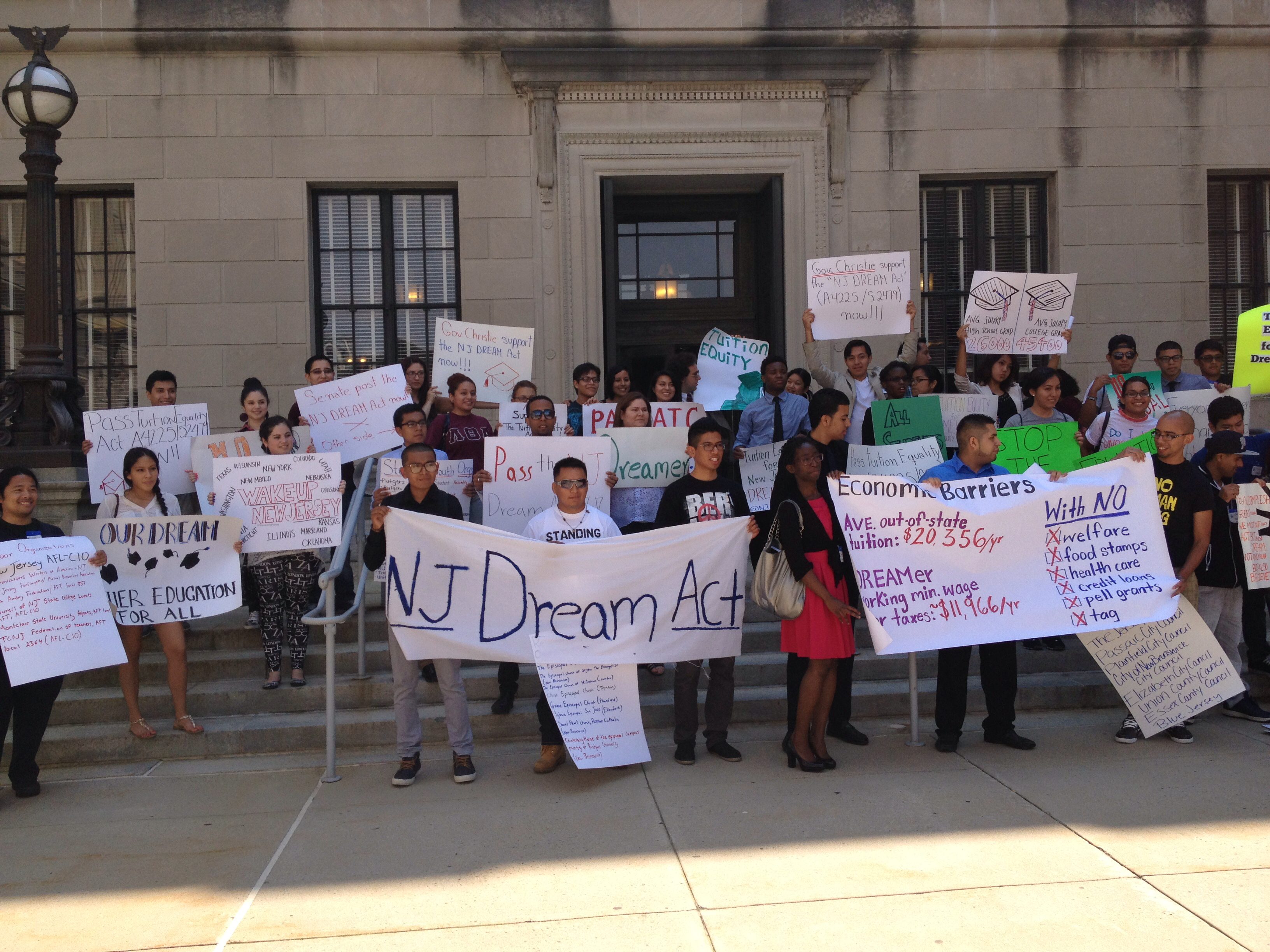
A proposed measure would let all NJ students — regardless of immigration status — pay in-state tuition at state schools
AdobePhotoshopExpress_2013_06_17_18:56:01
Supporters of the Tuition Equity Act rally outside the Statehouse after the Assembly Budget Committee vote on Monday.

A bill that would allow New Jersey high school graduates to qualify for in-state tuition regardless of their immigration status cleared its first hurdle Monday, though it remains doubtful Gov. Christie will sign it into law.

The Tuition Equality Act (A-4225) was released by the Assembly Budget Committee on a party-line 8-4 vote after a two-and-a-half-hour hearing before a packed committee room.

The New Jersey debate comes as the U.S. Senate prepares to consider a comprehensive immigration reform package. President Barack Obama is pushing for the legislation, which would tighten border security and offer a pathway to citizenship for many immigrants who currently are undocumented.

Read the full article here.

Conservative consensus on education includes supposedly liberal president

U.S. Education Secretary Arne Duncan was in Princeton today touting education reform that, to put it bluntly, will do little to fix public education.

Duncan, along with President Barack Obama and New Jersey Gov. Chris Christie, wants to tie teacher tenure to performance ratings — a questionable practice that is likely to elevate unreliable tests to even greater prominence and leave teachers at the whims of administrators. Tenure needs reform, but tying it and teacher pay to flawed evaluative systems will create more problems than it solves.

And yet, Duncan, who ran the Chicago school system, supports “pending legislation in Illinois that makes teacher tenure requirements more stringent and allows school districts to lay off teachers based on performance.”

“This bill could be a blueprint for the country,” said Duncan.

It is a blueprint for change, certainly, but it’s not change we should be willing to accept.

  • Send me an e-mail.
  • Read poetry at The Subterranean.
  • Certainties and Uncertainties a chapbook by Hank Kalet, will be published in November by Finishing Line Press. It can be ordered here.
  • Suburban Pastoral, a chapbook by Hank Kalet, available here.

Unbiased statistics needed to ensure honest debate on charter schools

There appears to be some doubt about the numbers that the Christie administration has been using to “prove” its contention that charter schools are the panacea to the problems facing poor school districts.

Robert Braun, in The Star-Ledger, took the state to task for its selective approach to statistics a month ago. More recently, Gordon MacInnes does the same thing. In an opinion piece on NJ Spotlight, the former education commissioner, raises questions about the structure of studies cited by Gov. Chris Christie and acting Education Commissioner Chris Cerf to support charter schools. In fact, he writes, the “evidence for this contention is thin.”

To bolster its case, the NJ Department of Education (DOE) released in January tables of test results showing that about three-quarters of charters had higher proficiency rates on state tests than their district peers.

Not so fast.

Columnists, respected academics and public school advocates lost no time in pointing out that meaningful performance comparisons must involve students with similar characteristics — like free lunch eligibility, special education or English learner status.

Failing that, the comparisons cannot be used to decide which schools do the better job.

The department returned on March 11 with much more expansive documentation that — surprise — supported the same conclusion concerning the superiority of charters. Accompanying the multiple charts, tables and bar graphs were statements confirming and strengthening the Christie administration’s policy preferences.

Poverty status is at the core of the DOE’s contention.

Essentially, the department anchors its argument that charters are pretty much like district schools when it comes to poor kids by dismissing the distinction between “free” and “reduced” lunch eligibility.

And that, MacInnes says,  makes little sense. There are significant differences in scores between free and reduced lunch students, as well as between girls and boys in charter and public schools and those of English learners and all of these variables need to be controlled for in order that studies be taken seriously.

MacInnes — who served under Christie Whitman and serves as an assemblyman from conservative Morris County — is not taking sides in the charter debate. Rather, he is asking for an honest accounting, especially given that a handful of national studies offer evidence that directly contradicts what the Christie administration would have us believe.

Before the Christie Administration bets just about everything on charter schools, it should conduct a fair and more complete assessment of the performance of similar students. When Stanford undertook a large-scale evaluation in 17 states, it did just that. It found that only 17 percent of charter school students outperformed their district peers, but 37 percent underperformed them. The rest did about the same.

Eighty-three percent doing worse or about the same does not sound like the answer to New Jersey’s educational woes.

  • Send me an e-mail.
  • Read poetry at The Subterranean.
  • Certainties and Uncertainties a chapbook by Hank Kalet, will be published in November by Finishing Line Press. It can be ordered here.
  • Suburban Pastoral, a chapbook by Hank Kalet, available here.

Data matters

If we are going to debate the efficacy of charter schools in New Jersey and elsewhere, shouldn’t we have non-biased and complete information on student achievement? The answer, I think, is implied by the question.

The problem, as Robert Braun points out today, is that we are being asked to judge charter schools without that information — with data, in fact, that has been selected to prove a particular political point.

“We are seeing a classic demonstration of how data gets manipulated to support whatever point of view is in vogue,” says Joseph DePierro, dean of the Seton Hall College of Education and Human Services.

DePierro, who is a charter school supporter, warned, “It’s a classic demonstration of how not to do research: First assert the conclusion and then scramble to find the data that supports it.”

Like other independent researchers, DePierro has concluded there are no significant differences between charter and traditional public schools.

The problem with the numbers, as released, is that they do not compare apples with apples. Consider the numbers from Newark’s Robert Treat Academy:

In third-grade language arts, RTA children scored 36.1 points above the Newark district percentage passing rate. In third-grade math, they scored 38.1 points above. Those kinds of scores held true throughout the grades. In sixth-grade language arts, all RTA students passed the statewide test — 65.6 points ahead of the district pass rate.

Great numbers that allegedly demonstrate the difference between traditional public and charter schools in the city. And yet, there is far more than meets the eye here:

According to the state’s data, of RTA’s 500 students, 42.9 percent are eligible for the federal free-lunch program — compared with 71.2 percent of children in the district. By income level, those children are not comparable. Only 6.6 percent of RTA’s students have been classified as disabled, compared with 19.7 of the district’s students. Again, the populations are simply not comparable.

That last part is not something we hear from charter supporters.

To truly judge charter schools and their impact on students and the public schools, we need to start by acknowledging that the populations served by the charters is drastically different than those in the public schools — the obvious economic differences are only a small part of the equation. Charter students tend to have more involved parents — parents have to apply for the admission lottery, which is a subtle self-selection process.

And, this is the part we have ignored, we need to do extensive research into what happens in the schools that lose students to the charters. If the students leaving are economically better off or come from more involved families, doesn’t that necessarily mean that those left behind are more disadvantaged? Shouldn’t we at least get an answer to that question and try to understand what that means for the students left behind?

Whatever your view of charter schools — I dislike them — I think we can all agree that we need unbiased research before we make wholesale changes in the relationship between the public schools and charters.

  • Send me an e-mail.
  • Read poetry at The Subterranean.
  • Certainties and Uncertainties a chapbook by Hank Kalet, will be published in November by Finishing Line Press. It can be ordered here.
  • Suburban Pastoral, a chapbook by Hank Kalet, available here.