
Slashing and burning blues

Jane Hamsher of FiredogLake calls it the cat food commission and, given its focus on cutting Social Security benefits, it is easy to see why.

The commission’s chairmen — a conservative Democrat tied to the Democratic Leadership Council (otherwise known as Republicans in sheep’s clothing) and a conservative, anti-Social Security Republican — unveiled the broad outlines of a plan they say will slash $4 billion from projected deficits over the next two years.

The plan has its moments — military spending is on the table — but it is unlikely to pass. And it shouldn’t. It represents an assault on the nation’s middle class and seniors, focusing most of the pain on those who need help right now.

According to an initial report in The New York Times, Social Security benefits would be cut for “most future retirees,” though “low-income people would get a higher benefit,” and the plan “would subject higher levels of income to payroll taxes to ensure Social Security’s solvency for at least the next 75 years.”

None of the “savings,” the Times reports, would be used for deficit reduction “reflecting the chairmen’s sensitivity to liberal critics who have complained that Social Security should be fixed only for its own sake, not to balance the nation’s books.” That’s a gross distortion of the liberal position, of course, which is that Social Security is solvent and that minor tweaks are all that are necessary (such as the expanded payroll tax).

Nevertheless, the commission and the Times continue to run the Social Security con, making it a prime target for budget cutters and privatizers. The chances that enough politicians would get behind changes like this and risk the ire of seniors remain thankfully slim, though I wouldn’t put anything past the corporate lackeys who run things.

More significant in today’s presentation, therefore, is the tax code rewrite being proposed. As described by the Times:

The proposed simplification of the tax code would repeal or modify a number of popular tax breaks — including the deductibility of mortgage interest payments — so that income tax rates could be reduced across the board. Under the plan, individual income tax rates would decline to as low as 8 percent on the lowest income bracket (now 10 percent) and to 23 percent on the highest bracket (now 35 percent). The corporate tax rate, now 35 percent, would also be reduced, to as low as 26 percent.

Even after reducing the rates, the overhaul of the tax code would still yield additional revenue to reduce annual deficits — a projected $80 billion in 2015.

Anyone catch that? Lower-income taxpayers will see their rate fall from 10 to 8 percent, but upper-income taxpayers get a much larger break — from 35 to 23 percent. These cuts would be offset by elimination of tax breaks — notably the mortgage tax deduction — that help cut the tax burden of middle class taxpayers.

Without more specifics, it is difficult to see how something like this would benefit the middle class, let alone the poor, though it seems a pretty big win for corporate and high-end taxpayers.

The three-decade framing of this issue as a spending problem has allowed the corporation and their elected lackeys to target so-called entitlement programs and discretionary spending while keeping the need for more revenue off the table.

Paul Krugman sums up the problem with the commission and its report in a blog post here, call it “unserious”:

If you’re sincerely worried about the US fiscal future — and there’s good reason to be — you don’t propose a plan that involves large cuts in income taxes. Even if those cuts are offset by supposed elimination of tax breaks elsewhere, balancing the budget is hard enough without giving out a lot of goodies — goodies that fairly obviously, even without having the details, would go largely to the very affluent.

  • Send me an e-mail.
  • Read poetry at The Subterranean.
  • Certainties and Uncertainties a chapbook by Hank Kalet, will be published in November by Finishing Line Press. It can be ordered here.
  • Suburban Pastoral, a chapbook by Hank Kalet, available here.
Scheer’s clear take

Robert Scheer, in a column that I should have linked to yesterday, offers probably the clearest takeaway from Tuesday’s election results. “Hey, stupid,” to paraphrase the 1992 Clinton campaign, “it’s the economy!’

  • Send me an e-mail.
  • Read poetry at The Subterranean.
  • Certainties and Uncertainties a chapbook by Hank Kalet, will be published in November by Finishing Line Press. It can be ordered here.
  • Suburban Pastoral, a chapbook by Hank Kalet, available here.

And this surprises us because?

We are facing high unemployment, which has sapped public budgets and led to major public-sector layoffs — and we are surprised when the thousands of public workers now out of work are slowing the economic recovery.

Economists at Rutgers University say losses in public jobs are, in part, slowing the Garden State’s economic comeback.

The findings will be released today during the Rutgers Economic Advisory Service forecast and conference in New Brunswick.

The study finds New Jersey has lost 269,000 jobs since January 2008. About 45,000 alone disappeared from May through September.

Economics Advisory Service director Nancy Mantell says New Jersey has lost 42,400 public sector jobs since May. More than half came from local governments.

It’s simple math: If you add more unemployed people to the mass of those already unemployed, you have more unemployed people — and that means there are fewer people who can buy houses, cars and other goods, making it less likely that businesses will be able to hire and so on. It is why many economists have pushed public spending — direct aid to workers, infrastructure projects, etc. — as the best approach to getting the economy moving in the right direction.

It appears, of course, that we are going to continue trying this other tack for a while, which means we shouldn’t expect an economic rebirth any time soon.

  • Send me an e-mail.
  • Read poetry at The Subterranean.
  • Certainties and Uncertainties a chapbook by Hank Kalet, will be published in November by Finishing Line Press. It can be ordered here.
  • Suburban Pastoral, a chapbook by Hank Kalet, available here.

Dispatches: The last resort — the failure of the private safety net

The title of this post pretty much sum it up, I think. Read this week’s Dispatches.

  • Send me an e-mail.
  • Read poetry at The Subterranean.
  • Certainties and Uncertainties a chapbook by Hank Kalet, will be published in November by Finishing Line Press. it can be ordered here.
  • Suburban Pastoral, a chapbook by Hank Kalet, available here.

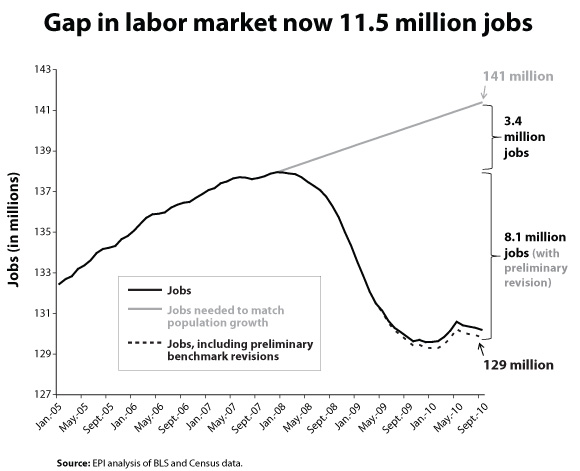
11.5 million is a lot of jobs

The jobs debate this election has boiled down to an argument between two parties who have no interest in discussing what really needs to happen to get enough people back to work to allow the public to feel as though the economy is finally going in the right direction. It is not enough to argue, as the Democrats have done, that it could have been worse. It could have been, but it is pretty bad right now and the numbers prove it. According to the Economic Policy Institute,

the labor market remains an estimated 8.1 million payroll jobs below where it was at the start of the recession in December 2007.  This number includes both the 7.8 million jobs lost in the payroll data as currently published plus the announced preliminary benchmark revision of -366,000 jobs to last March’s employment level.  And even this number understates the size of the gap in the labor market by failing to take into account the fact that simply to keep up with the growth in the working-age population, the labor market should have added around 3.4 million jobs since December 2007.  This means the labor market is now roughly 11.5 million jobs below the level needed to restore the pre-recession unemployment rate (5.0% in December 2007).  To get down to the pre-recession unemployment rate within five years, the labor market would have to add around 300,000 jobs every month for that entire period. In September, excluding changes in temporary Census hiring, the labor market lost 18,000. 

Yes, that’s 11.5 million jobs in an economy that is, at best stagnant on the job front. And yes, it could have been worse — the Labor Department estimates that the stimulus passed in 2009 saved about 5 million jobs. But, as many of us pointed out at the time, it was too small and now we are going to have to deal with the economic effects of a political miscalculation on the part of both the White House and Congresional Republicans for a long time.

  • Send me an e-mail.
  • Read poetry at The Subterranean.
  • Certainties and Uncertainties a chapbook by Hank Kalet, will be published in November by Finishing Line Press. it can be ordered here.
  • Suburban Pastoral, a chapbook by Hank Kalet, available here.