
Herbert Hoover and John McCain — the historical parallel.
Tag: economy
McCain’s problem
If the Obama camp can remember the Clinton mantra — “It’s the economy, stupid” — and find a way to connect on it, John McCain is going to have some problems.
To date, however, Obama has been difficulty getting through to the people who need to be gotten through to.
McCain, though, is doing its best to help the Illinois Democrat a helping hand:
With economic conditions worsening over the course of this year and voter anxiety on the rise, Mr. McCain has had to labor to get past the impression — fostered by his own admissions as recently as last year that the subject is not his strongest suit — that he lacks the experience and understanding to address the nation’s economic woes.
Wait, there’s more:
For much of this year, Mr. McCain has seemed to struggle to strike a balance between conveying the optimism that many voters want in their leaders, and the I-feel-your-pain empathy that they crave during hard times. His task is complicated by the tension between his plans to continue many of the economic policies of the unpopular incumbent Republican president he hopes to succeed, and his pledges to improve the American economy and shake up Washington.
Fundamentally convoluted
Here are the headlines on the economy from the last couple of days:
- Wall Street in Worst Loss Since 2001
- Fed Takes Steps to Aid A.I.G.
- Lehman Files for Bankruptcy; Merrill Is Sold
- Nation’s Financial Industry Gripped by Fear
And this is what Sen. John McCain has to say:
“You know that there’s been tremendous turmoil in our financial markets and Wall Street. People are frightened by these events,” McCain said. “Our economy — I think still, the fundamentals of our economy are strong — but these are very, very difficult times. And I promise you we will never put America in this position again.”
Um…. Huh? I’m having difficulty parsing this statement. The fundamentals are strong, but times are tough, which would seem to mean that the economy is not all that strong. So how can the fundamentals remain strong?
My head hurts.
Economic fundamentals in steel and concrete
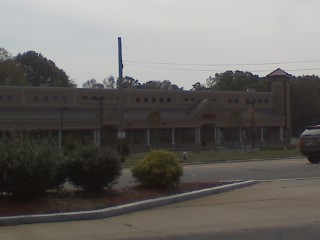
Consider this a sign of the economic times, a brand new shopping center on Route 27 at Route 518 that is slow to attract tennants (aside from another liquor store). Eventually, the tennants will come, but not until the “sound fundamentals” of our economy — as our wanna-be President John McCain puts it — improve and Americans have a little extra cash in their pockets.
This message was sent using the Picture and Video Messaging service from Verizon Wireless!
No credit where it isn’t due
The Washington Independent raises the question of why the presidential candidates are ignoring the credit crunch:
But, based on the contest so far, don’t look for either Sen. Barack Obama or Sen. John McCain to take on the biggest, most troublesome economic problem facing many American families and financial institutions — the credit crunch.
Like the budget deficit and rising Medicare costs, the credit crunch seems to be well on its way to earning the honor of the Issue Candidates Want to Ignore.
There are a number of reasons for this, the story says, including its complicated nature and the connections between campaign money and policy:
Dean Baker, co-director of the Center for Economic and Policy Research, says he does not expect either side to raise the issue:
“The Republicans don’t have much to say, and it’s not high on their agenda. The Democrats aren’t much different. Obama’s taken a lot of money from Wall Street, and the Republicans are tied to those people too. There’s just a real reticence to get into this.”
And that is to our detriment. As William Poole, the former president of the St. Louise Federal Reserve, points out the longterm costs of the bailout of Fannie Mae and Freddie Mac are likely to be high.
In Poole’s view, the bailout could wind up with a tab as high as $300 billion, or $1,000 for every man, woman and child in the country. That should be enough to get people’s attention, he said. So might figuring out who to blame for the mess, with suspects on both sides failing to rein in the mortgage giants as the firms lobbied Congress during the past decade. Poole, however, is not optimistic the candidates will take the bait.
Without a discussion of the credit crunch, real solutions are unlikely, as are mechanisms likely to prevent future meltdowns.
 Hank Kalet