Money for nothing

I like this Paul Krugman take on fears of a nationalized banking system. I heard some of that again today from U.S. Rep. Leonard Lance, who was in to speak with our editorial board (look for audio clips from the discussion next week). Lance said he didn’t believe in nationalization and that that business decisions should be left to private enterprise. To his credit, he is skeptical of the bank bailout — what he called TARP I and TARP II (and Tim Geithner’s Son of TARP, as he called it).

But his attitude misses the point. Here is what Krugman had to say:

We are not talking about fears that leftist radicals will expropriate perfectly good private companies. At least since last fall the major banks — certainly Citi and B of A — have only been able to stay in business because their counterparties believe that there’s an implicit federal guarantee on their obligations. The banks are already, in a fundamental sense, wards of the state.

And the market caps of these banks did not reflect investors’ assessment of the difference in value between their assets and their liabilities. Instead, it largely — and probably totally — reflected the “Geithner put”, the hope that the feds would bail them out in a way that handed a significant windfall gain to stockholders.

What’s happening now is a growing sense that the federal government, in return for rescuing these institutions, will demand the same thing a private-sector white knight would have demanded — namely, ownership.

Basically, the market is afraid that we — the taxpayers — might want something for all the cash we’ve thrown at the system.

Help for homeowners

The single most effective way of taking control of the housing market and stemming its precipitous slide is to prop up homeowners and prevent them from going into foreclosure.

The logic is simple: Each house that goes into foreclosure has a ripple effect, its diminished value echoing into the surrounding neighborhood, driving down other home prices and creating momentum for a foreclosure epidemic. As property values fall, there is the growing likelihood that many houses will be worth less than the mortgage paper their owners are carrying, which in turn might encourage some to walk away and leave their properties for the bank to deal with.

There are neighborhoods around the nation that have been destroyed by this dynamic and it is imperative that we find a way to stop this in its tracks.

President Barack Obama today unveiled a plan that he says will do that — offering assistance to up to 9 million homeowners in an effort he says “would shore up distressed housing prices, stabilize neighborhoods and slow a downward spiral that he said was ‘unraveling homeownership, the middle class, and the American Dream itself.’”

The plan has three basic components. One would help homeowners who continue to make loan payments on time, but are paying high interest rates and would otherwise not be able to refinance because they do not have enough equity or their houses are worth less than they borrowed. A second would assist people who are at risk of foreclosure by providing incentives to lenders to alter the terms of loans to make them substantially more affordable to struggling homeowners. The third would try to assure there is plenty of credit available for mortgages by giving $200 billion of additional financial backing to Fannie Mae and Freddie Mac, the two government-controlled mortgage finance companies.

Acorn’s Bertha Lewis, writing on OpenLeft, praised the president, saying his anti-foreclosure plan likely would have a greater impact on the economy than even the stimulus plan would have. The $75 billion plan “is a welcome initiative,” she writes, “especially in the wake of the 2 years of inactivity and neglect from the Bush Administration.”

I would argue that in terms of addressing the specific genesis of our present crisis – the toxic assets crippling the financial sector – the announcement today is of greater magnitude. For without a plan to address the predicted 8-9 million foreclosures over the next 4 years, that’s in addition to the 2.3 million that occurred in 2008 with a total estimated cost to the economy of over $850 billion, attempts to spur an economic recovery will fail. There can be no long-term solution without addressing the immediate foreclosure crisis.

That’s the key thing to understand. We have to help homeowners if we are to have any shot at stabilizing the housing market and easing the credit crunch. If housing values continue to fall, this can only continue to get worse.

The stimulus fix is in: Local schools lose in compromise

ShovelWatch, a joint ProPublicaWNYC Radio project tracking the stimulus package, offers this searchable database of U.S. school districts to give its readers a sense of how the changes in the federal stimulus bill as it has worked its way from the president through the House to the Senate and to a joint committee that announced it had reached a $789 billion compromise plan.

Here is a tentative breakdown from districts covered by Packet Group papers. The money listed was included in the bill that passed the House, but was cut from the Senate bill. Some of it apparently has been returned, but it is still unclear how much and which schools will benefit.

  • Princeton Regional — $145,600
  • West Windsor-Plainsboro — $182,800
  • Montgomery (Belle Mead) — $0
  • Cranbury — $19,200
  • Jamesburg — $100,500
  • Monroe — $609,800
  • South Brunswick — $247,400
  • Upper Freehold Regional — $39,700
  • Robbinsville — $298,700
  • Hightstown-East Windsor Regional — $401,800
  • Lambertville — $8,300
  • Lawrence — $309,900
  • Hillsborough — $327,200
  • Manville — $154,900
  • North Burlington Regional — $58,700
  • Florence — $174,000
  • Mansfield — $71,600
  • New Hanover — $44,700
  • North Hanover — $124,000
  • Springfield — $10,200
  • Hopewell Valley Regional — $61,700

Several of these districts — Monroe, Robbinsville (which is still listed as Washington), Mansfield — share names with districts elsewhere in the state, and the way the data is presented makes it difficult to know which district is which. The numbers represent my best guess at the moment, and I plan to revise this as I get better numbers.

Suffice to say that this is a lose-lose for the region: The schools won’t get the money to modernize, which means that they will not be creating construction work, which means that the workers won’t have money in their pockets to spend at local stores and so on. But, hey, we’ve cut the stimulus — which most economists have said was too small — down to a politically manageable size. Good work (he said sarcastically).

Advice to the president: Do the math

The Boston Globe hits on something important in an editorial today, reminding the president that he was elected with a rather broad mandate and he should not be letting three Republicans — so-called moderates — dictate what the federal stimulus package looks like.

That essentially is what has happened so far, as he attempts to wrangle bipartisan support behind the massive federal spending plan.

And yes, this is a spending plan. The idea behind any stimulus is to get money into the economy; the way you do that is to spend it. You can argue over the efficacy of public works projects, aid to states and tax rebates, but the simple fact is all of them are spending measures.

That said, the Globe makes a few good points — most notably, the aforementioned headcount.

With backing from only three Republicans – Senators Susan Collins and Olympia Snowe of Maine and Arlen Specter of Pennsylvania – the Senate yesterday passed an $838 billion stimulus bill that calls for about $108 billion less in spending than the House version. Unfortunately, the Senate plan eliminates $40 billion in state aid, much of it targeted for education. The same three Republicans who voted for the Senate plan also helped draft it and took the money out.

The reason, The Globe implies, is that the GOP has taken control of the narrative.

The point of the stimulus bill is to keep money moving through the economy – by blunting the impact of the recession upon individual families, and by creating jobs through public investments that produce long-term benefits. Yet to GOP critics, if it’s not a tax cut, it’s pork.

Pork, of course, is a bad word in politics, but “One person’s pork is another person’s beef.” The cuts in aid to states for a variety of state-level programs made by the Senate at the expense of new tax cuts have triggered a backlash among governors, leading Republicans like Arnold Schwartzenegger and Charlie Crist — one of John McCain’s closest allies — to get behind the new president.

Consider this photo from The Herald Tribune (via The New York Times):


The Globe notes Crist’s support, adding that

he introduced Obama at yesterday’s town hall meeting in Fort Myers, Fla. “This is not about partisan politics. It’s about rising above that, helping America and reigniting our economy,” Crist said.

The states, as most governors admit, “play a crucial role in reigniting the economy,” but most face budget shortfalls — some that make New Jersey’s look like pocket change.

If the federal government doesn’t come through for them, state workers will lose their jobs and state services will continue to decline, hurting the most vulnerable.

Obama, as The Globe writes, needs to take control of this debate, especially with negotiators from both house of Congress hacking away at the package in an attempt to come to a compromise.

The differences in the two plans — outlined in a nice chart from ProPublica (referenced by David Sirota on Open Left) — are pretty stark and encapsulate the differing priorities of the people running the show in their respetive houses. The House, not having to face a potential filibuster, offers a more comprehensive and progressive plan, with significant money for education, energy efficiency, aid to states and the poor. The Senate, which has been hijacked by the three Republican moderates and a few Bluedog Democrats, slashed much of this aid from the bill.

The Senate bill cut $27 billion from aid to the poor, $37.7 billion from aid to the states, $25.6 billion from education (mostly in school construction) and $14.7 billion from energy (which includes an $4.5 billion increase in spending on fossil fuel research, meaning cuts to alternative energy equal $19.2 billion). In their place, the Senate added $75.9 billion in tax cuts.

These numbers need context, of course, which has been supplied by Moody’s, the investment service. Moody’s, citing “a new policy consensus … forged out of collapse,” called for “aggressive and consistent action to quell the panic and mitigate the economic fallout.”

An unfettered Federal Reserve will pump an unprecedented amount of liquidity into the financial system to unlock money and credit markets. The TARP fund will be deployed more broadly to shore up the still-fragile financial system, and another much larger and comprehensive foreclosure mitigation program is needed to forestall some of the millions of mortgage defaults that will occur otherwise. Finally, another very sizable economic stimulus plan is vitally needed.

According to Moody’s, the House package offered “a very good starting point.” While the costs to the Treasury will be substantial, Moody’s said, the potential negative consequences “are problems for another day.”

The key finding, however, is that

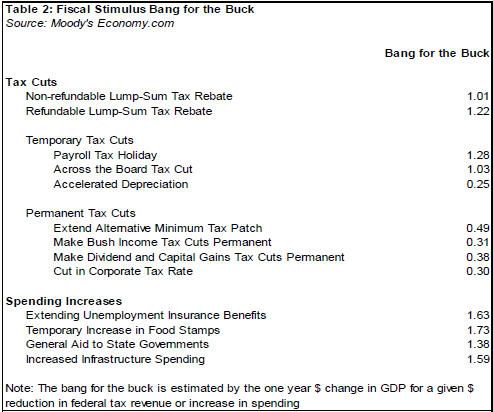
Increased government spending provides a large economic bang for the buck and thus significantly boosts the economy. The benefits begin as soon as the money is disbursed and are less likely than tax cuts to be diluted by an increase in imports. The most effective proposals included in the House stimulus plan are extending unemployment insurance benefits, expanding the food stamp program, and increasing aid to state and local governments. Increasing infrastructure spending will also greatly boost the economy, particularly as the current downturn is expected to last for an extended period. Most of the infrastructure money will be spent on hiring workers and on materials and equipment produced domestically.

At the same time,

Tax cuts generally provide less of an economic boost, particularly if they are temporary; on the other hand they can be implemented quickly. A particular plus for individual tax cuts included in the House stimulus plan such as the payroll tax and earned income tax credits is that they are targeted to benefit lower- and middle-income households that are more likely to spend the extra cash quickly. Investment and job tax benefits for businesses are less economically effective, but are not very costly and more widely distribute the benefits of the stimulus plan.

Moody’s offers a nifty little chart (chart taken from Open Left), which assigns value to each element of the stimulus plan:


I know a mediocre bill is better than no bill, but a failed bill likely will lead to retrenchment and blame and the end of the public’s limited tolerance for government intervention.

Failed negotiations = failed stimulus

Paul Krugman on the unstimulating stimulus package:

What do you call someone who eliminates hundreds of thousands of American jobs, deprives millions of adequate health care and nutrition, undermines schools, but offers a $15,000 bonus to affluent people who flip their houses?

A proud centrist. For that is what the senators who ended up calling the tune on the stimulus bill just accomplished.

Even if the original Obama plan — around $800 billion in stimulus, with a substantial fraction of that total given over to ineffective tax cuts — had been enacted, it wouldn’t have been enough to fill the looming hole in the U.S. economy, which the Congressional Budget Office estimates will amount to $2.9 trillion over the next three years.

Yet the centrists did their best to make the plan weaker and worse.

The centrists, however, are only partly at fault. President Barack Obama has earned his share of the blame by trying to be all things to all people — including those who wanted nothing to do with him whatsoever. So rather than being bold, Krugman notes, and pushing “a really strong stimulus plan, reflecting both the economy’s dire straits and his own electoral mandate,” he has “offered a plan that was clearly both too small and too heavily reliant on tax cuts.”

The reason?

Because he wanted the plan to have broad bipartisan support, and believed that it would. Not long ago administration strategists were talking about getting 80 or more votes in the Senate.

The debate reminded me of something I learned while working retail — I managed a tuxedo shop — in my early 20s: Never undersell a potential customer. If a customer were to come in looking for a tux, we were taught to put him in the most expensive one in the store. Let him direct you downward. If you start with the cheap suit, you’ll never get him in the more expensive ones, no matter how much nicer they might be.

The same goes for contract negotiations, selling a house or a car, etc. Always ask for more than you expect to get. If you put your best price on the table, you have no room for negotiations and you will have no choice but to take less than you might otherwise have received.

President Obama failed to follow this basic rule of negotiations and sales. His original plan was compromised before he sent it to Capitol Hill, leaving him with nowhere to go during negotiations — especially with a recalcitrant Republican minority in the Senate having just enough votes to filibuster his plan.

The result was a stalemate in the Senate that left Obama turning to a handful of centrists.

So Mr. Obama was reduced to bargaining for the votes of those centrists. And the centrists, predictably, extracted a pound of flesh — not, as far as anyone can tell, based on any coherent economic argument, but simply to demonstrate their centrist mojo. They probably would have demanded that $100 billion or so be cut from anything Mr. Obama proposed; by coming in with such a low initial bid, the president guaranteed that the final deal would be much too small.

Such are the perils of negotiating with yourself.